
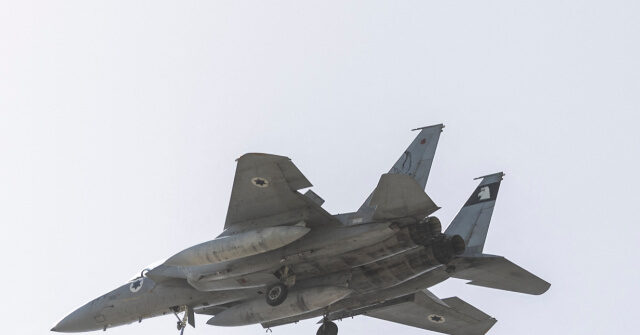
Dozens of Israeli fighter jets flew toward Iran’s border Monday in a massive show of force demonstrating Israel’s ability to strike the Islamic Republic, according to a report published Wednesday.
Israel notified the Trump administration in advance that the operation was a training exercise intended to demonstrate “power projection” and deter Iranian attacks, Axios reported, citing American and Israeli officials familiar with the mission.
The exercise involved dozens of fighter jets and aerial refueling aircraft that traveled more than 800 miles from Israel, passing through Syrian and Iraqi airspace before turning back near Iran’s western border.
The aircraft reportedly followed a route resembling those used in previous Israeli strikes against Iran, with Israeli commanders aware that Iranian air defenses would detect the formation.
Some American officials suspected Israel may have hoped to draw Iranian fire, potentially providing justification for renewed strikes. Other officials described the mission as a deterrence exercise, although they acknowledged the possibility of a dangerous miscalculation.
Fox News, which separately reported on the exercise Tuesday, said the Israel Defense Forces declined to comment when contacted about the operation.
The exercise took place the same day War Secretary Pete Hegseth made an unannounced visit to Israel and met Prime Minister Benjamin Netanyahu at Ovda Air Base in southern Israel.
American fighter jets and refueling aircraft were stationed at the base, although officials cited by Axios said Hegseth’s visit and the Israeli exercise were unrelated.
The military demonstration also followed President Donald Trump’s endorsement of Netanyahu on Sunday, ahead of Israel’s October 27 election. The two leaders spoke by telephone Monday, the same day Israeli aircraft conducted the exercise.
During their conversation, Netanyahu invoked Trump’s earlier remarks about unfinished business with Iran.
“Donald, you said we have a job to finish, and we’ll finish it together,” Netanyahu said.
“You’re a great warrior, and we’ll prove that very soon,” Trump replied, later telling Netanyahu, “You’re the man I want by my side.”
On Wednesday, Netanyahu intensified his warnings against Tehran, publicly reiterating his directive to Israel’s military and intelligence agencies to pursue the overthrow of Iran’s ruling regime.
Speaking at a military officers’ graduation ceremony, Netanyahu accused Iran’s new supreme leader, Mojtaba Khamenei, of following his father’s path and attempting to revive the country’s nuclear weapons program.
“There is only one way to remove this threat once and for all: overthrow the regime in Iran. And that is my directive to the IDF, the Mossad, and the security branches,” Netanyahu declared.
Netanyahu’s declaration followed a Financial Times report that he had ordered preparations for a major offensive against Iran earlier this month, potentially targeting nuclear facilities, regime installations, and civilian power infrastructure.
The operation, reportedly contemplated for around October 10, did not proceed after Trump opposed renewed large-scale strikes ahead of the November 3 U.S. midterm elections, according to people familiar with the discussions.
Israeli military sources subsequently disputed that an imminent attack had been ordered for that date, saying the heightened alert reflected concerns about a possible Iranian attack.
The reports come as Washington continues weighing military pressure against diplomatic efforts to secure an agreement preventing Iran from obtaining nuclear weapons and addressing Tehran’s restrictions on shipping through the Strait of Hormuz.
“Either there will be a deal, or there will be an attack,” a source told the Financial Times, describing the administration’s approach.
Trump, meanwhile, said Wednesday that the American military campaign had devastated Iran’s capabilities, while indicating that negotiations to end the conflict were continuing.
“We’ve taken Iran down to levels that they’ve never seen before,” Trump told reporters at the White House.
He also expressed satisfaction that Russia and China had largely avoided involvement in the conflict, saying he did not want to jeopardize what he described as progress toward ending the war.
The president had offered a more pointed assessment Tuesday when asked about the administration’s next steps.
“We’re doing very well with Iran, we just have to make a final decision of which way do we want to win. Do we want to win the nice way or the not nice way,” Trump told reporters.
Secretary of State Marco Rubio reiterated Wednesday that the United States would reject any agreement leaving Iran with a pathway to nuclear weapons, emphasizing that Trump would make the final decision on any deal.
Iranian officials, meanwhile, have threatened a broader military response to any renewed American or Israeli attacks.
Islamic Revolutionary Guard Corps spokesman Hossein Mohebi said Wednesday that Tehran was moving beyond its previously defensive military doctrine toward offensive and asymmetric retaliation.
“Now, we say if a country attacks us we will respond to it and we will invade,” Mohebi told Iran’s Student News Network.
He warned that Iran would strike its enemies with sufficient force to demonstrate the consequences of another attack.
An unnamed senior Iranian security official separately told state-run Press TV that Tehran had prepared for an “all-out, multi-layered, and comprehensive war,” threatening to strike American and Israeli interests and those of their regional supporters if hostilities resumed.
The confrontation began with joint American-Israeli strikes on February 28 that killed longtime Iranian Supreme Leader Ali Khamenei and inflicted extensive damage on the regime’s military, naval, and air-defense capabilities.
His son and successor, Mojtaba Khamenei, was reportedly seriously wounded during the opening attacks and has not appeared publicly since assuming power, fueling persistent uncertainty over his condition.
Iranian state media nevertheless reported Wednesday that Khamenei met parliament speaker Mohammad Bagher Qalibaf to discuss military developments, economic challenges, and strengthening the country’s defenses. The account did not establish that the meeting was independently verified or that Khamenei had made a public appearance.
Despite Tehran’s military warnings, Iranian Foreign Minister Abbas Araghchi said Wednesday that his government remained open to negotiations, provided Washington accepted what he described as a reciprocal and equitable agreement.
In a Financial Times opinion piece published Wednesday, Araghchi argued that further military action would fail to force Iranian concessions and reiterated Tehran’s demands for sanctions relief, an end to the American naval blockade, and a negotiated reopening of the Strait of Hormuz.
The administration has maintained that any agreement must prevent Iran from obtaining nuclear weapons, while Tehran has refused to accept Washington’s terms and warned of expanded retaliation if military operations resume.
Joshua Klein is a reporter for Breitbart News. Email him at jklein@breitbart.com. Follow him on Twitter @JoshuaKlein.