The government of Switzerland confirmed on Friday that a woman identified as the first patient in Nigeria diagnosed with Ebola Bundibugyo in the context of an ongoing outbreak in the Democratic Republic of Congo (DRC) is a Ugandan-born Swiss national who had not recently visited the DRC.
The news follows the Nigerian government’s confirmation on Tuesday that it had diagnosed a case of the rare strain of Ebola in a traveler who arrived in Abuja, the national capital, in early October. Reports indicate that the patient, who is 42 years old, tested positive for Ebola on October 20 after presenting for some time with an unknown illness. She was first incorrectly diagnosed with malaria before the discovery of the Ebola infection.
Reports indicated the patient was first treated for other diseases without success, which led officials to test for Ebola. The woman, identified in reports only as the spouse of an employee at the Swiss embassy in Uganda, reportedly entered Nigeria from Uganda. The lack of travel to the DRC prompted a back-and-forth between the Nigerian and Ugandan governments, as the latter insisted that it had not identified any new Ebola cases in recent memory and hinted the patient may have been exposed elsewhere.
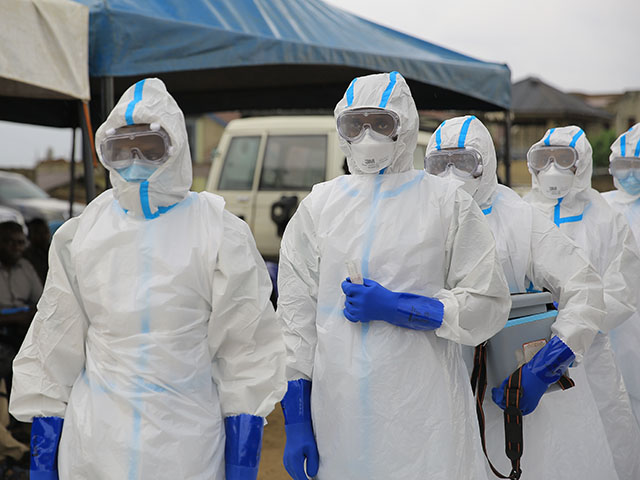
Ebola response teams organize a public demonstration to raise awareness about the Ebola virus disease in Beni, North Kivu province, eastern Congo, Tuesday, September 22, 2026. (AP Photo/Sebastien Kitsa Musayi)
An outbreak of Ebola Bundibugyo, a strain for which no treatment or vaccine exists at press time, was identified in eastern DRC as a public health emergency in May. The region most affected, Ituri province, is a hotbed of criminal militia warfare, illicit “artisan” mining, and high distrust of foreign humanitarian aid workers. As a result of its remoteness and the complexity of the circumstances there, World Health Organization (W.H.O.) Director-General Tedros Adhanom Ghebreyesus suggested the virus may have begun spreading there as early as January without proper detection.
As of mid-October, international public health authorities have confirmed 9,066 cases of Ebola Bundibugyo linked to the current outbreak. Slightly less than half of those, 4,381 people, have died as a result of the infections. Patients carrying the virus have been identified in the DRC, Uganda, Kenya, France, and now Nigeria.
Swiss authorities shared that the Nigerian woman diagnosed with the disease was hospitalized and is responding to treatment, though they suggested they may repatriate her for further aid. Her husband is reportedly asymptomatic at press time and remains in quarantine. Authorities reportedly identified 44 people as “contacts” of the patient.
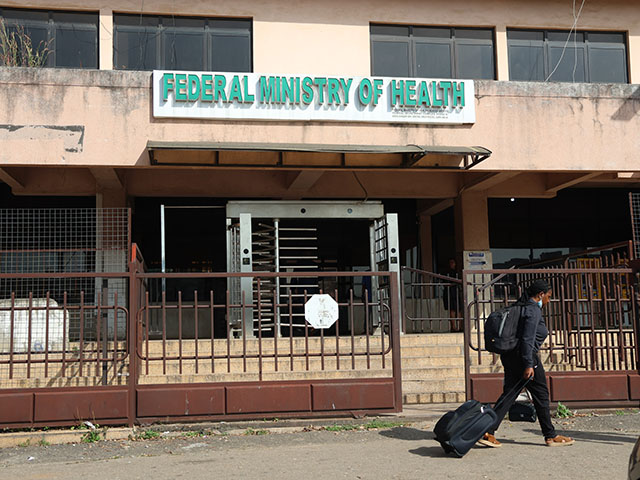
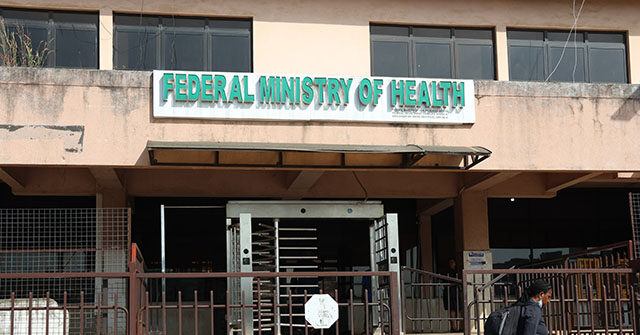
A woman walks past the Federal Ministry of Health in Abuja, Nigeria, Wednesday, October 21, 2026. (AP Photo/Afolabi Sotunde)
“The infection may have occurred during a trip to Uganda approximately two weeks ago,” the Swiss government statement read. “Her husband is in isolation; he has shown no symptoms. He accompanied his wife on the trip, during which she is believed to have contracted the Ebola virus.”
The Ugandan Health Ministry responded rapidly to the initial news this week of the discovery of the case, insisting that it had no evidence to suggest it was possible for someone to contract Ebola in Uganda in relation to the DRC outbreak.
“We wish to clarify that, as at the time of this statement, Uganda has no confirmed active Ebola cases,” the Ugandan Health Ministry said. “Travel through Uganda does not establish that infection occurred here. The location of exposure remains under investigation.”
Director-General of the Africa Centres for Disease Control and Prevention (Africa CDC) Jean Kaseya insisted in remarks on Thursday that countries implicated should avoid disputes or finger-pointing and be forthcoming with information related to the case.
“What we know is that the lady came from Uganda, but what we don’t know is whether it is a transmission from Uganda, Kampala, or a transmission that came from another place,” Kaseya said in an interview, according to the Nigerian newspaper Vanguard.
“I am talking to Ugandan, DRC and Nigerian authorities, that the person we know today without any doubt, that this is a Ugandan-born person who went to Uganda and she was there for some days and the husband flew to join her in Uganda,” he explained. “What we want is collaboration from this lady. She has to tell us, to disclose to the authorities; I need this information, Nigeria needs this information because we need also to support Uganda.”
The Nigerian government, meanwhile, announced increased surveillance actions to ensure the identification of any other potential patients entering the country.
“We currently have one confirmed case, and our priority is to contain it and prevent transmission into communities or a wider outbreak. We are working very hard to ensure that this does not happen,” Coordinating Minister of Health and Social Welfare, Prof Ali Pate told reporters on Thursday.
“We remain vigilant and are not taking anything for granted. However, there is no need for panic. We are confident that we can manage the situation, but we need the cooperation of Nigerians,” Pate added.
Information Minister Mohammed Idris, meanwhile, emphasized the need to inform Nigerians on the facts about avoiding the spread of Ebola and preventing “misinformation.”
“Our agencies must reach every community, in every language, with clear facts on how Ebola spreads, how to protect ourselves and where to report suspected cases,” he asserted.
In DRC – and other areas of Africa that have experienced Ebola outbreaks, such as Sierra Leone and Liberia – locals have expressed apprehension about international medical aid and health workers, fearing that they were intentionally killing patients. Some in DRC have doubted the existence of Ebola entirely, leading to mob attacks on treatment centers intended to “free” patients receiving treatment.