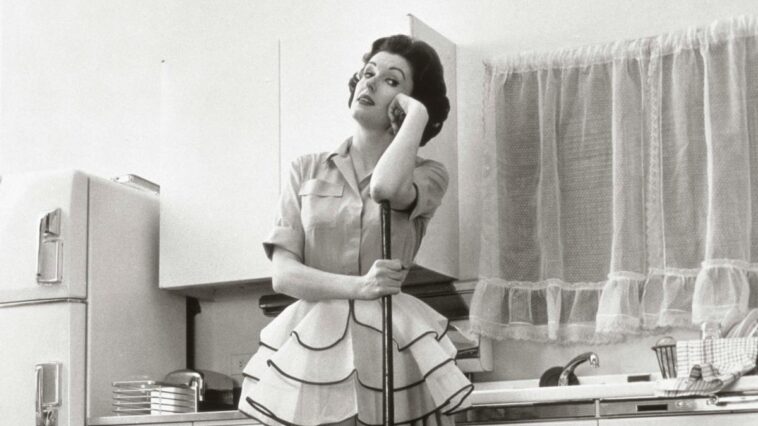
A social media search for the term “unpaid labor” yields thousands of videos and posts upset that homemakers will never receive a salary for what they spend all day doing. One post, from a group called “Care Gap,” notes that “women spend nearly 80 hours a week on unpaid labor.” Other accounts attempt to quantify the “unpaid labor” homemakers do, with one video estimating the cost of her work at $150,000. Readers immediately have thoughts of someone working double overtime as, essentially, a slave. It is the most uncharitable and denigrating way to describe homemaking, and it does a huge disservice to homemakers themselves.
As more and more households subsist on two full-time incomes, work has become increasingly associated with a place and a paycheck rather than a state of living in which everyone participates. The term “unpaid labor,” while technically an accurate description of domestic work (you don’t actually receive a salary or hourly wage for homemaking), describes such work in a way meant to denigrate labor for which you do not receive a paycheck.
In nearly every other sphere of life, we do work for which we do not earn a salary or an hourly rate. No one pays you to comfort a grieving friend, bring a meal to a new mother, or organize a surprise birthday party for your dad. But it would be hard to find anyone who would seriously claim this is useless work. Yet when it comes to motherhood, people get very angry that it is “unpaid.” Another video, speaking of working moms, notes that “women are working two jobs and getting paid for one.” As a culture, we are constantly measuring worth and value only by the most obvious of indicators — such as a paycheck or net worth — rather than the infinite value of the social advantages of a mother being able to spend most of her time with her children.
When we use the term “unpaid labor” to describe the tasks associated with motherhood, we set women up for failure. New mothers are often, understandably, overwhelmed by how much the very small people they just birthed need them. From breastfeeding to pregnancy to the natural bond a baby enjoys almost exclusively with his mother in the first few weeks of life to birth itself, women absolutely do most of the work to raise little humans when they are tiniest. In such a demanding time, a mother’s workload becomes all the more unbearable if she is surrounded by folks in her life and on her tiny screen harping on the fact that her labor is “unpaid.” A mother on her third nightly wake-up in as many hours will start contemplating what a rich lady she’d be if society wrote her a paycheck for her efforts of late. And she’s right; the paycheck would be astronomical. But no paycheck could properly compensate for the work she is doing because it is, in a word, priceless.
The trials of young motherhood are real, but cultural feminism worsens them. Throughout a woman’s education, people tell her that thanks to third-wave feminism, her role as a parent doesn’t have to be much different from her baby’s father’s role, as long as she marries a nice feminist who does 50% of the dishes. Biology is a bit of a cruel teacher in these cases. The tasks of early motherhood are undoubtedly hard, but the way we describe them to women makes them downright impossible. Mothers and fathers aren’t interchangeable, and the difference between how each experiences parenthood doesn’t simply lie in arbitrary divisions of household labor. There’s a difference that’s baked into a mother’s and a baby’s biology, and our culture would do well not to ignore that, for women’s sake.
Even beyond the early stages of motherhood that demand so much more from a mother than a father, the division of household labor tends to fall disproportionately on a woman. There are biological and instinctual reasons for this but also practical ones. Even if one does not believe there is a biological bent toward domesticity and homemaking in women, one can admit that if a woman is taking time off for maternity leave and passing up career promotions to work more manageable hours during early motherhood, she is likely to earn less than a man, and the man should then take on the bulk of the earning for the household while she handles the bulk of the domestic chores. The fact that only one party receives a paycheck for his work is not indicative of how important the other party’s work is.
This rather traditional division of labor exists in the majority of households, not just households that are Christian or conservative. In only 16% of opposite-sex couples is the wife the breadwinner. It is difficult to believe that this is because 84% of couples are particularly religious or anti-feminist or even traditional. The most feminist of men and women seem to still find themselves dividing up the labor of being a family by the man taking on the money-making work and the woman taking on the homemaking work.
Indeed, people often discuss the so-called gender pay gap, but the more significant pay gap exists between married fathers and other single men and women. To a mother who sees her household income as a joint effort (which it is), the 10% to 30% increase in wages her husband earns by being a married dad is part of the value she provides indirectly through her work in the home. In other words, even if we were to quantify a homemaker’s labors with dollar signs, she would hardly appear “unpaid.”
The term “unpaid labor” itself evokes images of the most infamous kind of unpaid labor: slavery. In reality, a term like “priceless labor” may be a far better description of what a mother does. She does not lack a paycheck for her work because it is insignificant, but because no paycheck would be adequate recompense. It can be difficult for women who spent college and their early career chasing a larger paycheck as an indication that they are doing well in life to switch to a kind of work whose recompense is far harder to quantify.
We can help mothers joyfully accept the labor of homemaking if we change the way we as a society think and talk about the recompense they receive for it by doing away with demoralizing descriptions like “unpaid labor.” For homemakers, this “joyful acceptance” looks like thinking too highly of your role’s worth to attempt to attach an imaginary paycheck to it. For the husbands of said homemakers, this looks like loudly and continually recognizing and celebrating the work of homemaking as real and dignified labor. For society more broadly, this looks like a complete overhaul of the way we think of value, as something that only comes in dollar signs and occurs outside of the home itself.
***
Sarah Wilder is a visiting fellow at Independent Women and contributor for IW Features.
This article is part of Upstream, The Daily Wire’s new home for culture and lifestyle. Real human insight and human stories — from our featured writers to you.