TEL AVIV — Should Prime Minister Benjamin Netanyahu be punished for the Oct. 7, 2023 terrorist attack — or is he, in fact, the strongest person to protect the Jewish state during its multi-front war?
That is perhaps the central issue when Israelis go to the polls on Tuesday for the sixth time in eight years. Netanyahu is the only Israeli security official who has remained in power following the surprise attack on southern Israel, which left 1,200 people dead and 251 taken hostage.
It also resulted in the Gaza war, a war against Hezbollah in Lebanon and a subsequent wave of anti-Israel protests and rising antisemitism around the world.

Critics want to form an Oct. 7 commission to examine the government’s failures during the terror attack. Also at stake is the fate of the draft for Israel’s ultraorthodox community, Jeremy Sultan, a political analyst at Israel’s Central Elections Committee, said in a recent talk with the Brookings Institute think tank.
On most major questions of interest outside Israel — the War in Gaza, West Bank settlements, the fate of the Palestinians, Netanyahu’s Likud bloc and the opposition have similar platforms, observers say.
Shachar Zafran, 25, who survived the Hamas assault on Kibbutz Ein HaShlosha, said she voted for Netanyahu in the last election but now intends to support former Prime Minister Naftali Bennett — the leader of a major opposition party.
“I personally — it’s going to sound a bit crazy — think that Bibi is quite a good leader,” Zafran said.
“He had his bad times with Oct. 7, obviously. We can’t ignore it. But I think we need to change, mainly because most Israelis don’t believe in him, and it’s tearing Israel apart.”

Who are the main contenders?
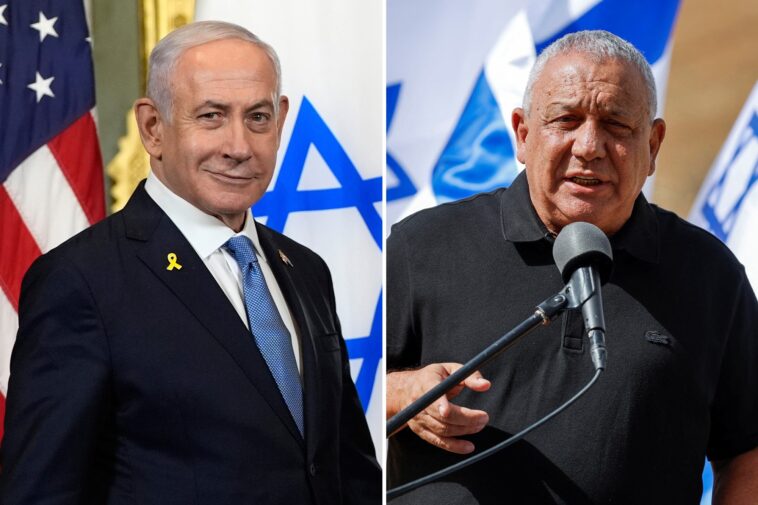
Netanyahu and former Israel Defense Forces chief Gadi Eisenkot are the two major contenders to lead Israel’s government.
Netanyahu has served as prime minister from 2009 to 2021, and returned again in 2022, with the premier touting himself as the only one who can lead Israel through the current wars and maintain a close friendship with the US.
His Likud bloc has allied with five other religious conservative and nationalist parties.
Eisenkot, who headed the IDF from 2015 to 2019, leads the centrist Yashar! party, which is allied with the Together coalition led by Bennett and Yair Lapid, as well as Avigdor Liberman’s Yisrael Beiteinu (Israel Our Home) and Yair Golan’s Democrats.

One key difference is that Eisenkot is against Israel’s dependence on the US — and says only Israelis can keep each other safe, according to Dahlia Scheindlin, a pollster and political consultant at the Haaretz newspaper.
Eisenkot’s position on the US has scared some voters, including Sderot Mayor Alon Davidi, who described the next two years a vital for Israel’s survival.
“We have two years of the Trump administration. We will not find anyone like Trump who will support Israel, and we need to use it,” Davidi said. “The one with experience all over the world is Netanyahu.”
Major Israeli polls show Netanyahu’s coalition trailing — with around 50 of the Knesset’s 120 seats. The opposition parties are projected to hold around 54 seats.
If neither group secures a 61-seat majority, smaller parties will be the deciding factor in the election, including Israel’s Joint List and Ra’am, which are both Arab-Israeli parties.

How does the election work?
Israel runs a parliament system where citizens vote for party members to take a spot on Knesset’s 120-seat house, meaning a coalition must hold a majority to elect a prime minister.
At least 38 parties are running in this year’s election, but only around a fourth will likely get enough support to get a seat at the table, Sultan said.
A party needs at least 3.25% of the national vote to enter the Knesset, which amounts to four seats.
Israelis vote nationally for a party — not for individual local seats like a UK parliamentary election — and seats are awarded based on the portion of national vote a party gets.

This means that Netanyahu’s Likud and Eisenkot’s Yashar parties have had to form alliances with other parties so they can reach the 61-seat threshold to establish the new government.
Additionally, Israelis must be in Israel to vote. With very few exceptions, Israeli expats must return to the Jewish state if they want to cast their ballots.
What are the big issues?
One of the biggest issues on voters’ minds is the formation of an Oct. 7 inquiry commission to address the failures of Netanyahu’s government to foresee the deadliest attack on Israel in 50 years.
Netanyahu’s administration has faced severe backlash over striking down the commission, with the prime minister standing as the only high-ranking member of government at the time who has yet to resign or leave public office since the attack.
“The fact that there is no investigation going on about Oct. 7 is a huge issue here for a lot of us, lefties and righties,” said Zohar Ben Ari, 49, a nurse who worked at Soroka Medical Center on Oct. 7.
Netanyahu’s defenders argue that his military achievements since Oct. 7 deserve as much consideration as the failures that preceded the attack, with retired Brig. Gen. Danny Van Buren arguing that the prime minister had performed well in a regional conflict extending from Gaza to Lebanon, Syria and Iran.
“This is a chess game that is being played, and in general terms, I think we did good,” Van Buren said. “Not everyone thinks the government is corrupted. Of course, they made mistakes. Maybe this mistake will cost them in the coming elections.”

Conscription is also another major topic as Israeli reservists have grown tired over the ongoing wars while ultra-Orthodox men continue to dodge the draft, getting an exemption for full-time religious study.
Netanyahu has protected the ultra-Orthodox community to appease his coalition members and retain control of the Knesset, and it remains to be seen if the opposition will renew the fight to push the draft through.
Judicial reform will also be at the forefront of Israeli voters’ minds next week as Netanyahu’s push to curb the power of the country’s Supreme Court has been criticized as a threat to the nation’s democracy.

When will the results be out?
Israeli broadcasters are expected to put out exit poll numbers by 3 p.m. EST, giving an indication of who is leading in the race and what the outcome might be.
But a better look at who the projected winners will be will likely not be available on Tuesday, with the preliminary results expected the next day, and official results not out until Nov. 4.
It could take as much as three weeks to a month for the winning parties to establish a coalition to set up a ruling government.
Eisenkot is predicted to have a more realistic chance of forming a government as his united opposition bloc stands to win 65 to 70 seats, but the parties may be too divided on key issues to join forces, Scheindlin noted.
Start your day with all you need to know
Morning Report delivers the latest news, videos, photos and more.
Thanks for signing up!
It would be up to Israeli President Isaac Herzog to select a party leader he believes will win the majority of support in Knesset. Herzog has three chances to tap a worthy candidate.
Should a majority of Knesset fail to rally around a candidate, a new round of elections would be held.
Yael Sherby-Hurwitz, 39, of Be’er Sheva, is among the undecided voters in Israel who hope that whatever new government forms can actually unite the country during a volatile period in history.
“I hope that somebody else can come and pick up the pieces and unite us and unite the Jewish people,” she said.