
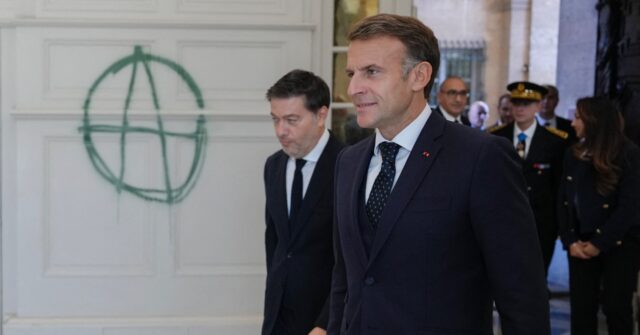
President Emmanuel Macron admitted on Monday that his government was caught flat-footed by the outburst of violent riots earlier this month accross France, which threaten to continue for the foreseeable future.
The so-called “Act II” demonstrations on October 17th in France, in which widespread looting and rioting took place as far-leftist groups converged with youths from ethnic minority enclaves, resulted in rampant destruction and injury, with around 2,400 arrests, nearly a thousand police officers, firefighters, and gendarmes injured, and an estimated 3,000 businesses impacted. The riots also saw an alleged far-left arson terror attack which resulted in the destruction of the 143-year-old City Hall in Limoges. According to the liberal think tank Fondation iFRAP, the riots on October 17th and 18th alone likely cost around €1.1 billion ($1.2bn) to the government and private businesses.
Mayors across the country were deeply critical of the federal government’s performance during the riots, which occurred following weeks of youth revolt unrest over supposed complaints about the education system. The mayor of Limoges, Guillaume Guérin, sensationally claimed that the National Police force dispatched to his city had run out of ammunition during the attack on the city hall, providing alleged far-left terrorists free rein of the building for nearly an hour.
More than a week after the fateful events, and after another weekend of riots which saw dozens of police injured and over 1,300 rioters arrested, President Emmanuel Macron finally admitted that his government had failed to properly prepare for the unrest.
Speaking to reporters during a visit to Marseille on Monday, where far-leftists also vandalised the local City Hall, Mr Macron said per the 20minutes newspaper: “We hadn’t anticipated what was going to happen at all… It’s absolutely true that in Marseille, as elsewhere, there weren’t enough police forces (on October 17).”
However, true to form, Macron still sought to deflect blame elsewhere, this time claiming that social media was a principal culprit for the riots, saying such platforms are “damaging our democracies.”
“They were used, especially on the 17th, to bring young people and older people to the scenes of delinquency, attacks, and looting,” the president argued, claiming that online there is a “great deal of confusion, a kind of permanent agitation that is taking place, a fascination with violence.”
Previously, Macron had blamed the “ultra-left” for sowing chaos and even U.S. President Donald Trump for supposedly sparking the energy crisis in Europe with the conflict in Iran, while ignoring the role that his mass migration policies have played in creating a disaffected underclass willing to engage in wanton violence and destruction.
President Macron, who only has six months left in his final term in office, also warned on Monday that the unrest is likely to continue.
“Next Saturday is still a risky Saturday,” he said, while pledging “to be organized, to be present, to protect property and people.”
“We will continue to have designated mobilization routes that will take place outside city centers,” Macron continued. “We will continue to support our shopkeepers and artisans. Funds have been set up by the State, supplemented by local authorities, and also by private funds… I have asked the government to respond to the legitimate demands that are at the root of this social movement.”
Yet it remains to be seen how long the government and the police forces can maintain the proper amount of force to prevent the protests from devolving into riots, with weeks of demonstrations already scheduled.
According to paper of record Le Figaro, the next major demonstration is set for next Saturday, which has been dubbed “ACT III” and has called for “gatherings” at the National Assembly in Paris and outside city halls across the country.
Two days later, high school and university students will return to class, potentially meaning that more youth revolts at schools could be on the horizon.
Meanwhile, multiple trade unions, including the leading left-wing CGT union, have vowed to go on strike on November 5th, demanding higher wages. Unless government negotiators manage to come to a settlement, this would likely add fuel to the fire of the protest movement.
Additionally, protests for pensioners and a demonstration for firefighters are also already scheduled for November 19th and December 4th, respectively.
The ongoing strife, which some have warned may last throughout the presidential election season, has many small businesses concerned for their future.
Even without the same scale of rioting, the president of the network of Chambers of Commerce and Industry in France (CCI France), Alain Di Crescenzo, estimated that business saw a “roughly 80 per cent” decline in activity over the weekend.