See more of our coverage in your search results.

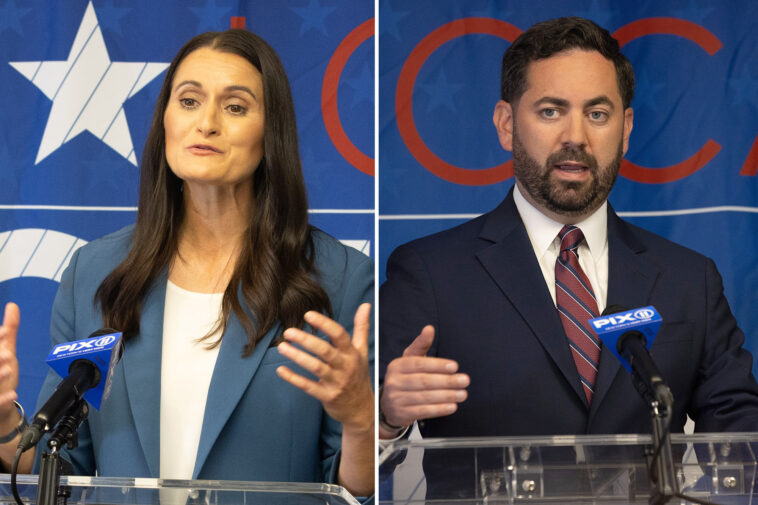
Democrat Cait Conley won the hotly contested race for New York’s 17th Congressional District — knocking out incumbent Rep. Mike Lawler in a critical blow for Republicans.
Conley, 41, took the race Tuesday by 7 points, winning 53.3% of the vote to 40-year-old Lawler’s 46.6%.
The GOP lawmaker and Trump ally conceded just before 11 p.m. despite a ballot-counting snafu in Westchester County that wasn’t expected to affect the overall vote.
That nail-biting finish matched the rest of the race — which saw both candidates neck and neck almost start to finish, with many polls finding them mere points apart right up to the finish line.
It also followed a troubled election day, when ballot machines failed at numerous polling places across Westchester County. The machines spat thousands of ballots out and refused to count them, with the board of elections chalking the problem up to a programming issue.
That forced election officials to secure the ballots for later counting, and caused fears of delays in the critical district race.
Conley’s win could have far-reaching implications for the balance of power in Washington — as the 17th is one of New York’s few swing districts and means Democrats won back a crucial seat in the House amidst predictions of a nationwide blue shift.
Republicans had held the 17th since 2022, when Lawler clinched the vote in another tight race — 50.3% to 49.7% — and defended his seat in 2024 with a more decisive 7-point spread
Lawler’s seat helped Republicans dominate the House, paving the way for President Trump to roll out his agenda when he retook the White House in 2024.
New York’s 17th stretches across the lower Hudson Valley from around White Plains to Hopewell Junction, giving it a wide spread of population density and demographic makeup.
That makeup includes a sizable Jewish population, meaning debates of US policy towards Israel — and New York City Mayor Zohran Mamdani’s derisive views of the Jewish nation — took center stage in between the candidates.

That culminated in a fiery exchange in October at their second debate showdown, when Lawler accused Conley of waffling every time she was pressed on what he described as Mamdani’s “antisemitic base” — the virulent anti-Zionism pervading Hizzoner’s Democratic Socialists of America party — before she finally snapped.
“Yes, I do denounce Mamdani’s statement on Oct. 7th,” she said, referring to the mayor’s widely-panned anti-Israel comments on this year’s anniversary of the Hamas terror attack. “I condemn antisemitism from any party or anyone.”

Lawler, meanwhile, has been an outspoken supporter of Israel throughout his time in office.
Another point of contention between the candidates was illegal immigration, ICE and New York’s sanctuary laws — a topic enflamed by the NY-17 constituent Sheridan Gorman, who was murdered while in Chicago last spring by an illegal immigrant who had previously been arrested and released.
Sheridan was from Westchester and her parents still live there, and they openly endorsed Lawler while making their presence and story known on the campaign trail.
The grieving parents even spoke at the candidates’ first debate in September and asked whether they would support New York’s sanctuary laws — with Lawler denouncing the policies, while Conley provided a non-committal response about the laws intended to protect illegal immigrants.
And that point exemplified the line both candidates drew during their campaigns — Conley cast Lawler as a Trump yes-man, while Lawler characterized Conley as somebody more interested in national Democratic interests than the needs of lower Hudson Valley residents.
But Conley didn’t always toe the party line — in October she notably declared she was “in absolute agreement” after Lawler said during a joint forum that “we need a new governor. Kathy Hochul has to go.”
Conley — a Hudson Valley native, and graduate of West Point, Harvard and MIT — will assume her new office on Jan. 3 with the rest of the incoming Congress.
She then went on to work in the Department of Homeland Security’s Cybersecurity and Infrastructure Security Agency, where she specialized in election security.
And though it will be her first term as an elected official, it won’t be her first time working for the government — Conley spent 16 years serving in the Army, and was deployed to Afghanistan and Iraq before working in counter terrorism.