
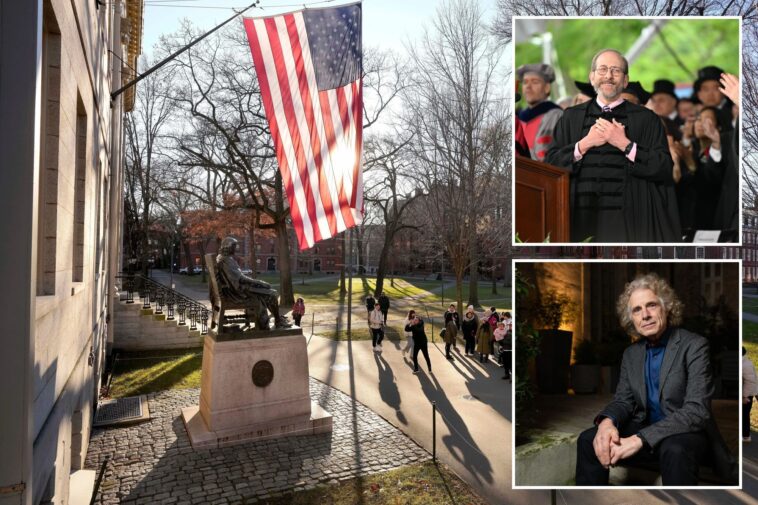
In the years since October 7, 2023, Harvard University has been in crisis: the social fabric of campus was torn apart by chaotic pro-Palestine protests, president Claudine Gay was ensnared in plagiarism allegations, its affirmative action policies had been struck down by the Supreme Court, the school was named the worst college in the country for free expression, grade inflation was running rampant, and the Trump administration’s ire was directed at its federal funding.
The nation’s premier university — and American higher education more broadly — had lost the faith of students, faculty, donors, and the public alike.
But the only place to go from rock bottom is up.
Over the past several years, Harvard has fought to win back trust with all manner of policies aimed at protecting academic freedom, fighting grade inflation, promoting dialogue, making learning AI-resistant, and re-centering academics in campus life. According to professors on the ground, it’s actually working.
“I think for the first time university leadership realizes that higher ed — and Harvard in particular — has gotten itself into trouble,” Harvard psychology professor Steven Pinker told The Post. “I do think there’s a change. These various initiatives — constructive dialogue and intellectual vitality — are in the air.”

Pinker says that’s largely happened under the leadership of president Alan Garber, who took over in January 2024.
“Our previous administrations, I think they just saw their main goal as keeping the university out of trouble: don’t make waves, no scandals, keep the finances solvent,” Pinker, who has taught at Harvard for more than 20 years, said. “The university was on autopilot, as long as it didn’t attract negative headlines. But I don’t think they had put much thought into: What is the university for? And are we accomplishing those goals?”
Under Garber’s leadership, the university established an Open Inquiry and Constructive Dialogue Working Group and moved to clarify protesting policies, updating campus rules to clearly prohibit demonstrations in libraries, classrooms, dorms, and dining halls.
A second faculty committee also decided that the university will no longer make institutional statements about controversial issues — like they previously had in the wake of George Floyd’s murder or Donald Trump’s 2016 election — unless they are directly related to campus life.

The Arts and Sciences faculty, meanwhile, moved to adopt new rules about viewpoint-neutral teaching, adding language in the student handbook that expressly makes clear that a student’s politics shouldn’t affect their grades — and ensuring professors that the views they express outside of class shouldn’t impact their ability to teach.
Beginning in Fall 2025, students were able to hold their professors accountable, too, via course evaluations that expressly ask them whether their instructor encouraged competing viewpoints.
For Santiago Romero-Brufau, a professor of biostatistics, the effects of these changes have already been discernible.
“A few years ago, it was much more tense,” he told The Post. “People seem a lot more comfortable speaking more freely about things that might be politically sensitive, without as much fear of cancellation or repercussions to your career.”
He’s especially excited by the school’s decision to subject classroom discussion to Chatham House rules in a bid to reduce self-censorship — meaning that students can talk about what was discussed in their classroom, but can’t say who said what.

“There’s no teeth behind it if someone doesn’t follow it, but it communicates to students, faculty and the community that . . . we might say things that we then change our mind about, that we’re exploring,” Romero-Brufau said.
Philosophy professor Ned Hall agreed it’s an important step forward: “In my experience — which is limited and selective in all sorts of ways — students respond to it really well [and] they’re very interested in having conversations about controversial issues.”
This is the sort of progress Hall has long been advocating for on campus. In April 2023, months before October 7th, he was one of more than 100 faculty members who established the Council on Academic Freedom, demanding the school do better to promote open inquiry.
Hall says that “a sense of disappointment has been building for a while” among his students who find debate is stifled in their classrooms. “I think students are starting to get tired of a culture where you have to really watch what you say because someone might go off on you on social media,” he said. “There’s been growing impatience with that kind of culture.”

Harvard’s reforms have seemingly helped in this regard. While the school was deemed the worst school for free expression in the Foundation for Individual Rights and Expression (FIRE)’s annual free speech rankings, they have since soared to 71st out of 261 schools, and the university is now ranked among the top 25 schools for political tolerance.
“It’s hard to point to exactly one [reform] and say that was what made the difference,” Laura Beltz, FIRE’s Director of Policy Reform, told The Post. “But when you take all those together, it sends a message to students that Harvard will be standing up for free speech, and that’s something they hadn’t been hearing in the past.”
Beltz says Harvard’s biggest challenge will be ensuring that new students keep that spirit alive. “Colleges have a hard time with this because their population is always turning over,” she said. “Harvard’s going to have to constantly invest in this and engage in it.”
The school is trying to do just that, with various initiatives meant to induct incoming students into a culture of free speech. Starting with the Class of 2029, applicants to Harvard were required to write an application essay about a time when they “strongly disagreed with someone” and tell admissions officers what they learned from that experience.

And, as of this past fall, new students have to complete a required orientation module called “Intellectual Life and Constructive Disagreement.” Hall thinks it represents “really quite a substantial change” to freshman orientation. “It signals pretty clearly to students who apply to Harvard that we care about things like being able to engage in good faith with people who disagree with you,” he said.
Meanwhile, the school has also acknowledged criticism about grade inflation. In 2024, Dean Amanda Claybaugh appointed a faculty committee to develop a policy reform, after an internal review found that the median graduating GPA rose from 3.56 to 3.83 in just 15 years. Their proposed solution — a 20% cap on A grades in undergraduate courses — was approved overwhelmingly by the faculty and will officially take effect in fall 2027.
“After years of grade inflation, the college has finally done something about it. Not enough [but] it’s a start,” Pinker said. He also celebrated the university for encouraging professors to take attendance in large lectures, which he’s started doing for the first time in his career. “Before, it was considered rather mean to take attendance or to count participation,” he said. “Now it’s closer to a norm.”

The school has also tackled the challenges posed by artificial intelligence head on. The university’s Derek Bok Center launched a “Teaching and AI” initiative aimed to help faculty redesign assignments to be AI-resistant. Their suggestions include moving to in-person and even oral exams.
All these changes, Pinker said, are sparking an academic renewal: “There is greater willingness, both among the administration and among the students, to take academics seriously as the whole reason that people are here in the first place, presumably, as opposed to [seeing their time there as being about] networking, rowing, singing in the choir, doing stand-up.”