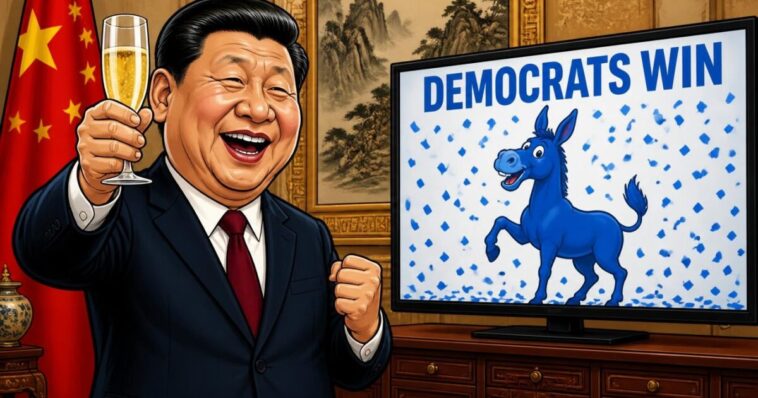

Beijing stands to benefit from Democratic plans to undo President Donald Trump’s tariffs and restrain the war with Iran, Chinese analysts say, after Democrats took control of the House and Senate in the November 3 midterm elections. The Chinese Communist Party’s state news agency, Xinhua, told its readers on November 5 that most American voters blamed rising fuel and food prices on Trump’s “tariff war” and his military action against Iran.
Beijing’s official response was restrained. Foreign Ministry spokeswoman Mao Ning told reporters the midterms were a U.S. domestic affair, according to China Daily, the Chinese government’s English-language newspaper.
House Democratic Leader Hakeem Jeffries said before the election that Democrats would be united from the start on holding votes against the Iran war and undoing Trump’s tariff regime. After the vote, removing the tariffs remained high on the Democrats’ agenda as part of their focus on inflation.
Mu Chunshan, an independent political analyst based in Beijing, told The Diplomat that “if the Democrats can restrain Trump’s impulses to China and other countries in the areas of tariffs and trade, that would be better for China-U.S. relations.” He also said Democratic restraint on Trump’s military operations could help advance negotiations over Iran’s nuclear program and security in the Strait of Hormuz.
Wu Xinbo, dean of the Institute of International Studies at Fudan University in Shanghai and an adviser to China’s Foreign Ministry, said that if Democrats limit Trump, he “will be less able to leverage a tariff card in negotiations with China.” The U.S.-China trade truce expires in January, and negotiations are set to resume later this month. Craig Singleton, a senior fellow at the Foundation for Defense of Democracies, warned that Beijing could conclude Trump needs a deal more than China does and press harder for tariff reductions and other U.S. concessions.
Repealing Trump’s tariffs through legislation would require his signature or a veto override, which takes a two-thirds vote of members present and voting in both chambers. Democrats are projected to hold about 54 Senate seats, well short of the 67 votes needed if all senators vote. Trump could also agree to tariff reductions himself during negotiations.
Congressional oversight requires no presidential signature, and analysts expect Democrats to use it against Beijing. Scott Kennedy, senior adviser and trustee chair in Chinese business and economics at the Center for Strategic and International Studies (CSIS), told CNBC that “the Democrats may nudge the U.S.’s China policy in a more hawkish direction through hearings and legislation, particularly on economic security issues and Taiwan.”
Chinese analysts acknowledge the risk. Mu said both U.S. parties “share negative views on China, for example on national security or high-tech competition,” and that “these will not change in any particular way due to the outcome of the midterms.” Wu warned that a Democratic Congress “may force Trump to resume arms sales to Taiwan next year,” adding, “If that happens, that will also undermine the stability of US-China relationship.”
Democratic pressure on China is expected to center on Taiwan and technology, while the party’s first national security priorities are Ukraine aid and Russia sanctions. A Pew survey released in May 2025 found that 58% of Republicans named China as the greatest threat to the United States, while Russia was the top answer among Democrats.
Gallup found in 2024 that only 18% of Democrats named China as America’s greatest enemy. Xi is counting on that focus to leave Beijing room to rebuild its influence in Latin America. Democratic aides told Reuters that boosting aid to Ukraine will be a top priority when the new Congress is seated in January.
Under the Biden administration, China expanded its influence in the region despite Washington’s efforts to stop it, as Honduras switched recognition from Taiwan to China in March 2023 and the COSCO-backed Chancay megaport opened in Peru in 2024.
Trump has since driven China out of its most strategic positions in Latin America. Panama became the first country in the region to exit China’s Belt and Road Initiative, Panamanian authorities seized two canal ports from Hong Kong-based CK Hutchison, and U.S. forces captured Nicolás Maduro, whose Venezuela was China’s only “all-weather” strategic partner in Latin America.
Beijing now hopes a Democratic Congress will help it recover some of those losses.
Ad block users: Some site features may not work correctly while an ad blocker is enabled, because they break scripts and content this website depends on. If you can’t see comments below, for example, please disable your ad blocker.