
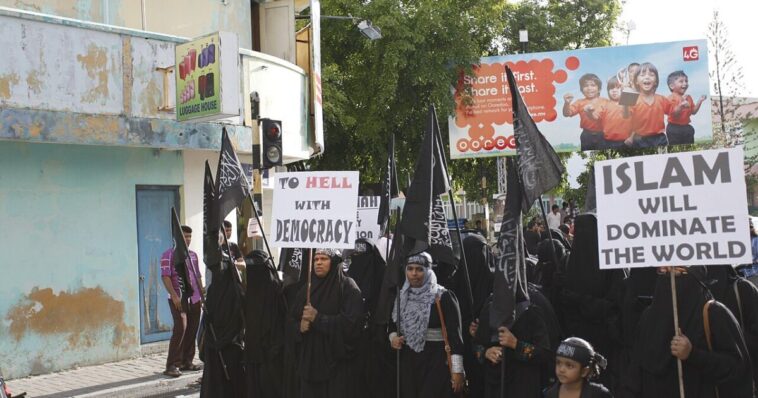

A recent Rasmussen Reports/Our Republic survey has found a surprising surge in support for Sharia law among America’s youngest voters.
According to the October results, 43 percent of likely voters between the ages of 18 and 24 view Sharia favorably—marking a notable increase from previous years. The same poll indicated that more than a quarter of voters under 30 would support the adoption of Sharia law within a local community.
This rise prompts a pressing electoral question: has this growing approval of Islamic law translated into measurable electoral outcomes in recent cycles, including the current year?
Recent election cycles have indeed seen several historic victories for Muslim-American candidates, a trend some analysts link to shifting demographics and attitudes. In Michigan, Democrat Abdul El-Sayed (D-MI) defeated Republican Mike Rogers (R-MI) to become the first Muslim elected to the U.S. Senate; he is scheduled to be sworn in on January 3, 2027.
Meanwhile, in New Jersey’s 12th congressional district, Adam Hamawy (D-NJ) secured a seat as the state’s first Muslim member of the House of Representatives. In New York’s 13th district, Darializa Avila Chevalier (D-NY) also won her congressional race.
They are not alone in their success. Veteran incumbents also secured re-election, continuing their service. Representative André Carson (D-IN) won another term in Indiana’s 7th district. In Minnesota’s 5th, Ilhan Omar (D-MN) was re-elected to her fifth consecutive term. Rashida Tlaib (D-MI) retained Michigan’s 12th congressional district, and Lateefah Simon (D-CA) held California’s 12th.
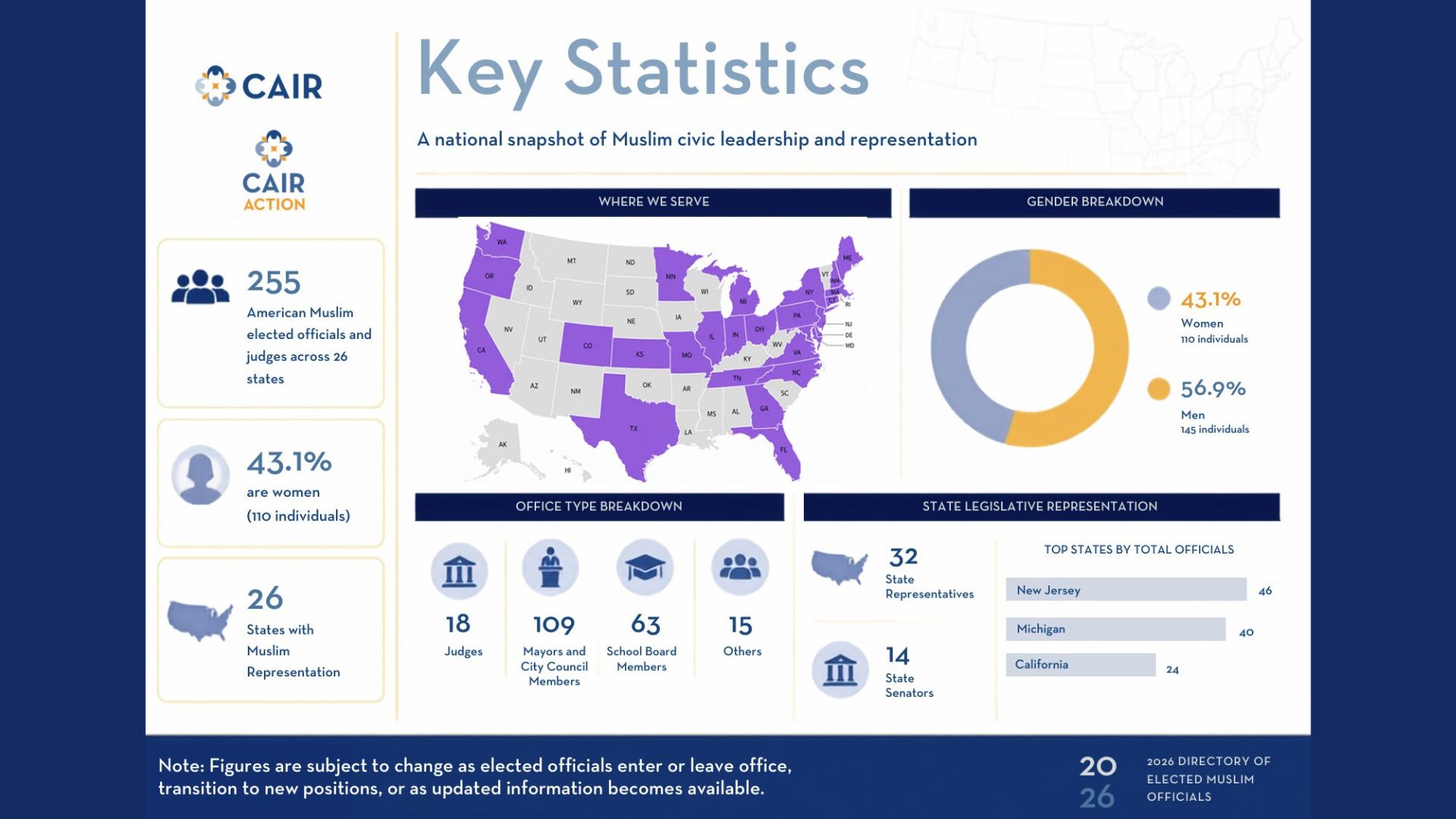
Congressional representation has reached a new peak with Muslim lawmakers set to serve in the upcoming term. At the state level, 46 Muslim legislators hold office, with 32 in state house seats and 14 in state senates. Local governance shows even broader integration: 98 serve on city or county councils, 63 on school boards, 11 as mayors, and 18 as judges. An additional 15 officials hold roles in municipal agencies, law enforcement, and transportation oversight.
A post-election analysis from the Council on American-Islamic Relations (CAIR)—an unindicted co-conspirator by federal prosecutors in the 2007 Holy Land Foundation for Relief and Development (HLF) terrorism financing trial—confirms the “record-breaking” milestone: more than 255 Muslim officials now hold elected office across the United States. Clearly, these findings reflect growing political influence at every level of government.
This growing political influence at every level of government appears to validate concerns raised by education advocates like Melanie Kurdys of United States Parents Involved in Education (USPIE), who recently framed young voters’ political discernment as a generational crisis of understanding.
The USPIE President and board member argued that many young people lack historical knowledge, describing them as drawn to social issues but conditioned by an “oppressed-oppressor model” taught in schools.
Kurdys drew a sharp distinction between discrimination and discernment, particularly regarding religious law. She claimed that criticizing Sharia law is often misconstrued as anti-Islamic sentiment rather than a defense of American foundational values. “Young people don’t have the information to be discerning about why it would be an impact,” she told The Gateway Pundit, pointing to principles of equality that she believes are incompatible with Islamic religious practices.
She conceded that many American Muslims practice their faith and integrate peacefully into society, but Kurdys warned against what she called “enclave communities” where more extreme practices might take hold. She cited concerns about press coverage being overly sympathetic, obscuring what she described as oppressive elements.
The solution, according to Kurdys, lies in education reform and media representation. She criticized government schools as nearly irredeemable and advocated for homeschooling or private Christian education as short-term solutions.
For adults beyond school age, she emphasized the need for conservative media to calmly articulate these arguments. “The messaging has to be beyond this election,” she explained, noting that the fundamental issue concerns preserving America’s national character against what she perceives as transformative threats from hardline Islamists.
As these competing narratives unfold—one charting measurable political integration through democratic processes, another framing it as civilizational erosion—the nation finds itself navigating not merely policy differences but fundamentally irreconcilable visions of American identity itself.
Ad block users: Some site features may not work correctly while an ad blocker is enabled, because they break scripts and content this website depends on. If you can’t see comments below, for example, please disable your ad blocker.