
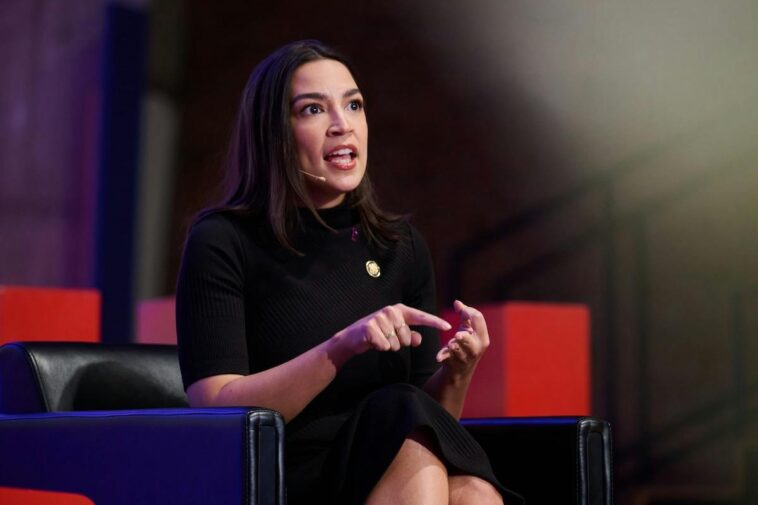
Rep. Alexandria Ocasio-Cortez (D-NY) took to Instagram Live to explain the responsibilities of the House speaker to her followers who are apparently unfamiliar with the basic mechanics of their own government.
“The speaker’s job is legislative, and it is political,” Ocasio-Cortez said during her livestream over the weekend, using a handwritten diagram to walk viewers through the position’s responsibilities.
The congresswoman explained that the speaker oversees the House majority’s legislative strategy, including the party’s “whip operation” — the process of determining how members are likely to vote on legislation and ensuring a bill has enough support before bringing it to the floor.
“You know which bills have the numbers to pass before you bring it to the floor, and you know which bills do not have the numbers to pass before you bring it to the floor,” she explained.
Ocasio-Cortez also described the speaker’s political responsibilities, including maintaining the party’s majority and raising money. She noted that the Democrat caucus includes members across a broad ideological spectrum, requiring its leadership to coordinate lawmakers with competing priorities.
The livestream then turned to the internal process by which House Democrats select their leaders. Ocasio-Cortez explained that the speaker is elected by members of Congress rather than directly by voters, a basic fact she seemingly believes her constituents did not realize.
She compared the internal leadership ballot to a regular election, explaining that members select among candidates rather than simply voting yes or no on a single nominee.
AOC’s basic tutorial reflects a persistent concern about Americans’ understanding of their political institutions.
Ocasio-Cortez has had her own trouble understanding basic civics. In a 2018 livestream, she declared that Democrats should “work our butts off to make sure that we take back all three chambers of Congress — rather, all three chambers of government: the presidency, the Senate and the House.” The legislature is bicameral — not tricameral — and the three branches of government are the executive, legislative, and judicial.
A 2025 report from the Hoover Institution found broad agreement among civic education experts that civics receives insufficient attention throughout the educational system, from K-12 schools to universities. The report identified standardized testing requirements and an increased emphasis on STEM subjects as factors that have pushed civics and history aside.
In 2019, the federal government spent approximately $54 per student to support STEM learning, compared with just five cents per student for civic education, according to figures cited by the Hoover report.
The consequences extend beyond the classroom. A survey of more than 4,000 young adults between the ages of 18 and 24 found that 40% could correctly answer only one of four standard civics questions. Thirty-five percent said they did not feel sufficiently informed to participate in politics.
The Annenberg Public Policy Center has also documented gaps in basic political knowledge among adults. In its 2022 survey, fewer than half of Americans — 47% — could name all three branches of the federal government, down from 56% the previous year.
The American Bar Association has similarly pointed to declining civic knowledge among young people, citing persistently low student proficiency on the National Assessment of Educational Progress civics exam. Its review found that only 31 states required a one-semester high school civics course, while just six required a full year.
The decline has not occurred in a vacuum. The Hoover report identified the No Child Left Behind Act and subsequent education reforms as contributing to a shift toward standardized testing in reading and mathematics, leaving less instructional time for civics and history. The growing emphasis on STEM education has further crowded out those subjects.
There are also disputes over what civics education should teach. The Hoover researchers found that educators and experts across the political spectrum generally agreed that civic education should transcend partisan divisions and provide students with a shared understanding of American government. But ideological battles over curricula have complicated efforts to establish common standards.
Conservatives have raised concerns that some schools prioritize activism and ideological frameworks over foundational knowledge of the Constitution, American history, and the structure of government. Heritage Foundation education analysts Jonathan Butcher and Madison Marino Doan have argued that civics instruction should emphasize constitutional principles, individual liberty, and the responsibilities of citizenship.
The need for stronger civic instruction is not limited to one political party. The Hoover report found broad support among parents, educators, and civic leaders for improving students’ understanding of government, even as disagreements persist over how to accomplish it.