
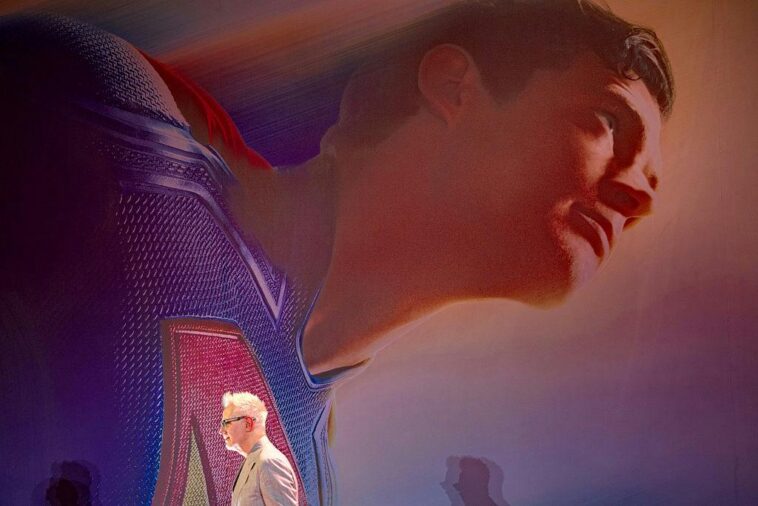
James Gunn’s departure from DC Studios is a reason for hope, in a world in which there is, sadly, very little of said virtue in circulation.
From the moment “Superman” was released last year, many warning signs pointed to the fact that DC Studios bet on the wrong horse when they hired Gunn to oversee their cinematic efforts. After all, this is a movie that you absolutely should not let your seven-year-old nephew see, unless your nephew enjoys seeing someone being tortured and then executed by being shot in the head point-blank on screen – in which case, you have bigger problems than a dull movie. Gunn’s unfamiliarity with the rural Americans who would normally want to see this film was evident in the way he portrayed Clark Kent’s farm upbringing. No self-respecting farmer and his wife would leave rusted furniture out for everyone to see unless they were ill, impoverished, and reclusive—none of which describes the Kents. After seeing her drunken cameo near the end of the film, I had no desire the following year to spend my time or money on the Ke$ha-like version of Supergirl that Gunn co-produced. Judging by its box office, apparently neither did anyone else.
Apologists for the Gunn universe endlessly told us that kindness is the new punk rock, backed by an insipidly vapid, endlessly repeated corporate punk tune that one imagines Ian MacKaye wincing over. Never mind, of course, that kindness without mercy is often little more than a bourgeois social convention, that the punk rock movement rejected that convention entirely, or that mercy is much harder to practice than mere kindness.
This particular form of kindness, moreover, is selective at best, at least as Gunn presents it. Is it kind, for example, for a powerful super-being like Hawkgirl to toss an admittedly wicked, but utterly defenseless, human being to his death, instead of turning him over to the proper authorities? An action doubtless intended to rouse cheers from the same cinemagoers who decry legally-imposed capital punishment in their social media posts with no sense of irony? Gunn selectively constrained the viewer into rejecting the possibility of mercy, reform, and redemption for ALL, because in his universe, such things are permitted only for a select few.
All of this is surely bad enough, but perhaps the worst aspect of the Gunn version of Superman is its failed attempt to toss away the mythological in order to make it less impressive, or somehow more accessible. While I didn’t particularly care for the Snyderverse, with its murky palettes, weird editing, and excessive body count, Jack Snyder understood something about characters like Superman, Batman, and Wonder Woman that James Gunn did not. They are meant to be larger-than-life figures, and he kept them that way. Gunn turning Kal-El into a sort of Jim from “The Office” cosplaying as Superman betrays a lack of understanding of this.
One of the touchstones of Superman’s identity is that, as Kal-El, he was sent to Earth for benevolent purposes by his father Jor-El, a father whose guidance and reassurance the son continues to seek, in a quasi-supernatural way. Jor-El acted as he did not only in order to save his son’s life, but also to preserve and impart the best aspects of their now-vanished civilization: its wisdom and accomplishments, its values and virtues, in order to benefit the people of Earth as a whole. Superman’s father gives his son a life mission grounded in self-sacrifice, recognizing the responsibilities of those given superior opportunities in life.
Gunn’s reimagining of Superman’s origin – I won’t state “spoiler alert” because there is no reason you should ever see this film if you have not already – is that Superman was sent to Earth by his father not to save it, but to dominate it, and populate it with his, er, “seed.” When Gunn’s Superman finally realizes that this is his reason for being, he rejects it, but it is ultimately an act of nihilism. If there is no loving father behind the son, then what are we left with? Some dude staring blankly into a mosh pit at Burning Man?
By making Jor-El’s underlying motivation one of malevolence, thereby causing the son to reject the father as being unworthy of respect, Gunn effectively emasculates the role of fatherhood, a not-infrequent theme of his. Star-Lord’s biological father in the “Guardians of the Galaxy” films, Ego, creates Peter Quill not out of love, but to subjugate other planets. This backstory may have worked for a character few people knew or cared about, but it does not work for a well-known character like Superman, who has been beloved by generations of Americans for nearly a century.
Imagining Jor-El as an avatar of Satan rather than Jehovah is more problematic than one might have realized while watching the film, distracted by pointless subplots, a perennially whinging Clark Kent, and appallingly poor CGI. Gunn effectively turns Kal-El into a false prophet who, though he may reject his origins now, we are given no guarantee that he will not pursue them later under different circumstances. We already know this inversion of the Nativity story from cinema, of course: “Rosemary’s Baby,” for example. As a matter of fact, Richard Donner, a director who knew a thing or two about making a Superman movie that is actually good, gave us his take on this theme in “The Omen,” two years before he made “Superman: The Movie.”
One might argue, at this point, that despite changing the backstory, Gunn has his Superman reject his evil origins, and that is to the good. The problem is that this is not Superman’s story to begin with — it’s Hellboy’s. Altering the fundamental nature of a well-known character can sometimes work, but as a general rule, you should mess with it very cautiously, if at all. Woe to the director (and studio) who gets it wrong – see, e.g., Luke Skywalker.
Ultimately, any decision to change course and personnel comes down to hard numbers, rather than disputes over artistic vision or issues of moral philosophy. If you can’t outperform expectations, you aren’t going to be kept around for very long in any industry, but particularly not in one where hundreds of millions of dollars are being spent at your direction in search of profit. Superhero movies are a form of art, yes, but they are primarily products created in search of profit, not for their own sake. There is still one more Gunn Superman film in the can to get through, set to premiere next year, and perhaps it will be profitable.
Yet once the dust settles and computerized Krypto is permanently deleted, I would urge DC to consider whether Superman and the movie-going public would be better served by embracing him for who and what he is: the Big Blue Boy Scout. He is perfect the way he is and does not need to be refashioned into some other director’s own, rather pedestrian, image. Supes may be a bit broken, at present, but he is not beyond being mended – and he has many more adventures that he could be sharing with us in the years to come.
***
William Newton is a critic, commentator, and public speaker with a wide variety of interests in the art world. He is a graduate of the Georgetown University School of Foreign Service, the University of Notre Dame Law School, and Sotheby’s Institute of Art in London. He lives in Washington, D.C.