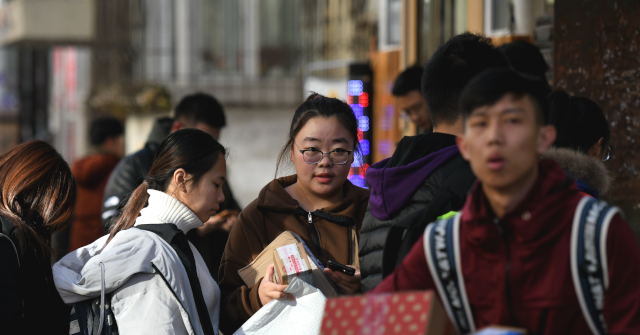
China’s Singles’ Day online shopping event, which rivals Black Friday in the United States, posted sluggish sales this year as consumer optimism lagged far behind reported GDP growth. Chinese consumers are reportedly still worried about the depressed real estate market and would rather save than spend on the biggest retail day of the year.
“Optimism over a recovery in domestic demand has faded. Improvements in sentiment have repeatedly proved short-lived,” senior Asia-Pacific economist Max Zenglein of The Conference Board told the Associated Press (AP) on Wednesday.
Citigroup forecast a weak 2 percent increase in Singles’ Day volume for 2026. The sort of luxury and big-ticket items that used to sell briskly during the event moved poorly this year as shoppers seemed more inclined to buy necessary items at holiday discounts.
“Chinese consumers are increasingly focused on health, wellness, hobbies, and experiences. We’re seeing this across multiple age, gender, regional, and socioeconomic divides,” observed WPIC Marketing and Technologies CEO Jacob Cook.
Ironically, some of the best-selling luxury items were from American brands like Coach and Ralph Lauren, which generally enjoyed a good third quarter in China.
Singles’ Day is officially November 11 each year (the date written as 11/11, or four ones, is where the name comes from), but the shopping event tends to last for at least a week nowadays, much as Black Friday has grown far beyond the day after Thanksgiving.
The original idea for the holiday, which began in 1993, was to give lonely single people an opportunity to buy presents for themselves. In 2009, China’s e-commerce giant Alibaba decided to begin treating the day as a huge online shopping extravaganza, essentially creating the modern iteration of the holiday through an act of corporate willpower (and a massive marketing budget).
The ad campaign was bright and optimistic, not as glum as the notion of a day for single people to treat themselves might suggest. The college students who invented Singles’ Day saw it as an opportunity to buy new clothes, jewelry, and cosmetics — for themselves, or as gifts for their love interests in the hope that they might not be single much longer.
Other online retailers got in on the action, and soon Singles’ Day became one of the most important yearly barometers of consumer spending in China. Perhaps even more than American and European Christmas shopping, the Chinese holiday was driven by the mood of consumers and their opinion of the overall economy. The amount of money they spend, and precisely what they spend it on, is diligently studied to divine the feelings of a population that is understandably nervous about criticizing the policies of its rulers.
One theory for online sales lagging far behind China’s reported 4.6 percent GDP growth for the quarter is that most of that growth came from exports. Chinese consumers are not buying the lion’s share of what China is selling.
Another problem is the ongoing real estate crisis in China. Apocalyptic fiscal collapse seems less of a looming threat than it was a few years ago, but home values have slid about 20 percent over the past five years, especially in smaller cities. Many Singles’ Day shoppers told reporters they wanted to spend less and save more. Young Chinese consumers cannot shake the feeling that the boom years are behind them.
Singles’ Day is also the victim of “discount fatigue,” as ApertureChina founder Yaling Jiang put it to the AP.
“Looking at what Singles’ Day originally was: a shopping festival where people used to expect the largest discounts of the year. That is not true anymore after it was extended to multiple platforms, then to a monthlong thing,” she explained.
Perpetual discounts are partly a consequence of retailers competing to get the attention of consumers who don’t want to spend money. On the other hand, some Chinese manufacturers see little point in squeezing sales out of the domestic market when exports are booming. Both industrialists and Communist officials are content with income from overseas replacing Chinese consumer spending.
The big players in Chinese e-commerce are much less prepared to make do without domestic consumer spending, so they decided to enlist artificial intelligence (AI) in the battle for shoppers.
The South China Morning Post (SCMP) on Thursday saw AI agents as the star salespeople (well, non-people) of Singles’ Day 2026, as AI agents aggressively persuaded customers to add a little more to their digital shopping carts.
AI was particularly good at persuading people to buy services online, from housecleaning and professional movers to travel packages and medical consultations.
According to e-commerce giant JD.com, purchases of time with its AI medical assistant program soared by over 500 percent this year. Alibaba reported a 700 percent increase in purchases of tokens for AI time. One AI productivity platform carried by Alibaba sold 100,000 subscriptions in half an hour earlier this month.
China’s state-run Global Times noted on Thursday that this was the first year AI tokens were sold as discounted items on Singles’ Day, and many of the buyers were students, households, and small businesses.
“A few years ago, Double 11 meant stocking up on household goods. Now I’m stocking up on computing power the same way. That tells you how fast artificial intelligence has moved from a developer tool to something ordinary consumers just buy like a phone plan,” said a shopper in Beijing.