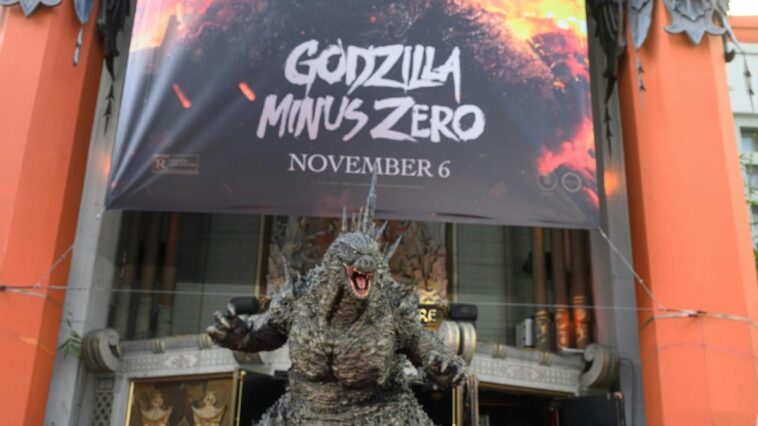
By 1949, Japan had endured military defeat, two atomic bombs, and a costly visit from Godzilla. One might reasonably have expected the country’s quota of apocalyptic calamities to be exhausted. Filmmaker Takashi Yamazaki, much to our delight, evidently disagrees.
His “Godzilla Minus Zero” picks up two years after the events of the acclaimed “Godzilla Minus One,” with Japan unyieldingly clawing its way back to stability. Former kamikaze pilot Kōichi Shikishima (Ryūnosuke Kamiki) — Kamikaze Emeritus is my preferred nomenclature — has married Noriko Ōishi (Minami Hamabe), and together they are raising their adopted daughter Akiko (Sae Nagatani). After years of destruction and bereavement, they have finally assembled something resembling an ordinary family life.
Naturally, Yamazaki decides to torment his protagonists with a sequel. His latest scourge arrives aboard a meteorite that, of all places, crashes in Japan, unleashing Ghidorah, a flying dragon with a remarkable talent for leveling Japanese cities. Its first stop is Matsumoto, spared the Allied bombings of World War II (choosing the wrong side to ally with was on them) only to be flattened by an illegal alien from outer space. They just can’t catch a break.
Yamazaki captures the creature’s rampage in full IMAX glory, with gravity-defying beams hoisting entire buildings into the sky and lightning bolts reducing what remains to rubble. The sheer scale is terrifying, enhanced by Naoki Satō’s haunting symphonic score, whose piercing, repetitive motif sounds like a bomb siren designed by Richard Wagner. It is among the loudest and most thrilling theatrical experiences I can recall, enough to make anyone planning that trendy trip to Japan reconsider.
The scientists tasked with dispatching Ghidorah are an enterprising lot, although their ingenuity has a habit of making matters considerably worse. Makoto Aoyama (Masami Nagasawa), a prodigy meteorologist whose weather-predicting powers rival those of Karen in “Mean Girls,” proposes turning the creature into a giant lightning rod. The intervention instead transforms it into the three-headed King Ghidorah. In the Japanese monster business, every promising technological breakthrough seems to produce an even larger catastrophe. Shouldn’t Pearl Harbor have been sufficient warning about the perils of escalation?
Yet amid the thunderous destruction, Yamazaki understands that the weight of the spectacle rests with the fragile lives caught beneath it. For a film without so much as a single kiss, “Godzilla Minus Zero” contains a remarkably affecting love story. Shikishima and Noriko must reconcile their duty to protect their country with the obligation to remain alive for their child. Few scenes are more dispiriting than Akiko innocently wishing them a “safe trip,” scarcely old enough to comprehend that she might be orphaned all over again.
Min Tanaka gives perhaps the film’s finest performance as Professor Kanji Murakami, a survivor of the atomic bombing who lost his family and has spent the intervening years nursing a consuming hatred of America. His wide, almost hypnotized eyes seem haunted by the horrors of Hiroshima, his grief having curdled into a relentless desire to inflict similar devastation upon American cities. His eventual decision to forsake that vengeance and channel his resolve into defeating the monsters — sparing other families the suffering that has devoured his own life — lends the film a poignant moral dimension.
By the third act, Japan’s beleaguered pragmatists stumble upon a strategy that would have elated President Ronald Reagan. Conventional munitions have proved useless, and every direct attempt to destroy Ghidorah has only strengthened it. The obvious solution is proxy warfare: lure Godzilla back into the fray and let the indigenous radioactive strongman settle accounts with the foreign invader. Godzilla becomes postwar Japan’s Contra, an unruly, unmanageable asset recruited to neutralize a far worse adversary.
Much like its analogous Sandinista counterparts, Ghidorah lacks any semblance of purpose. It doesn’t even feed on the humans it massacres like ants; it seeks out thriving cities and bustling metropolises and descends upon them in a feat of indiscriminate destruction. Rarely do we see such a true manifestation of Marxism displayed on film.
If the two monsters happen to destroy each other, so much the better. As expressed more literally in Gareth Edwards’ 2014 “Godzilla,” “let them fight.”
Their climactic duel is spectacular, although Yamazaki occasionally allows it to overstay its welcome, approaching Marvel territory as colossal CGI action figures repeatedly smash into one another and the human stakes recede from view. The film is similarly susceptible to an excess of sentimentality, particularly in a protracted tearful farewell that the screenplay almost immediately undercuts with a breezy “oh, never mind.” These frustrating indulgences keep “Minus Zero” from reaching the same heights as its leaner predecessor.
Yamazaki has restored a much-needed humanity to a franchise long accustomed to relegating its human characters to background noise. His protagonists have families to love and obligations to honor. Their vulnerability gives the destruction its force and the spectacle its emotional weight. As Alphaville sang in its 1984 hit, “Things are easy when you’re big in Japan.” Yamazaki’s accomplishment is making us care about everyone who isn’t.
***
Harry Khachatrian (@Harry1T6) is a film critic for the Washington Examiner. He is a software engineer, holds a master’s degree from the University of Toronto, and writes about wine at BetweenBottles.com.
This article is part of Upstream, The Daily Wire’s new home for culture and lifestyle. Real human insight and human stories — from our featured writers to you.