See more of our coverage in your search results.

Members of the “world’s most endangered tribe” made a rare encounter with government workers in the Brazilian rainforest for food as non-profit officials expressed fear over the “troubling” sign.
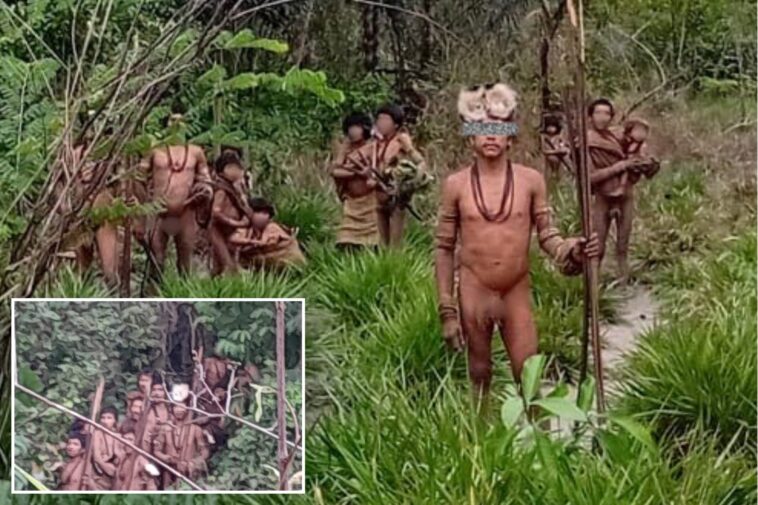
Roughly 20 Awá Indigenous people had approached an outpost searching for yams in the Amazonian village of Tawari, in the northeast state of Maranhão, on Monday, according to human rights group Survival International.
The hunter-gatherers accepted the food and returned to their territory that has been decimated by illegal logging, hunters and cattle ranchers over the years.

The barely clothed, nomadic tribesfolk held long, wooden spears as they stood on the edge of the thick forest, according to images shared by the group.
“This is a troubling indication of how the continued invasion of uncontacted peoples’ forests puts otherwise self-sufficient Indigenous people in real danger,” Survival International Director Caroline Pearce said.
“The uncontacted Awá are under extreme pressure as intruders encroach from all sides of their territory, driving them into an ever-smaller island of the Amazon rainforest, surrounded by destruction.”
The head of Survival International’s Brazil arm, Sarah Shenker, called the encounter “a crisis moment really and a wake-up call,” according to the Associated Press.
The Awá are considered one of the most threatened tribes on Earth and remain one of the last uncontacted peoples, having survived as an isolated group without encountering modern civilization.
The nomadic group uses bows and arrows to hunt armadillos, gathering wild honey and babassu nuts in the dense primal forest.

Several groups, including the indigenous Guajajara – known as the Forest Guardians – have sought to protect the Awá, claiming government officials have failed to safeguard the tribe from the invasive practices of loggers and cattle ranchers in the region.
“The situation in the forest is challenging: climate change, fires, deforestation and land encroachment are having a direct impact on their lands and the Awá way of life, which depends exclusively on hunting and gathering,” the Guajajara people said.
“The Forest Guardians have always worked to protect the Awá against encroachment, even at the cost of losing warriors in battle,” the Guajajara added. “We demand immediate action from the relevant authorities, in direct dialogue with COCALITIA and the Guardians, to ensure what the Awá believe is best for them, safeguarding their lives, health, safety and dignity. FOR THE AWÁ, FOR THE TENETEHAR AND FOR THE FOREST!”
Pearce urged lawmakers to get tougher on protecting the Awá’s land after the historic encounter.
“The Brazilian government must commit the resources necessary to protect Arariboia from the loggers and ranchers who are razing it, in flagrant defiance of the law,” Pearce said.
The Arariboia Indigenous Territory is roughly 1.2 million acres.