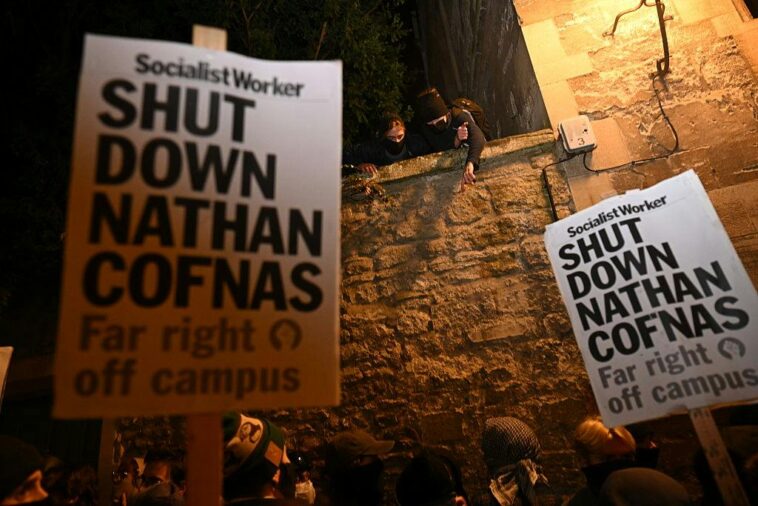
What image does Oxford University bring to mind? Most picture stone cloisters and cycling scholars in billowing robes. Perhaps even cozy, wood-paneled pubs like The Eagle and Child where J.R.R. Tolkien and C.S. Lewis drank pints in the mid-20th century. Few would picture balaclava-clad protesters beating up university porters and intimidating students for attending a lecture.
This week, the Oxford University Reform Society had invited Nathan Cofnas, an American philosopher and postdoctoral researcher at Ghent University in Belgium, to speak about the influence of DEI on higher education. The society is the university branch of Reform U.K., the insurgent right-wing party led by Nigel Farage. Cofnas, meanwhile, recently rose to prominence as the man who exposed the fraudulence of the late former Cambridge academic Jason Arday, who committed suicide in August after the ensuing scrutiny.
Cofnas is hardly a conventional academic speaker, and his views on race are objectionable and rather unsavory to many, myself included. But in a country that claims to value free speech, his invitation ought to have been unremarkable at an institute of higher learning.
But the scenes at Oriel illustrate two major, unresolved problems in British public life: the reality of two-tier policing and the threats to free speech.
As is often the case these days, hundreds of protestors descended on the college. Entrances were blocked, and attendees were aggressively confronted. Videos circulating online showed scenes that would have been more at home in the days of 1970s English football hooliganism than outside an Oxford college.
Those gathered outside the college were perfectly entitled to hold placards and chant slogans. However, they had no right to physically prevent others from entering the building, or to assault and intimidate those with whom they disagreed. This distinction seemed to get lost very quickly.
This gathering was not unforeseen. The event and the corresponding protest had both been advertised weeks in advance, and Oriel College had contacted Thames Valley Police about the arrangements. The college itself even arranged a “silent protest,” supposedly ending at 6 pm. The coordination and coverage of the scenes showed little evidence of robust planning and competence. Former Metropolitan Police Detective Dominic Adler, who writes widely on policing issues in Britain, criticized the college and police for failing to grip “an entirely predictable scenario” and giving the protestors “carte blanche” to cause disruption.
Britain is hardly short of legislation to deal with such scenes. The Public Order Act 1986 provides powers to address threatening or abusive behavior, harassment and disorder. Assault remains a criminal offense. The law also provides powers to deal with serious obstruction and public disorder. Those who crossed the line into criminality, and there were many, should face a rigorous and proportionate response. A political cause does not confer immunity from the law.
A much wider concern here is the willingness of British police to enforce the law at all. We have become accustomed in Britain to seeing officers caught between competing political groups, apparently reluctant to upset either side. Increasingly, they appear more concerned with calming the most intimidating crowd, or the one with the most fashionable cause, than protecting the rights of individuals caught up in the melee.
In March 2024, for example, Iranian-born activist Niyak Ghorbani was arrested at a pro-Palestinian demonstration in London after holding up a placard declaring Hamas a terrorist organization. Protesters confronted him in an attempt to take his sign. Instead of addressing those surrounding and intimidating Niyak, the police opted to pull him away, before pinning him to the ground and arresting him on suspicion of assault. The mob won.
Policing protests is, by nature, a balancing act, especially when counter-protestors are involved. But showing weakness, as British police have done repeatedly in recent years, and bowing down to whoever shouts loudest, is a recipe for disaster. It incentivizes escalation by the protestors, both in the moment and long-term, and undermines the legitimacy of the police in everyone’s eyes. They become neither a credible deterrent to lawbreakers nor a credible defense to law abiders. The police must remember that their job is to protect the rights of those on the receiving end of the mob, not simply act as stewards at a music festival.
This brings us to the threats to free speech in Britain today. Ultimately, this episode was a free speech victory, as Cofnas’s lecture went ahead. The Higher Education (Freedom of Speech Act) 2023 was designed to strengthen lawful speech on university campuses and was a great step in solidifying the idea that universities ought to be institutions where ideas are challenged rather than suppressed. Despite receiving a petition opposing Cofnas’s talk — signed by 30,000 people including sitting members of Parliament — the college held firm. In an admirable if depressing sight, pictures uploaded to X showed the provost of Oriel College, Lord Mendoza, donning his college puffer jacket, pushing back the front door as the mob of protestors attempted to gain entry.
Yet British law does not protect free speech as much as it should. As we at the Prosperity Institute pointed out in July of this year, the same Public Order Act which should empower police to arrest violent protestors criminalizes speech delivered “within the hearing or sight of a person likely to be caused harassment, alarm or distress”. This law has been used to arrest and prosecute many Brits for simply expressing their views over the past few decades, and has had a chilling effect on free speech, empowering the intolerance witnessed outside Oriel this week.
In the end, legislation and policing can only do so much. They cannot manufacture a culture of tolerance amongst students and a wider community which treats preventing an event from taking place as a cause célèbre. The intense and violent scenes outside Oriel are just the latest sign of intolerance on the British political Left. We will likely see more before too long.
***
Matthew Bowles is senior policy researcher at the Prosperity Institute.