See more of our coverage in your search results.

Price check on aisle five.
Mayor Zohran Mamdani couldn’t do the math on his taxpayer-funded grocery stores this week — totally floundering when asked in an interview to explain how the city-mandated 30% discounts would work.
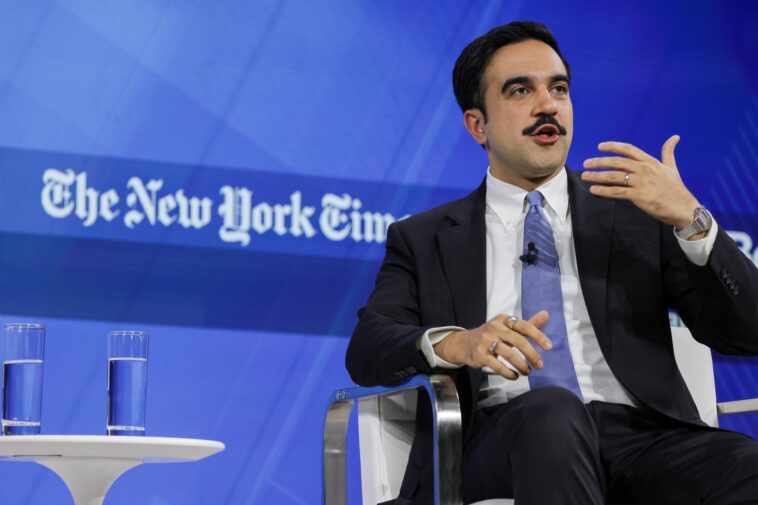
“How is this going to work at all? Just walk through the math when you think about it,” New York Times columnist Andrew Ross Sorkin pressed Mamdani at the DealBook Summit on Wednesday, noting supermarkets already operate on slim margins of 1% to 4%.
“It’s going to be subsidized,” Hizzoner vaguely replied after Sorkin added that the subsidy would come from the taxpayers.

Sorkin tried again.
“Right, it is going to be subsidized. Okay, and so my question is how you see that subsidy long-term affecting the other supermarkets in the city?” he asked.
Mamdani never answered, instead he turned the question back on shoppers.
“When you were saying, ‘Explain the math to me,’ in some ways that’s the question that New Yorkers are asking themselves every day when they go to the grocery store,” Mamdani said.
The mayor has promised the five publicly funded, privately operated stores will sell food staples at an average of 30% below retail price.
His administration’s request for proposals shows the city would use taxpayer money to build the stores, pay their rent and property taxes and cover operators’ losses from the discounts — but has no guaranteed returns for taxpayers if the stores do turn a profit.
Experts have cast doubt on Mamdani’s pledge to sell food at the steep discount.
“This is a subsidy, delivered through a storefront. It will genuinely help households that live near one. But it does not make food cheaper,” David Ortega, a food economist at Michigan State University, wrote in an August essay for Vital City.

“It pays part of the food bill on the shopper’s behalf, with tax dollars,” he wrote.
The mayor tried to distract from the question with petty politicking, taking a swipe at Fox News viewers.
“We’re going to create five, which I know might be news to a lot of Fox News viewers, because they hear about it every day, like we’re going to create a million,” he said. “And these five, first of all, they’re not free supermarkets, which is often how they are described. They are cheaper supermarkets.”

Then Mamdani rambled on arguing the discounts are needed “because what we are seeing is the lines of New Yorkers at food pantries are just continuing to lengthen every single day.”
Moments later, he said he wants wealthy New Yorkers shopping there too.
“I want these supermarkets to not just be for those who can’t afford a supermarket in their neighborhood, but frankly to be for any New Yorker,” he said. “And that’s what we want for every single aspect of the public sector: be so good that no matter how much money you have in your pocket, you think ‘this is the best thing for me.’”

The RFP bars operators from limiting the discounts by income.
The document also describes a lopsided deal for taxpayers as they would have to pay for the stores’ losses, but aren’t guaranteed to share in the stores’ profits if they do make money.
Instead, the RFP gives bidders extra credit for sharing company profits with their workers.
Ortega warned the model has limits.
Start your day with all you need to know
Morning Report delivers the latest news, videos, photos and more.
Thanks for signing up!
“It could work in a small network. It almost certainly cannot work at scale, not unless the City is prepared to treat groceries as a permanent public good, funded in the expense budget year after year the way schools and street repair are,” he wrote.
The city has committed $70 million to build the five stores, but it hasn’t said how much it will pay operators each year to cover the discounts.
Bids to run the stores closed Oct. 16, and City Hall has said it will announce the selected operator next year.
A spokesperson for Mamdani did not immediately respond to an inquiry from The Post.
The National Supermarket Association sued the city in September, arguing the taxpayer-funded stores are predatory pricing meant to undercut other grocers.