See more of our coverage in your search results.

A college freshman struck gold on her very first archaeological dig, unearthing a delicate Roman chain that had remained buried for nearly 2,000 years.
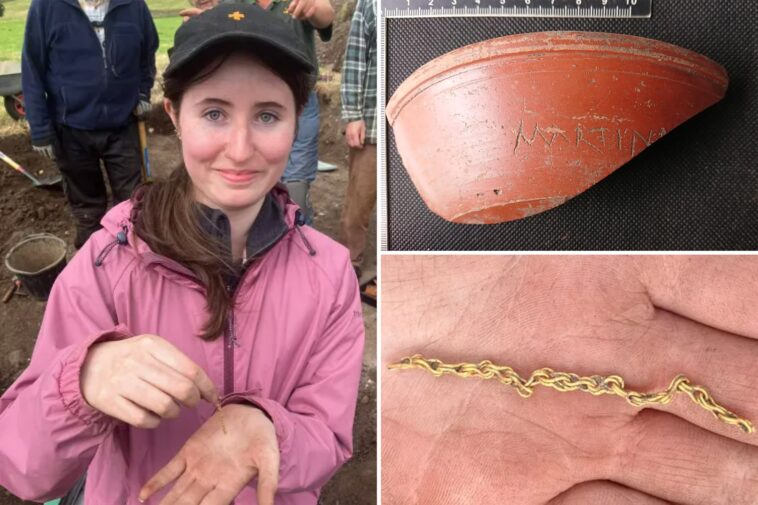
Elise Zallu, a first-year archaeology student at Newcastle University in England, made the stunning discovery during a summer excavation in Redesdale, Northumberland, where classmates also uncovered military ornaments, ancient inscriptions and a gemstone depicting the Roman god Jupiter.
The roughly 2.8-inch-long chain was so well preserved that, if the entire piece had survived, it could still be worn today, according to university researchers.

“Finding the gold chain was really surreal, especially given it was the first day of my first dig,” Zallu said.
“I didn’t expect to find anything like that my whole career, so it was definitely a surprise.”
The intricate piece was fashioned using a Roman technique known as loop-in-loop, in which individual gold rings were shaped into figure eights, folded and woven together.
Such craftsmanship was typically reserved for expensive jewelry, military amulets and other prized possessions associated with wealthy Romans and high-ranking officers.
“Finding a gold artefact is something many archaeologists can go an entire career without experiencing,” said Dr. Eric Tourigny of Newcastle University’s School of History, Classics and Archaeology.
“For a first-year student to discover a beautifully preserved Roman gold chain on their first day in the trench is truly remarkable.”

Zallu wasn’t the only rookie archaeologist to hit pay dirt.
Fellow student Shannon Wood uncovered a folded sheet of lead bearing traces of Latin writing on the same day.
Researchers believe the mysterious object may have served as a commercial seal used in trade or military supply operations. Another possibility is that it contained a personal message or curse, a practice common throughout the Roman world.
On the second day, student Megan Potter dug up an ornate bronze cavalry fitting that still retained much of its original gold gilding despite centuries underground.
The crescent-shaped ornament, known as a peltate cavalry dangler, would have been attached to a soldier’s belt, horse harness or sword scabbard.
Archaeologists suspect the costly accessory may have belonged to a cavalry officer or another prominent figure stationed along Rome’s northern frontier.

The discoveries continued into the excavation’s final week, when students Maisy Watmough and Zoe Yuill uncovered a tiny gemstone bearing an intricately carved image of Jupiter.
The polished orange carnelian stone depicts the king of the Roman gods clutching a scepter and a miniature figure of Victory, with an eagle at his feet.
Known as an intaglio, the gemstone would have been mounted in a ring and pressed into wax to authenticate documents.
It was the fourth such engraved stone recovered from the site, including two found in 2025 and another discovered during the 19th century.

“It was so exciting to find the intaglio,” Watmough said.
The students also unearthed Roman coins, spearheads, pottery and personal accessories, including ceramic fragments scratched with graffiti.
One bowl bears an inscription believed to identify someone named Martinus, whose name appears on several other pieces recovered during the excavation.
In all, 52 Newcastle University freshmen participated in the summer 2026 fieldwork, spending two weeks apiece working alongside volunteers from the Redesdale Archaeology Group.