
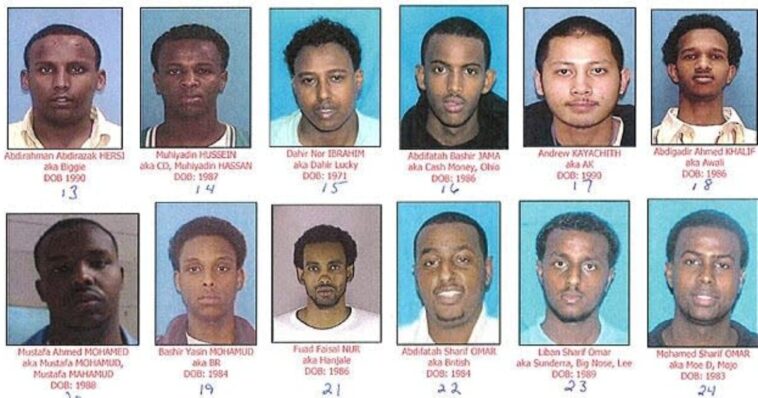

While Minnesota officials debate whether it’s offensive to call certain Twin Cities youth gangs “Somali gangs,” law enforcement estimates that about 300 Somali youths belong to roughly a dozen gangs in the metro area. U.S. crime statistics from individual jurisdictions cannot show how often Somali immigrants commit crimes nationwide.
Denmark, by contrast, records convictions by country of origin. Government figures show that Danish-born sons of Somali immigrants are convicted at more than three times the national rate. In one group of Somali men, 62 percent had been convicted by age 30.
Somali community members and law enforcement officials met in the Twin Cities on Thursday, Nov. 19, to discuss shootings tied to Somali youth gangs. Authorities say about 300 young people belong to roughly a dozen Somali gangs and estimate total gang membership across all groups in the metro area at up to 2,000.
Ramsey County Sheriff Bob Fletcher said arrests have not ended the problem. Fletcher told KSTP that authorities had arrested about 100 of those 300 gang members. “Many of them cycle out. Just because you arrest them doesn’t mean they’re not going to continue to participate in the gang life.”
Federal lawmakers had raised the issue months earlier. In a July 23 letter to U.S. Attorney Daniel Rosen, Minnesota Republican Reps. Pete Stauber, Michelle Fischbach and Brad Finstad wrote, “We cannot ignore that there are twelve Somali gangs operating in Minnesota.”
Early on Oct. 6, Bloomington police responded to a shooting in the 10000 block of Harriet Avenue. More than 100 rounds were fired. Bloomington Police Chief Booker Hodges linked the shooting to Somali-American gang activity. “These kids are different. They’re out here shooting each other based on social media beef,” Hodges said.
That day, Fletcher backed a regional task force and pressed Hennepin County officials to join it. “Hennepin County Sheriff’s Office, we need Dawanna Witt to commit to this project,” Fletcher said. He also questioned whether Hennepin County Attorney Mary Moriarty’s policy on young offenders was effective. On Oct. 19, the Minnesota Bureau of Criminal Apprehension announced that more than 40 law enforcement agencies had agreed to coordinate their response to gang and group violence.
Some attendees at the Nov. 19 meeting argued that the Somali community was being singled out unfairly. Some Somali Minnesotans had also cautioned law enforcement against using the label “Somali gangs.” Minneapolis City Councilman Jamal Osman, a Somali-born Democrat, called Fletcher’s rhetoric “dangerous.” In December 2025, Moriarty posted a video claiming that reports of Somali gangsters terrorizing residents were rumors.
U.S. data cannot settle the dispute because American crime statistics are not broken down by country of origin. Analysts rely on incarceration data instead and disagree on how to interpret it.
Alex Nowrasteh of the Cato Institute posted a chart based on the 2023 American Community Survey showing that 1,170 per 100,000 Somali-born residents aged 18 to 54 were incarcerated, compared with 1,221 per 100,000 native-born Americans in the same age range. Researchers writing in City Journal estimated that Somalis were twice as likely to be incarcerated as comparable native-born Americans. They also found that Somali men aged 18 to 29 who arrived in the United States at age 15 or younger had a higher incarceration rate than native-born men of the same age.
In a Cato response, Nowrasteh agreed that young Somali men had a higher incarceration rate than both native-born men overall and native-born white men. He argued, however, that Somalis should be compared with native-born black Americans. That comparison favors Somalis because native-born black Americans have the highest incarceration rate of any racial or ethnic group, as Nowrasteh himself has written for Cato.
Denmark does not face this problem. It can publish conviction figures by country of origin because Statistics Denmark links its conviction register to its population register, which records each resident’s country of origin.
Danish-born sons of Somali immigrants had one of the highest conviction rates in Denmark in 2024. Statistics Denmark’s annual report, Indvandrere i Danmark 2025 (Immigrants in Denmark 2025), found that they were convicted at more than three times the rate for men in Denmark as a whole after adjusting for age. The gap persisted after the agency accounted for the Somali population’s younger age profile. Among the groups cited in the report, only the sons of Lebanese immigrants had a higher rate, at nearly four times the national rate. The sons of Syrian immigrants were convicted at just over three times the national rate.
The Danish government groups Somalia with countries in the Middle East and North Africa, as well as Pakistan and Turkey, under the label MENAPT. In 2023, 4.3 percent of Danish-born sons of immigrants from MENAPT countries were convicted of a penal code violation, more than five times the rate of 0.8 percent for all men in Denmark, according to a Ministry of Immigration memo. Among men who immigrated from those countries, 1.8 percent were convicted, more than twice the national rate.
About one in six men aged 20 to 24 descended from MENAPT immigrants was convicted of at least one penal code violation from 2021 through 2025, according to figures the Danish Ministry of Justice submitted to the Folketing (Danish parliament) on Nov. 5 and reported by the Danish tabloid Ekstra Bladet. In that age group, the conviction rate was 20.67 percent for Somali descendants, 21.67 percent for Syrian descendants and 21.55 percent for Lebanese descendants.
An earlier study by the Danish think tank Unitos used Ministry of Justice crime statistics to track men born from 1985 through 1987. The study found that 222 of 357 Somali men, or 62 percent, had been convicted of a crime by age 30, Breitbart reported, citing the Danish newspaper Jyllands-Posten. By age 30, 60 percent of Lebanese men and 52 percent of Moroccan men had been convicted, compared with 18 percent of Danish-born men.
Minnesota has the largest Somali population in the United States, with an estimated 80,000 to 100,000 people. Denmark publishes conviction figures for its Somali population every year. Minnesota publishes none.
Ad block users: Some site features may not work correctly while an ad blocker is enabled, because they break scripts and content this website depends on. If you can’t see comments below, for example, please disable your ad blocker.