
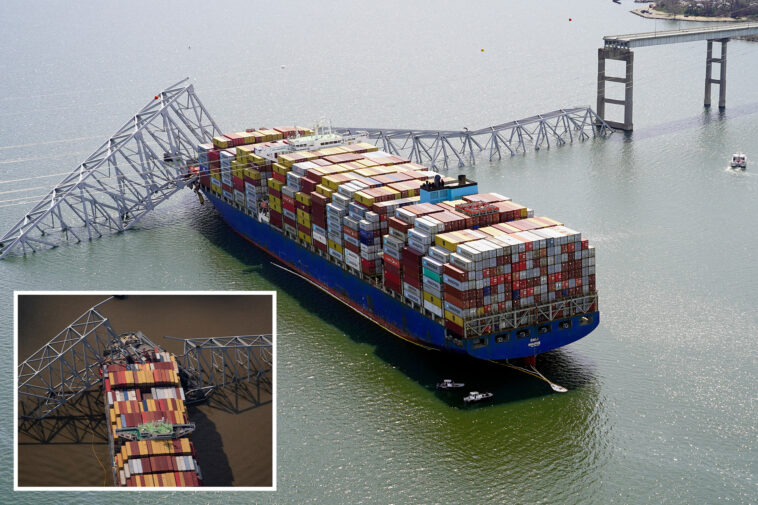
A loose signal wire caused the blackout that sent the cargo ship Dali crashing into Baltimore’s Francis Scott Key Bridge, the National Transportation Safety Board (NTSB) said Tuesday, blaming the Maryland Transportation Authority (MDTA) for failing to assess the bridge’s ability to withstand a ship strike.
The collapse of the Francis Scott Key Bridge occurred early on March 26, 2024, when the container ship Dali lost power and struck a support pier, prompting the spans to fall into the Patapsco River.
The NTSB’s final report found that a single misinstalled wire led to a total power loss that left the Dali without propulsion or steering moments before impact. The board said the tragedy could have been prevented if Maryland had followed safety recommendations issued years earlier.
“The National Transportation Safety Board determines that the probable cause of the contact of the container ship Dali with the Francis Scott Key Bridge was a loss of electrical power blackout due to a loose signal wire connection to a terminal block stemming from the improper installation of wireless label banding,” the board said.
Investigators said the crew reacted quickly to the blackout but had too little time to restore power before the vessel struck the bridge. The ship’s proximity to the span, combined with delays in restarting its systems, made the collision unavoidable.

The report also faulted the MDTA for not conducting a vulnerability assessment, a step recommended by the American Association of State Highway and Transportation Officials to identify ways to protect bridges from ship strikes.
The NTSB said contributing to the collapse “was the lack of countermeasures to reduce the bridge’s vulnerability to collapse due to impact by oceangoing vessels, which could have been implemented if a vulnerability assessment had been conducted.”

Engineers testified that the Dali’s crew misused a flushing pump as a service pump, a practice the ship’s operator, Synergy Marine Group, failed to detect or stop. That misuse limited the vessel’s ability to recover power after the blackout.
Start your day with all you need to know
Morning Report delivers the latest news, videos, photos and more.
Thanks for signing up!
The NTSB also criticized Synergy for allowing critical electrical systems to run in manual mode rather than automatic, which hindered the Dali’s recovery after the power failure.
“Staff found that Synergy operational oversight was inadequate because it did not discontinue crew’s ongoing use of the flushing pump as a service pump for the diesel generators aboard the Dali, and at least one other vessel,” NTSB engineer Bart Barnum said.

The board also found that communication failures prevented timely warnings to highway workers, who had no chance to evacuate before the bridge collapsed.
The NTSB’s findings came a day after Maryland officials said rebuilding the Francis Scott Key Bridge will take two years longer than expected and cost more than twice the original estimate. State engineers now say the project won’t be finished until 2030 and could cost as much as $5.2 billion — up from the initial $1.9 billion projection used to secure federal funding.

Jim Harkness, the MDTA’s chief engineer, told The Washington Post that inflation and market factors are driving the increase.
“Estimating is difficult on these larger projects,” he said. “The market factors, that all comes into play.” Transportation Secretary Sean Duffy had predicted in August that the final bill would be “double plus” the initial estimate once federal dollars were committed.
The NTSB’s findings paint a picture of cascading failures — from a single faulty wire to years of missed safety precautions — that combined to cause one of the deadliest infrastructure disasters in Maryland’s history.
As the state works to rebuild the bridge, the growing costs and timeline delays underscore how deeply the collapse continues to ripple through Maryland’s economy and infrastructure.