
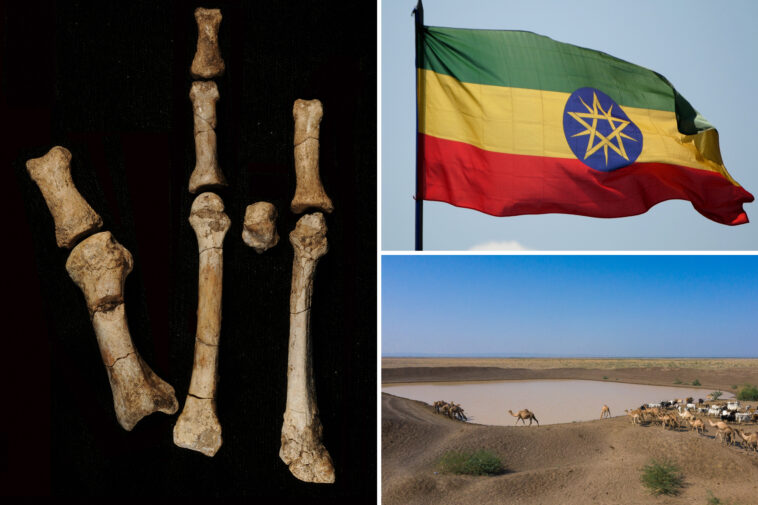
A strange fossilized foot unearthed in Ethiopia over a decade ago may finally have an identity, according to scientists.
A new study argues that the 3.4 million-year-old “Burtele foot,” discovered in 2009, belonged to Australopithecus deyiremeda, a controversial human relative that lived at the same time as our ancestor “Lucy,” according to findings published in the journal Nature on Tuesday.

The team of scientists who found the foot went on to name the new species in 2015, based on other 3.4-million-year-old jaw bones unearthed in the same location.
But the Burtele foot could not be confirmed to belong to the hominin until recent research.
Au. deyiremeda had modern traits, like smaller canine teeth similar to Lucy’s species — Australopithecus afarensis — but also more primitive, ape-like features, including an opposable big toe built for climbing, scientists said.
Despite its branch-friendly feet, the human relative still walked upright on the ground, revealing that hominins living at the same time moved vastly differently from each other.

“What we are learning now is that, yes, bipedality was the key component of our evolutionary history, but there were so many ways to walk on two legs while on the ground,” the lead author of the study, Yohannes Haile-Selassie, a paleoanthropologist and director of Arizona State University’s Institute of Human Origins, told Live Science.
The discovery of the Burtele foot puzzled scientists at first, as they believed that humans were fully bipedal, or walking on their own two feet, by the time Lucy was alive.
Lucy, a 3.5-foot female hominin skeleton discovered in Ethiopia in 1975, confirmed that our early ancestors habitually walked on two legs as early as 3 million years ago.
The foot’s grasping big toe suggested Au. deyiremeda spent more time dwelling in trees, while Lucy spent more time on the ground.
The species of the Burtele foot was unknown for years because bones from the head are necessary for species designations, Haile-Selassie told the outlet.

His team returned to the Woranso-Mille site in the Afar region and uncovered 13 new tooth and jaw fossil fragments of the same age near where the Burtele foot was found. Researchers eventually “confidently” assigned the foot to Au. deyiremeda.
Scientists have had mixed opinions on the foot’s hominin designation, while others have welcomed the new possibility for research on how Lucy and other human relatives could coexist.
“I think dietary differences and locomotion adaptation differences would be the best way to coexist,” Haile-Selassie told the outlet.
“Is that a surprise? Maybe not, because we know that modern primates today — closely related primates — they live together in the same area.”