
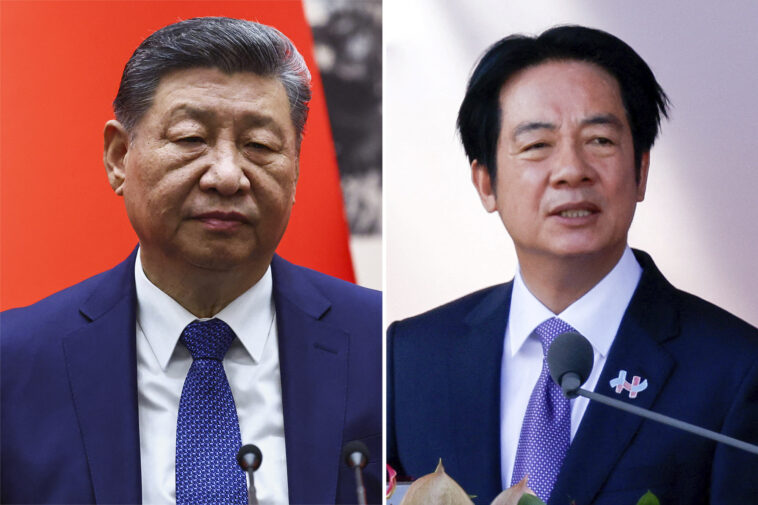
The US on Wednesday released its annual report on China’s military power — revealing that China will be prepared to invade Taiwan in a little more than a year as its fast-growing war machine poses an increasing threat to the United States and its allies.
The report, produced each year by the Pentagon, warns Beijing is gearing up for conflict — potentially over Taiwan — by 2027 as pressure on the self-ruled island continues to intensify.
Taiwan in the crosshairs
The 2025 report reveals the People’s Liberation Army is aligning its forces to give Chinese President Xi Jinping credible military options to make a “strategic decisive victory” in Taiwan by 2027, according to the report.
The year 2027 has long been flagged as when Beijing would have built up enough resources to launch its long-held goal of taking over the island nation by force.
Dubbed the “Davidson window,” then-Chief of the Indo-Pacific Command Adm. Phil Davidson first flagged that year as China’s ready-by date in March 2021.
“The PLA continues to refine multiple military options to force Taiwan unification by brute force,” the report said.
“Those options include, most dangerously, an amphibious invasion, firepower strike, and possibly a maritime blockade.”

US homeland ‘increasingly vulnerable’
China’s historic military buildup includes rapid expansion of nuclear forces, hypersonic weapons, long-range missiles, cyber warfare units and space capabilities — developments the Pentagon says now place the US homeland at growing risk.
“China’s historic military buildup has made the US homeland increasingly vulnerable,” the report said. “China’s top military strategy focuses squarely on overcoming the United States through a whole-of-nation mobilization effort that Beijing terms “national total war.”
Not only is the homeland under threat, but the US territory of Guam is under particular risk — as well as the Pentagon’s presence in the Western Pacific on military bases in Asia and naval ships sailing in the region.
“PLA strikes could potentially range up to 1500-2000 nautical miles from China,” the report said. “In sufficient volume, these strikes could seriously challenge and disrupt US presence in or around a conflict in the Asia-Pacific region.”

Pacific power grab
The report warns Beijing is pushing to dominate the Indo-Pacific’s First Island Chain, stretching from Japan through Southeast Asia, as part of a broader strategy to reshape the global balance of power.
That’s been another long-sought goal of Beijing’s, which sees the entire South China Sea west of the so-called nine-dash line of islands as its territorial waters.
Beijing considers the island chain, which runs from Japan’s southwestern-most islands to the Malay Peninsula, “the strategic center of gravity for its goals in the region,” the report said.
However, that doesn’t mean China intends to stop there. Their top goal, the report’s authors said, is to overthrow the US as a global superpower — and will continue to push its influence throughout the world.

“As Beijing continues to grow wealthier and more powerful, it is logical that its military power will also continue to grow towards a force capable of projecting power worldwide,” they wrote.
“This aligns with Beijing’s stated ambition to field a “worldclass” military by 2049, and the People’s Liberation Army has already made significant progress in this regard,” they added.
Cyber and space battlefields
Chinese cyber operations have targeted US infrastructure and military networks, while space systems are increasingly integrated into Beijing’s warfighting plans, the Pentagon said.
“In 2024, Chinese cyber-espionage campaigns such as Volt Typhoon burrowed into US critical infrastructure, demonstrating capabilities that could disrupt the US military in a conflict and harm American interests,” the report said.
Such operations have demonstrated that not only can the Chinese military’s cyber warriors carry out sophisticated attacks, but they can also do so without being detected in networks by using “advanced techniques,” according to the report.

China is likely to continue similar operations in the future — and is capable of building new cyber capabilities for future use in a war, “including for disrupting the US military’s ability to mobilize in conflict.”
“During the initial stages and throughout a conflict, China probably would seek to create disruptive and destructive effects — from denial-of-service attacks to physical disruptions of critical infrastructure — to shape decision making and disrupt military operations,” the report said.
Countering China
While Washington is concerned about Beijing’s aggressive ambitions and hostile actions, the Pentagon in its report said it does “not seek to strangle, dominate or humiliate China.”
“We seek only to deny the ability of any country in the Indo-Pacific to dominate us or our allies,” the report said.
“That means being so strong that aggression is not even considered, and that peace is therefore preferred and preserved.”

To do so, the Department of War intends to “prioritize bolstering deterrence in the Indo-Pacific through strength, not confrontation,” according to the report.
Despite the clear threat, “relations between the United States and China are stronger than they have been in many years” due to Trump’s leadership, the report assessed.
The DoW will aim to advance those ties, “in part by opening a wider range of military-to-military communications with the PLA” and focus on deconfliction and de-escalation in the process, according to the report.
Start your day with all you need to know
Morning Report delivers the latest news, videos, photos and more.
Thanks for signing up!
“President Trump seeks a stable peace, fair trade, and respectful relations with China, and the Department of War will ensure that he is able to achieve these objectives from a position of military strength,” the report said.
“In the process, we will forge and sustain a balance of power that will enable all of us to enjoy a decent peace in an Indo-Pacific — one in which trade flows openly and fairly, we can all prosper, and all nations’ interests are respected,” it added.