
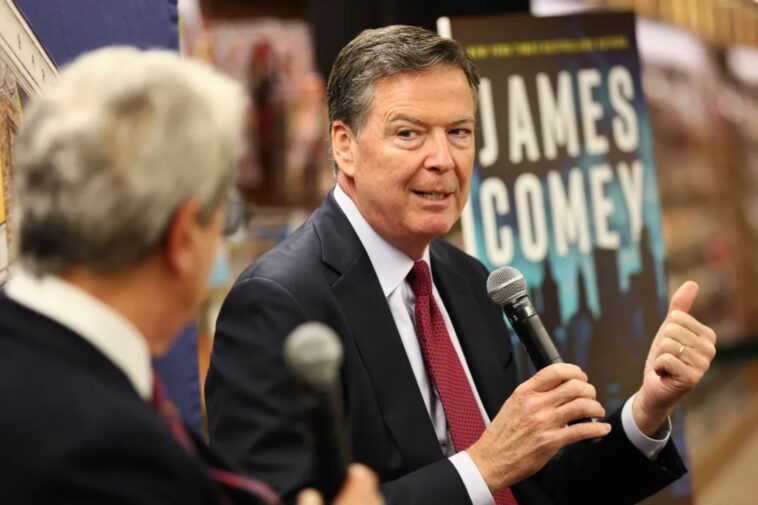
A federal judge ordered prosecutors Monday to turn over secret grand jury records in the case against former FBI Director James Comey to his legal team Monday, calling out “a disturbing pattern of profound investigative missteps, missteps that … potentially undermine the integrity of the grand jury proceeding.”
And one legal expert said the bombshell decision could spell disaster for the prosecution against Comey and potentially be a huge embarrassment for the whole Department of Justice.
In a 24-page ruling, US Magistrate Judge William Fitzpatrick accused the feds of flouting attorney-client privilege to secure an indictment of President Trump’s longtime nemesis, ripped interim US Attorney for the Eastern District of Virginia Lindsey Halligan for “fundamental misstatements of the law” to the panel, and flagged unexplained irregularities in the grand jury transcript.

Specifically, the judge laid out a timeline of the day the two-count indictment of Comey was handed up, noting that Halligan claimed to the court that she last had contact with the grand jury at 4:28 p.m., while the panelists were deliberating.
However, the grand jury rejected one additional count against the former top lawman, necessitating prosecutors to draw up a second indictment for Halligan to sign.
The interim US attorney’s declaration stated that she learned that one count had been rejected at 6:40 p.m. and the hearing on the return of the indictment began seven minutes later.
“The short time span between the moment the prosecutor learned that the grand jury rejected one count in the original indictment and the time the prosecutor appeared in court to return the second indictment could not have been sufficient to draft the second indictment, sign the second indictment, present it to the grand jury, provide legal instructions to the grand jury, and give them an opportunity to deliberate and render a decision on the new indictment,” Fitzpatrick said.
“If the prosecutor is mistaken about the time she received notification of the grand jury’s vote on the original indictment, and this procedure did take place, then the transcript and audio recording provided to the Court are incomplete,” he added. “If this procedure did not take place, then the Court is in uncharted legal territory in that the indictment returned in open court was not the same charging document presented to and deliberated upon by the grand jury … and provides another genuine issue the defense may raise to challenge the manner in which the government obtained the indictment.”

Fitzpatrick also took issue with investigators’ handling of four search warrants executed by the FBI in 2019 and 2020 as part of the bureau’s Arctic Haze probe into how classified information from the bureau was leaked to news outlets.
The warrants targeted Comey’s friend and lawyer Daniel Richman, a professor at Columbia Law School, and sought information from his iPhone, iPad, iCloud account and hard drive.
Fitzpatrick found that while the government allowed Columbia, Richman and his attorney to identify privileged content in what they found, they “never engaged Mr. Comey in this process even though it knew that Mr. Richman represented Mr. Comey as his attorney as of May 9, 2017, and three of the four Richman Warrants authorized the government to search Mr. Richman’s devices through May 30, 2017, 21 days after an attorney-client relationship had been formed.”
The judge also noted that while the FBI “was permitted to search all of the Richman materials” they could only seize evidence of theft of government property and retention of national security information, “both markedly different offenses than those with which Mr. Comey is currently charged.”
Comey, 64, was indicted Sept. 25 on charges of lying to Congress and obstruction of justice in connection with September 2020 testimony before the Senate Judiciary Committee.
Fitzpatrick said that while there is no evidence privileged communications between Comey and Richman were directly shared with the grand jury, “it is equally true that the materials seized from the Richman Warrants were the cornerstone of the government’s grand jury presentation.”

The judge noted that only one FBI agent appeared before the grand jury, despite having been given “a limited overview of privileged communications between” Comey and Richman.
“The government’s decision to allow an agent who was exposed to potentially privileged information to testify before a grand jury is highly irregular and a radical departure from past DOJ practice,” Fitzpatrick wrote.
“The government’s position that privileged materials were not directly shared with the grand jurors ignores the equally unacceptable prospect that privileged materials were used to shape the government’s presentation and therefore improperly inform the grand jurors’ deliberations,” he added elsewhere.
On top of that, the judge laid into Halligan for apparently suggesting to the grand jury that Comey not testifying in his defense should be interpreted as a sign of guilt. (Halligan’s actual comment was redacted from the judge’s order.)
Start your day with all you need to know
Morning Report delivers the latest news, videos, photos and more.
Thanks for signing up!
“The prosecutor’s statement ignores the foundational rule of law that if Mr. Comey exercised his right not to testify the jury could draw no negative inference from that decision,” Fitzpatrick wrote. “The prosecutor’s statement … may have reasonably set an expectation in the minds of the grand jurors that rather than the government bear the burden to prove Mr. Comey’s guilt beyond a reasonable doubt at trial, the burden shifts to Mr. Comey to explain away the government’s evidence.”
The second statement by Halligan, also redacted, “clearly suggested to the grand jury that they did not have to rely only on the record before them to determine probable cause but could be assured the government had more evidence–perhaps better evidence–that would be presented at trial.”
Fitzpatrick gave the feds until close of business Monday to hand over audio recordings of the grand jury proceedings to the defense as well as all grand jury materials filed under seal.

Halligan’s office later Monday filed an emergency motion asking for Fitzpatrick’s ruling to be put on hold, arguing he “may have misinterpreted some facts he found when issuing the latest order.”
A source in Halligan’s office said they will be appealing the ruling.
Former federal prosecutor Neama Rahmani said the ruling doesn’t bode well for the case against Comey and said if the indictment gets thrown out it would be “incredibly embarrassing” for Halligan and the entire Justice Department.
“There is a good chance this indictment is dismissed, where normally there is no chance an indictment is dismissed,” Rahmani said. “It’s a really big deal. If this indictment gets dismissed, it’s game over because the five-year statute of limitations will have run out and they can’t get another indictment.
“It would be a huge hit to her reputation. There would be egg on her face,” Rahmani said, pointing to Halligan’s lack of prosecution experience, adding: “It would be incredibly embarrassing for her and the entire Department of Justice if that were to happen.”
Comey and his attorneys are challenging the case against him on other grounds, including that Halligan was illegally appointed and that the prosecution itself is unlawfully vindictive.
The US Attorney’s office for the Eastern District of Virginia declined comment, as did an attorney for Comey. The DOJ did not immediately respond to a request for comment.