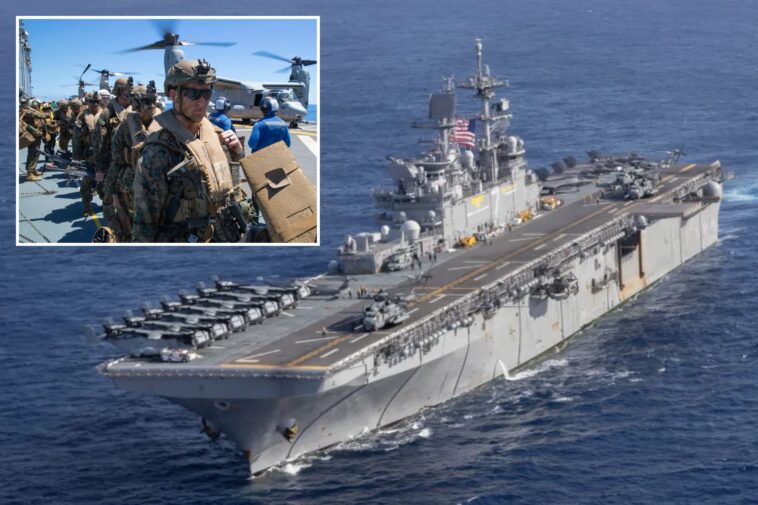
WASHINGTON — The Pentagon is deploying the USS Tripoli and up to 5,000 military service members to the Middle East after President Trump vowed Friday to unleash “unparalleled firepower” on the “deranged scumbags” leading Iran.
The deployment of the amphibious assault ship comes as the American military admits it’s currently unable to dislodge Iranian influence over the vital Strait of Hormuz as global oil prices spike.
The expected two-week voyage from East Asia matches Energy Secretary Chris Wright’s timeframe of “by the end of the month” for reopening the crucial waterway.

The repositioning of the Tripoli, which resembles an aircraft carrier but is smaller and operates closer to shore, was first reported by the Wall Street Journal.
The precise scale of the deployment is unclear.
The Journal reported that Secretary of War Pete Hegseth authorized the use of an “element of an amphibious ready group and attached Marine expeditionary unit, typically consisting of several warships and 5,000 Marines and sailors.”
Fox News chief national security correspondent Jennifer Griffin confirmed the deployment, but reported that approximately 2,500 Marines are part of the repositioning.

The Japan-based Tripoli was spotted sailing alone south of Taiwan on Thursday, US Naval Institute News reported — making it unclear if it will be joined by the USS San Diego and USS New Orleans, large ships known as amphibious transport docks that comprise the Tripoli Amphibious Ready Group.
Gen. Dan Caine, chairman of the joint chiefs of staff, acknowledged at a Friday morning press conference that the US military cannot currently escort commercial vessels through the Strait of Hormuz.
“It’s a tactically complex environment,” Caine said. “Before I think we want to take anything through there at scale, we want to make sure that we do the work pursuant to our current military objectives to do that safely and smartly.”

Similar naval deployments foreshadowed the opening salvo of the Iran war on Feb. 28.
The USS Abraham Lincoln aircraft carrier strike group arrived in the Arabian Sea south of Iran in late January, and the USS Gerald R. Ford departed the Greek island of Crete on Feb. 26, two days before the initial attack.
Trump’s prior military missions featured an element of surprise — including with deceptions about the likely timeframe last June before the president ordered an attack on three Iranian nuclear sites.

After Trump ordered the daring Jan. 3 US raid on Caracas to arrest socialist strongman Nicolas Maduro, he said that the armada offshore was a hint about what was coming.
In addition to reopening the Strait of Hormuz, through which about 20% of the world’s petroleum flows, officials reportedly studied seizing Iran’s Kharg Island, the loading site for about 90% of the Islamic Republic’s oil exports.
Start your day with all you need to know
Morning Report delivers the latest news, videos, photos and more.
Thanks for signing up!
Trump told Fox News Radio in an interview that aired Friday that Kharg Island is not currently a priority — but that his mind could change.
“It’s not high on the list, but it’s one of so many different things, and I can change my mind in seconds,” Trump said.
The Pentagon declined to confirm the Tripoli’s deployment.
“Due to operational security, we do not discuss future or hypothetical movements,” a military official told The Post.