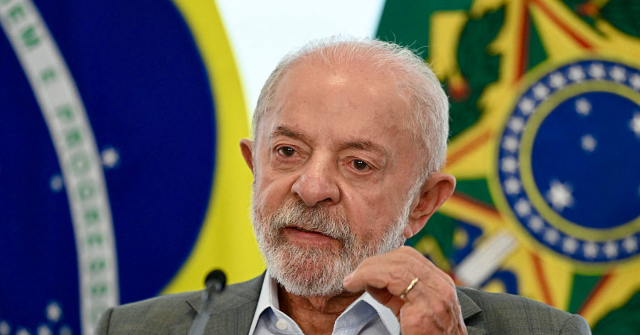
Socialist President of Brazil Luiz Inácio Lula da Silva on Monday claimed that he is carrying the “burden” of the “promiscuity” of the Supreme Federal Tribunal (STF) after coming in second place in the first round of the 2026 presidential elections.
The Brazilian president and leader of the ruling Workers’ Party (PT) made the comment during a PT event after meeting with members of his campaign team. The encounter followed Sunday’s elections, in which Lula came in second place against conservative Senator Flávio Bolsonaro, leading to an October 25 runoff vote between the two candidates. Lula has publicly affirmed that he believed he was going to win in the first round. Bolsonaro, however, defied all polling projections and overperformed against the incumbent socialist president in what is now being described as the best electoral performance by the Brazilian right wing in four decades.
The Brazilian candidate, speaking alongside Vice President Geraldo Alckmin, affirmed that he is the only “anti-system” candidate in the race (Lula has been president three times, for a total of 12 years in office). He also claimed to be carrying the “burden” of the scandal that has rocked the Brazilian Supreme Federal Tribunal (STF) over the past weeks.
“Because there’s only one anti-system candidate, and that’s us, there’s no other candidate. And we’re carrying a very serious burden on our shoulders, the promiscuity that has taken hold in the Brazilian Supreme Court following those allegations,” he said.
Although Lula did not mention any situation in particular, Lula’s remarks appear to attribute some degree of responsibility for his electoral performance on Sunday to the actions of the STF surrounding the “Banco Master” case, a broad investigation into corruption and financial fraud involving the eponymous São Paulo-based bank.
The case sparked a crisis on the Brazilian Supreme Court after one of its justices, André Mendonça, unsealed a police report in early September containing an analysis of alleged chat messages between Justice Alexandre de Moraes and Daniel Vorcaro, a Brazilian banker currently in police custody and one of the main individuals implicated in the Banco Master investigation.
The unsealing of the police report triggered a “civil war” between de Moraes and Mendonça, with de Moraes — a self-style “anti fake-news crusader” and arguably Brazil’s most powerful judge — accusing Mendonça of “abuse of authority” and demanding an investigation against him. The escalating judicial impasse also involved other members of the top court, ultimately prompting STF Chief Justice Edson Fachin to intervene and remove de Moraes from the “anti-fake news” inquiry that the controversial justice used for years to persecute and censor conservative voices in Brazil. Fachin also vowed that he would soon bring an end to the inquiry, originally launched in 2019 and continuously renewed over the past seven years.
According to Metrópoles, the Lula campaign has been concerned about how the STF controversy would affect the president’s electoral performance since as early as September. The Brazilian president reportedly said during the event that it is a serious matter when “you reach a point where the Supreme Court is viewed with suspicion by society.” As such, he emphasized, it is an issue that his campaign will have to “address” in the following days leading to the October 25 runoff.
“That’s why I’ve been saying that I was part of the first judicial reform. It’s important for activists to know that the first judicial reform in this country was carried out by me, Márcio Thomaz Bastos, and Justice Jobim, when he was Chief Justice of the Supreme Court,” Lula said during the event. “And it didn’t yield the results we wanted, because corporatism took over the councils. But we need to carry out another reform. And we need to define what society’s role is in this reform.”
“We need to define, in concrete terms, how we’re going to choose Supreme Court justices. Is it in the personal interest of the President of the Republic? Is it due to pressure from the National Congress? Is it in the interest of economic power?” he continued.
The Brazilian president stressed to his followers that it is necessary to reach out to the about 33.4 million voters that did not participate in Sunday’s election and “convince” them to vote. Sunday’s general elections saw a turnout of nearly 79 percent, with 122.2 out of 158.7 million registered voters participating according to Brazil’s Superior Electoral Court (TSE).
Per Jovem Pan, Lula, without directly mentioning Flávio Bolsonaro, claimed that it would be necessary to show the public “what lies behind the election of a potential heir to fascism.” He also reportedly expressed to be “disappointed” with Sunday’s results and said there is “no reason” for him to not be reelected in the runoff, but urged his allies to not pick “fights” with the electorate.
“May this loss serve as a lesson for the next election. You’re talking to someone who has lost four elections. No one has lost more than I have,” he said. “No one has made it to the runoff more times than I have. Nor has anyone won the presidency more times than I have.”
Jovem Pan pointed out that no candidate who finished the first round of a presidential in second place has managed to overturn the result and win in the runoff since Brazil returned to democracy in 1985.
Despite Lula’s “anti-system” claims, the Brazilian socialist president has run for president a total of seven times since Brazil’s returned to democracy. Lula unsuccessfully ran in 1989, 1994, and 1998 before becoming elected president in 2002, 2006, and 2022. He is currently running for a seventh time, seeking to become reelected for a fourth term in the upcoming race against Sen. Bolsonaro.
Prior to running for president, Lula also unsuccessfully ran as governor of São Paulo in 1982 before becoming elected as congressman in 1986.