
NEWYou can now listen to Fox News articles!
For years, Europeans have asked a version of the same question: Will the United States remain committed to NATO? Sharp rhetoric about allies and their willingness to more equitably share the burden of defense spending has raised doubts about the future of the transatlantic relationship itself.
Yet the latest Reagan Institute Summer Survey suggests that reports of NATO’s demise in American politics are greatly exaggerated. This nationwide U.S. public opinion poll, conducted in the weeks leading up to the 2026 NATO Summit in Ankara, reveals a broad and resilient base of support for the alliance among the American people — including many who are often assumed to be skeptical of U.S. engagement abroad.
This headline finding should reassure allies across Europe: 73% of Americans believe that keeping the United States in NATO matters to America’s security and prosperity. That includes a majority of both Democrats and Republicans. It also includes 61% of self-identified MAGA Republicans, a constituency frequently portrayed as opposed to America’s traditional alliances.
MOST TRUMP SUPPORTERS STILL BACK NATO DESPITE YEARS OF TRUMP’S CRITICISM, NEW POLL FINDS
NATO’s collective defense principle is also popular, as 72% of Americans say they would support the United States responding with military force if a NATO ally was attacked. Among MAGA Republicans, 69% support this core Article 5 commitment.
These numbers tell an important story. Americans understand that NATO is not charity or a favor the United States does for Europe. It is a strategic alliance that advances American interests by deterring adversaries, protecting security and ensuring that the United States does not face global threats alone.
At the same time, the survey also highlights a reality that European leaders should not ignore: support for NATO is not uniform across the American political landscape. Overall, 55% of Americans oppose withdrawing the United States from the alliance. But among MAGA Republicans, 63% support U.S. withdrawal from NATO.
TRUMP CALLS OUT NATO AHEAD OF SUMMIT, CALLING IT ‘RIDICULOUS’ FOR US TO PERSIST ON ‘ONE SIDED PATH’
These findings point to a paradox in the message Americans are sending to European allies. Many Americans who are skeptical of NATO nevertheless support the practical outcomes the alliance delivers. They view NATO as important to U.S. security. They support defending allies under attack. But at the same time, they have real questions about the institution itself and continued U.S. participation.
What does that tell us about the future of America’s commitment to NATO? Perhaps continued U.S. support for the alliance will depend less on abstract arguments about transatlantic solidarity and more on tangible evidence that the alliance is prepared to meet today’s challenges, adapt to evolving security threats and spend more on defense.
American policymakers from both parties have long argued that European allies should assume a greater share of responsibility for transatlantic security and increase their own domestic defense spending. Russia’s full-scale invasion of Ukraine accelerated that process, prompting significant investments in defense — especially in Eastern Europe.
But now, the alliance has entered a new phase. Every NATO ally is meeting the Wales Summit guideline of spending 2% of GDP on defense. And the historic goal of 5% of GDP from last summer’s NATO Summit in The Hague reflects a recognition that the security environment has fundamentally changed. The alliance requires investments in military readiness, modernized capabilities and industrial capacity.
The significance of this commitment extends beyond defense planning. It has become a political test of NATO’s credibility in the United States.
Many Americans, particularly those who are skeptical about the value of U.S. alliances, are not judging NATO by its founding principles, summit declarations or strategic concepts. They are judging it by performance. The question moving forward will be: Are America’s allies making meaningful investments in their own defense so our alliance is prepared to meet evolving security challenges together?
The NATO Summit in Ankara is the latest testing ground for this question. And allies have demonstrated measurable progress toward the commitments they made in The Hague in 2025. Total defense and security spending has already reached around 4% of GDP, just a year later. There are early indicators that real increases in spending will accelerate procurement and force modernization, strengthen defense industrial production, and deliver the capabilities required to deter aggression.
CLICK HERE FOR MORE FOX NEWS OPINION
No one in Europe should view this as a concession to American political pressure; rather, it is an investment in the long-term health of the alliance itself. Defense investment, modernization and industrial base growth will directly benefit the security and economies of European countries, not just the United States.
And on the U.S. side, the Trump administration National Security Strategy‘s focus on “[e]nabling Europe to stand on its own feet… including by taking primary responsibility for its own defense” should not be viewed as the United States walking away from NATO; rather, it is an opportunity for European partners to play their appropriate role.
CLICK HERE TO DOWNLOAD THE FOX NEWS APP
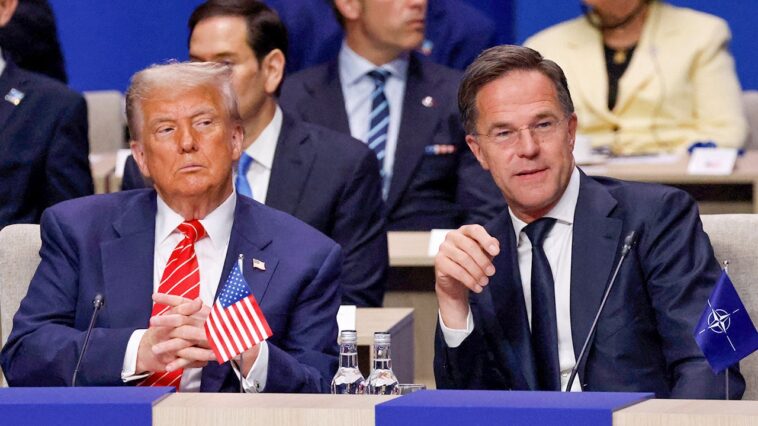
As Secretary-General Mark Rutte put it when he spoke at the Reagan Institute in Washington earlier this year, “This is a move from unhealthy co-dependence to a transatlantic alliance grounded in true partnership.”
The strongest argument for keeping America in NATO is not rhetoric — it is results. If European allies continue to strengthen their defense capabilities and make tangible progress toward the transatlantic burden shift, they will reinforce the case that NATO remains indispensable to American security and prosperity. And in an era of political uncertainty on both sides of the Atlantic, that may be the most important investment the alliance can make.
Rachel Hoff is Policy Director at the Ronald Reagan Institute.