
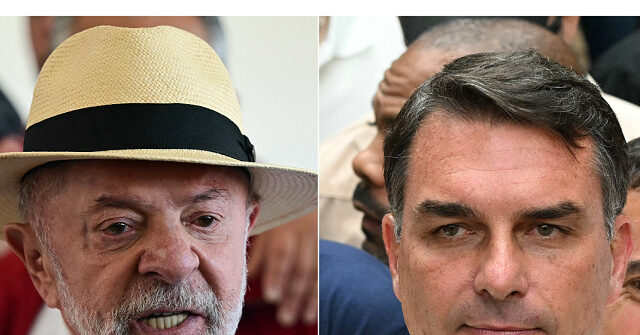
Conservative Sen. Flavio Bolsonaro won Sunday night’s presidential election in Brazil, defeating incumbent socialist President Luiz Inácio Lula da Silva – but did not pass the 50 percent threshold necessary to win the presidency outright, triggering a runoff election.
Brazilians took to the polls on Sunday for general elections for the presidency, local state leadership positions, and seats in the Brazilian Congress. Bolsonaro and Lula were among 13 candidates competing for the chief executive position, though polling prior to the election did not indicate that any of the other candidates were attracting any meaningful levels of support to vie for first place.
At press time, Brazil’s electoral officials have counted 99.57 percent of the vote. Bolsonaro is in the lead with 47.12 percent support, or nearly 56 million votes, while President Lula obtained 45.05 percent of the vote, or about 53.5 million votes. The third-place candidate, self-help author Augusto Cury, obtained only 2.89 percent of the vote, or about 3.4 million votes.
The map shows a near-even split north-south in the country. Lula’s socialist Workers’ Party (PT) campaign won most of Brazil’s northern states, except for Roraima, which borders Venezuela and has taken in a high number of Venezuelan refugees fleeing socialism. Bolsonaro and his Liberal Party (PL), meanwhile, won the states of Rio de Janeiro and Sao Paulo as well as the south of the country.
In Brazil, for a candidate to be elected president in the first round, he or she must obtain over 50 percent of the vote. Sen. Bolsonaro did, on occasion, appear to be over the 50 percent threshold as the votes rolled in, but his lead over Lula dwindled as votes from the leftist strongholds in the nation’s northeast rolled in. The winner of the runoff election is the candidate who receives the highest number of votes, regardless of how many.
Brazilians will return to the polls for the runoff election on October 25.
Lula, 80, is running for a fourth term as president of Brazil, an especially notable feat given that he was convicted of misappropriating government funds while president following his second term and banned from running for office. He attempted to run for president from prison in 2018 but failed to make it to the ballot. The Brazilian top court, the Supreme Federal Tribunal (STF), overturned the ban on public office and allowed him to run in 2022 against then-incumbent Jair Bolsonaro, narrowly defeating him.
Sen. Bolsonaro announced his presidential run after the same STF, which allowed Lula to run again, imprisoned his father and banned him from public office. The younger Bolsonaro ran a campaign condemning Lula’s radical leftist policies and championing conservative economic and social positions.
Sen. Bolsonaro appears to have outperformed polls. The final round of polls published the week before the election showed Lula and Bolsonaro extremely close in support, often within the polls’ margin of error. Many of these polls showed a slight lead for Lula; however, not the other way around.
The two frontrunners arrived at the top of the polls following an arduous and typically chaotic presidential campaign season in Brazil that arguably began in late 2025, when Brazil’s top court sentenced Lula’s expected rival, former President Bolsonaro, to 27 years in prison on dubious “crimes against democracy” charges and banned him from running for public office for 35 years, or until he is 105 years old. The Bolsonaro family, with several members already in politics, mobilized rapidly to shift away from the original plan of patriarch Jair running against Lula. Sen. Flavio Bolsonaro announced in late December 2025 that he would challenge Lula, cementing support from potential rivals such as Sao Paulo Gov. Tarcísio de Freitas. Tarcísio was reelected on Sunday.
Several other Bolsonaro family members, such as former first lady Michelle Bolsonaro and Flavio’s younger brother Renan Bolsonaro, also announced bids to run for Congress. At press time, Brazilian media is reporting that the former first lady, Renan, and fellow brother Carlos were all elected to either the Senate or Chamber of Deputies (the lower house), while Flavio’s mother (and Jair’s ex-wife) Rogéria Bolsonaro and Jair’s brother Renato Bolsonaro also ran for office, but their results are not yet complete.
During the last month of the election, both sides faced significant attacks. Lula, who was convicted of corrupt acts while serving his second term as president, was accused of supporting pedophilia after stating during an event to celebrate the opening of a prostate cancer center that “women learn to get touched from a young age, men don’t,” and this makes urology more challenging. Bolsonaro, meanwhile, was falsely accused of plotting to use state power to persecute the veneration of the Virgin Mary if elected. While Brazil is historically a Catholic nation, Flavio and Jair are Evangelical Christians, part of a faith that has experienced exponential growth in the country in the last decade.
The STF’s election offshoot, the Superior Electoral Tribunal (TSE), interfered significantly during the last week of the race. The TSE ordered the censorship of comments by conservative lawmaker Nikolas Ferreira condemning Lula’s comments on girls being “touched.” It also banned TV Globo, a mainstream news outlet that was scheduled to host the final presidential debate, from showing an empty podium to represent Lula after the president refused to participate. The meddling resulted in the cancelation of the debate. Globo blamed “judicial interference” for the cancelation.