
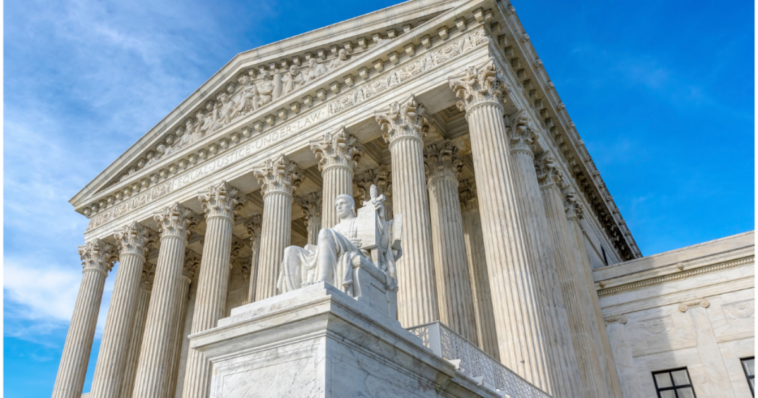
The US Supreme Court on Tuesday voted to allow states to ban transgender biological males from girls’ sports in a massive win for red states.
The court ruled in a 6-3 opinion that West Virginia and Idaho’s laws banning biological males from girls’ sports did not violate the Constitution’s equal protection clause or Title IX. Two biological male athletes, represented by the American Civil Liberties Union (ACLU) and Cooley Legal, sued the states to allow them to compete with girls.
“Title IX transformed American sports and American life. Enacted in 1972, that landmark law promoted equal opportunity for female student-athletes and has facilitated the extraordinary growth of women’s and girls’ sports over the past 54 years,” Justice Brett Kavanaugh wrote in the Majority opinion.
“To provide equal opportunity for female athletes, schools do not merely maintain, for example, one soccer team, one basketball team, one ice hockey team, and one lacrosse team that are equally open to female and male athletes. That approach would deny equal opportunity to female athletes because, as all agree, females and males have inherent physical differences relevant to athletic performance.”
Justice Clarence Thomas slammed the mental illness of “gender dysphoria” in a concurring opinion.
“Because ‘gender dysphoria’ is a mutable mental state that is the object of psychiatric treatment, it does not resemble the immutable characteristics on the basis of which our precedents have applied heightened scrutiny— race, sex, or national origin. Instead, gender dysphoria resembles other characteristics on the basis of which legislatures may classify with a merely rational basis,” Thomas wrote. “Second, as the Court recognizes, this case concerns ‘biological men’ and ‘boys who identify as girls.’ Ante, at 10, 27. Men and boys with gender dysphoria are not women or girls, even if they believe that they are.”
“Sex is an immutable ‘biological’ characteristic, see ante, at 10; it is binary; and ‘man’ and ‘woman, boy’ and ‘girl,’ are the terms that correspond to adults and children of each sex,” he continues. “To use language to obscure reality—to show ‘indifference regarding the truth’— is to lie to the public and cease to treat our fellow citizens ‘as equal[s].’”
Justice Kentanji Brown Jackson and Justice Sonya Sotomayor wrote dissenting opinions. Jackson, the Biden appointee who famously couldn’t define what a woman is, argued in her opinion that the court was wrong to hold that “Title IX protects against discrimination solely on the basis of ‘biological sex,’” and that it “should have assumed as much while leaving open the possibility that Title IX’s definition of ‘sex’ is more capacious.”
She further argues that when an a male athlete changes his sex assigned at birth, his “ability to play girls’ sports changes too,” and it is a type of “sex discrimination” to prevent him from playing in girls’ sports.
The ruling is expected to impact up to 27 states with similar laws on the books.
More from CBS:
In two of the most closely watched cases of its term, the Supreme Court upheld laws from West Virginia and Idaho that restrict transgender athletes’ participation in school sports. The cases are known as West Virginia v. B.P.J. and Little v. Hecox.
Justice Brett Kavanaugh authored the opinion for the majority, writing that under Title IX and the Equal Protection Clause, schools can base eligibility for women and girls’ sports teams on biological sex.
“Consistent with Title IX and the Equal Protection Clause, we hold that the States may maintain women’s and girls’ sports for biological females. They may determine eligibility for women’s and girls’ sports based on biological sex,” Kavanaugh wrote. “The Constitution and Title IX do not require an overhaul of women’s and girls’ sports throughout America.”
The ruling protects similar laws in 27 states that have been enacted in recent years in response to high-profile instances of transgender athletes competing in girls’ and women’s sporting events. President Trump signed an executive order last year that prohibits educational programs that receive federal dollars from allowing transgender girls and women to play on the teams that align with their gender identity.
Ad block users: Some site features may not work correctly while an ad blocker is enabled, because they break scripts and content this website depends on. If you can’t see comments below, for example, please disable your ad blocker.