The UAE Swaps OPEC for the Free World
The United Arab Emirates announced this week that it would leave OPEC and OPEC+, effective May 1. It’s the hardest blow the cartel has ever absorbed. The UAE has been part of the cartel since 1967 and is OPEC’s third-biggest producer, one of only two members with meaningful spare capacity, and its departure removes 13 percent of the organization’s production capacity. No top-tier producer has ever walked out before.
Many Americans might have missed the significance of the UAE exit because it hardly registered in financial markets. Brent crude barely flinched, which is understandable because the Strait of Hormuz disruption is so dominant right now that OPEC governance is a secondary story for oil traders. But for the longer-term architecture of global energy and finance, this may be the most consequential move so far this the year.
The immediate implications are clear enough. The UAE has 4.8 million barrels a day of production capacity but was capped at roughly 3.4 million under OPEC quotas. It is among the world’s lowest-cost producers. It can bypass the Hormuz blockade through overland pipelines. Free from the cartel, it will have both the incentive and the ability to ramp up output, which is good news for anyone who wants lower oil prices, including the Trump administration.
Gulf OPEC delegates have warned that the exit could spur more defections, as several members have long chafed at Saudi dominance. If the UAE can leave and pump freely, the incentive for staying inside the cartel and deferring to Riyadh erodes fast.
Restructuring the Global Trading System
Perhaps more importantly, the OPEC exit did not happen in a vacuum. Consider the sequence of the past ten days.
Around April 18 and 19, UAE central bank governor Khaled Mohamed Balama met with Treasury Secretary Scott Bessent and Federal Reserve officials on the sidelines of the IMF and World Bank meetings in Washington, the Wall Street Journal reported at the time. He raised the possibility of a dollar swap line. On April 21, President Trump said on CNBC that he would like to help the UAE if he could. On April 22, Bessent told the Senate that “many” Gulf and Asian allies had requested swap lines, describing them as tools “to maintain order in the dollar funding markets and to prevent the sale of U.S. assets in a disorderly way.” On April 24, Bessent posted on X that “extending permanent swap lines can be a major first step in creating new U.S. dollar funding centers in the Gulf and Asia.”
A dollar swap line is an arrangement in which the Federal Reserve or the Treasury exchanges dollars for a foreign currency with another country’s central bank, with an agreement to reverse the transaction at a later date. It is not a loan or a credit line. It provides immediate dollar liquidity without forcing the recipient to sell off dollar assets like Treasury securities or equities in a way that could destabilize markets. The Fed maintains standing swap lines with a handful of close allies including the European Central Bank, the Bank of Japan, and the Bank of England. Extending one to a Gulf state like the UAE would be a significant expansion of that circle.
Then on April 28, the UAE quit OPEC.
We should be cautious about assuming these moves were negotiated as an explicit package. But the strategic logic connecting them is hard to ignore, especially when you read them against the intellectual framework the administration’s own economic architects have laid out.
The Blueprint and the Builder
Stephen Miran, who served as chairman of the Council of Economic Advisers before moving to the Federal Reserve Board of Governors, published a paper in November 2024 describing how the United States could restructure the global trading and financial systems. A central argument was that America should explicitly link trade policy to security policy. Countries inside the American defense and economic umbrella would receive favorable terms—including liquidity facilities—while those outside would face tariffs or exclusion.
Critically, Miran identified swap lines as the key institutional incentive. “The desire to maintain access to such swap lines,” he wrote, “will be a powerful long-term incentive for remaining inside the U.S. security and economic umbrella.” He also noted that most foreign exchange reserves now sit in Middle Eastern and Asian hands and that a “different kind of diplomacy” would be needed to engage those partners.
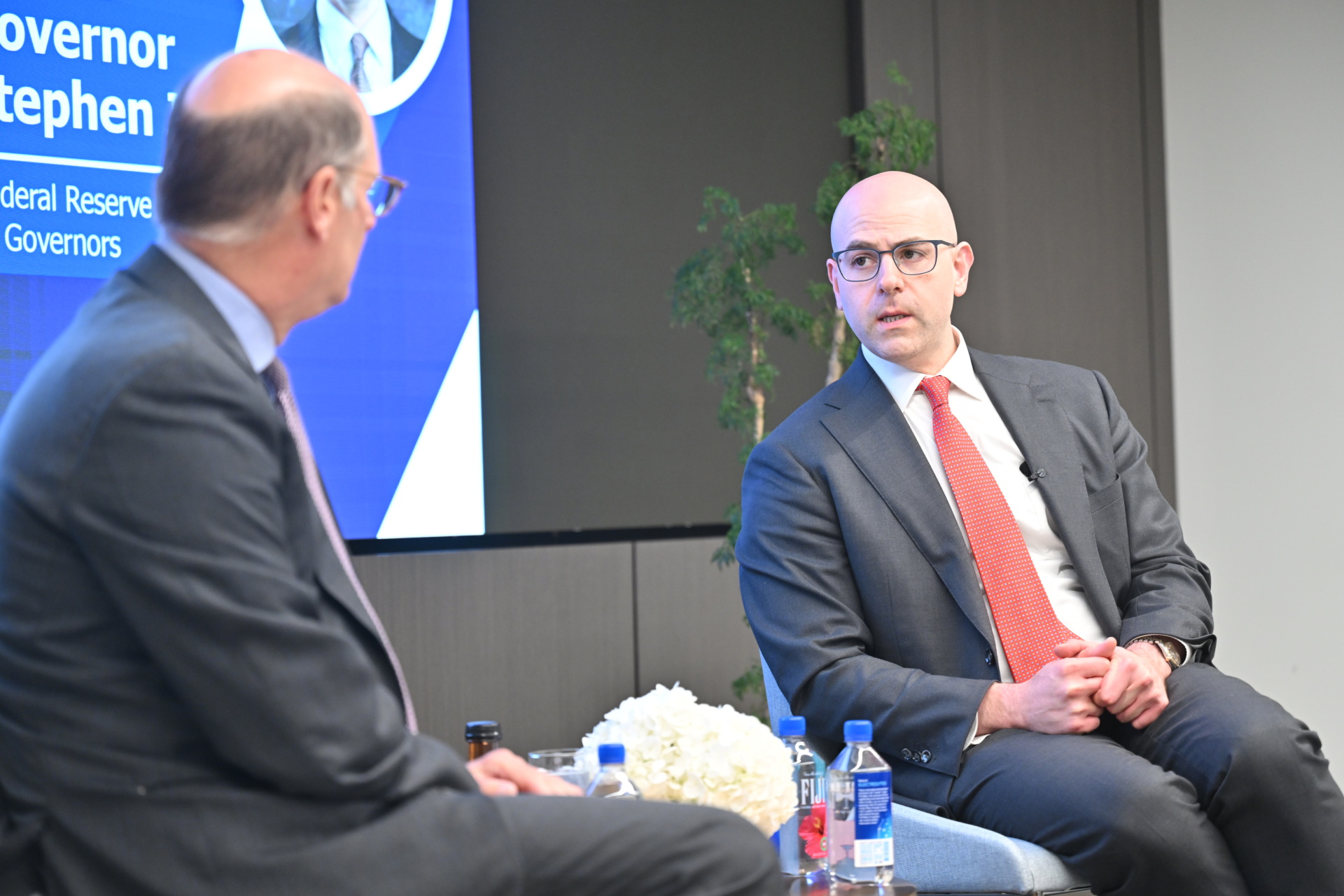
Federal Reserve Governor Miran delivered a speech on the regulatory dominance of the Federal Reserve’s balance sheet at Bank Policy Institute on November 19, 2025. (Federal Reserve via Flickr)
In recent months, Bessent has appeared to be building an actual global economic infrastructure that resembles the plan Miran sketched. The old petrodollar compact was implicit and multilateral. Gulf states priced oil in dollars, recycled surpluses into Treasuries, and the American security umbrella was assumed. The new arrangement taking shape is explicit and bilateral. The UAE gets a dollar backstop that anchors its financial system and signals top-tier partnership with Washington. What the United States appears to get in return is a major producer unshackled from the cartel, committed to expanded output, and firmly inside the American financial and security architecture.
Nearly every analyst who has examined the swap line discussions agrees the UAE does not actually need the money. It has roughly $300 billion in foreign exchange reserves and more than $2 trillion in sovereign wealth assets. The UAE’s ambassador to Washington pushed back hard against any suggestion of financial distress. The swap line is not a bailout. It is a commitment device — the financial architecture that formalizes the relationship. As David Beckworth and Izabella Kaminska explained in a video posted Tuesday, these facilities do not need to be heavily used to matter. Their mere existence reassures markets, much the way deposit insurance stabilizes banking systems.
That is why Bessent’s “dollar funding centers” language matters so much. He is not describing emergency plumbing. He is describing a new system — one where bilateral swap facilities replace multilateral institutions as the primary scaffolding for global dollar liquidity. Each facility is a negotiation where Washington can set terms. Each partner that signs on reinforces dollar dominance and weakens the case for alternatives.
If this is the template, the question is who comes next. Bessent has said “many” allies are asking. Each conversation is an opportunity to extend the architecture Miran described — security and trade intertwined, with the dollar swap line as the price of admission and the proof of commitment.
The UAE did not just leave OPEC on Monday. It may have given us a glimpse at the road map for the future of global trade and security.