Reshoring America and Bringing Mickey Mouse Down to Earth
Welcome back to Friday. This is the Breitbart Business Digest weekly wrap, where we expand our productive capacity to wade once more through the news of the past seven days.
This week saw Jerome Powell give up his crown cling to his chairmanship for at least a few more days and insist that even after that he will still lurk in the cloakroom. Fittingly, inflation returned drunk and ugly to the party, just to remind us what Powell wrought. The American manufacturing sector, however, is booming—and not just because everything is so artificial and intelligent. Also, Mickey Mouse flew too close to the sun.
We Make a Big Production Out of the Manufacturing Boom
This should go down as the month the American manufacturing boom completed the journey from thesis to observable fact.
Core capital goods orders hit a record high in March data reported earlier this month. The industrial production figures released Friday blew away expectations. The producer price index gave us evidence of intense demand for American-made technology, particularly around anything adjacent to artificial intelligence.
This is quite different from earlier jumps in technology. The smartphone and tablet boom, for example, changed how Americans consumed technology. The AI boom is changing how America manufactures it.
During the tablet surge, Americans bought millions of sleek new devices, but much of the manufacturing expansion happened overseas. The demand was here. The factory growth was elsewhere. The last real comparison may be the 1990s tech boom, when computer manufacturing expanded rapidly in the United States. That boom came before China entered the World Trade Organization and before the full offshoring model became the default setting for consumer electronics.
The AI boom is different. It is not just a consumer-device cycle, although consumers are increasingly signing on to AI services. It is a physical-infrastructure cycle: servers, chips, communications gear, electrical equipment, cooling systems, fabricated metals, and power infrastructure. And much of the building is being done here in the United States.
The April industrial production data make it clear. Output of computer and electronic products rose sharply. Computer and peripheral equipment jumped. Semiconductors and other electronic components climbed. Information-processing business equipment rose even faster. Capacity is expanding too, meaning this is not just existing factories running harder. The industrial base itself is growing.
There are reasons this cycle is landing differently. Tariffs make foreign sourcing less attractive. A renewed spirit of economic nationalism has made domestic production fashionable again. Suspicion of China has made companies more sensitive to supply-chain security, intellectual property theft, and geopolitical risk. And AI safety concerns make the location and control of hardware, data centers, and critical infrastructure far more important than they were in the tablet era.
The last consumer-tech wave made Americans better customers for foreign factories. The AI boom is making America build again.
A Supply-Side Revolution
The data make it clear that this is the new supply-side moment. The AI boom is not just lifting demand for chips, servers, communications gear, and electrical equipment. It is expanding the nation’s capacity to produce them.
Over the past six months, capacity in computers, communications equipment, and semiconductors has grown at roughly a 15 percent annualized pace. Output of information processing equipment is up at a nearly eight percent annualized pace. That is what an investment boom looks like when it begins to alter the productive structure of the economy.
This is not just a high-tech capacity expansion. Total manufacturing capacity over the last six months has expanded at an annualized rate of 1.14 percent. Last year, manufacturing capacity expanded 1.24 percent, the biggest expansion since 2012. If we do a rough back-of-the-envelope calculation to back out auto manufacturing, the rest of manufacturing expanded roughly 1.4 percent last year, the biggest growth year since 2007.
Supporting this capacity expansion are a bunch of traditional supply-side policies and a couple of new ones. The traditional factors came from the One Big Beautiful Bill’s tax cuts, especially the ability to expense capital expenditures, and the administration’s deregulatory program. Trump added to the mix a policy of energy abundance and new tariffs. The result is a revival of growth in America’s productive capacity.
Inflation Came in Hot
While this week’s inflation reports came in hotter than expected and the breadth of inflation expanded beyond fuel, we still think the greater economic risk from high energy prices is deflationary and contractionary. A general rise in the price level is typically impossible to sustain without income growth or a previously high saving rate coming down. That usually means an expansion of credit, fueling an expansion of the money supply. Absent that, higher prices in one sector tend to drain demand in others.
Why was April different? There were a few factors that let inflation leak out of the gas pump. One was the fiscal impulse from the Trump tax cuts hitting refund checks. Another was the three rate cuts of last year. Combined with the cost pressures from higher gasoline prices, these created a strong inflationary flash in April. But now that the Fed appears to be on hold until next year and the immediate stimulus from the refunds is fading, inflation is likely to be pulled back toward fuel.
You can already see signs that higher energy prices may be a drag elsewhere. In April, furniture sales fell by two percent, and clothing store sales fell 1.5 percent. Department store sales dropped 3.2 percent. These aren’t shops that are going to be passing through fuel costs, and the manufacturers who supply them—often foreign manufacturers—are going to feel the pinch.
Jerome Powell Just Lost His Parking Spot
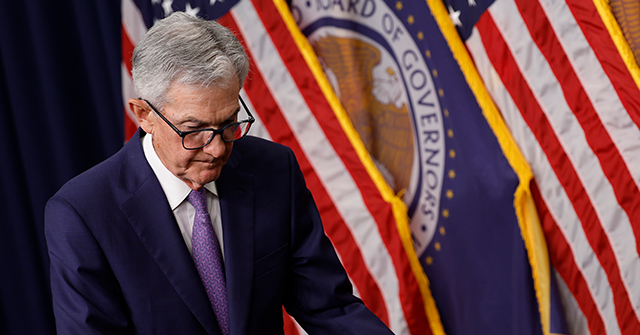
Friday was Jerome Powell’s last day as chairman of the Federal Reserve. His successor, Kevin Warsh, will be sworn in shortly after President Trump returns from China.
Powell’s decision to stay on as a governor, supposedly to defend the independence of the Fed, is a deep insult to Warsh. The implication is that Powell is indispensable and Warsh is a risk to Fed independence. Warsh should probably overlook the insult—for the most part. But it probably would not be too petty to move Powell’s parking spot to an inconvenient location, perhaps underneath a tree popular with the local avian residents.
UPDATE: We spoke too soon! Powell Is Still Clinging To The Chair!
At 5 P.M. on Friday, the Fed announced that its Board of Governors had appointed Powell as chair pro tempore while we await Warsh’s swearing in.
“As Chair Jerome H. Powell’s term as chair concludes, and with the swearing in of Kevin M. Warsh as his successor pending, the Federal Reserve Board on Friday named Powell as chair pro tempore. This temporary action to name the incumbent as chair pro tempore is consistent with past practice during similar transitions between chairs. Powell will serve as chair pro tempore until Warsh is sworn in as the new chair,” the Fed said in an official statement.
As we’ve pointed out many times, there’s no statutory authorization for the board to appoint an outgoing chair as chair pro tempore. The Federal Reserve Act says that if the chairman is absent, then the vice chair presides. If both are absent, the board can elect a member to serve as chair pro tempore. But vice chair Philip Jefferson is not “absent.” He voted for this action. So the board lacks any plausible authority to take this action.
What’s more, even if Jefferson were absent, the board probably lacks the authority to appoint its own head. The statute speaks of an “absent” chair, which should probably be understood as describing when a presidentially appointed and Senate-confirmed chair is temporarily unable to attend a meeting. It does not fit the situation of a chair made vacant by the expiration of a chair’s term before a new chair is sworn in.
When the Carter White House’s Office of Legal Counsel looked into this question in 1978, it concluded that there was no authority on the part of the board to appoint a temporary chairman. Instead, the authority falls to the president as part of his general duty to keep the government running.
This is also unprecedented. While the Fed board has appointed chairs pro tempore in the past, it did so with the explicit or implicit consent of the president. Typically, this has arisen when a president has re-appointed a sitting chairman but that chairman has not been confirmed. That happened between two of Alan Greenspan’s terms and between Jerome Powell’s two terms. In those situations, the board can be understood as acting under the president’s delegated authority to appoint his nominee as temporary chair. In two other cases—Marriner Eccles in 1948 and Arthur Burns in 1978—the temporary arrangement proceeded with explicit presidential involvement. Carter went even further, expressly designating Burns as acting chairman until his successor was designated or Burns’s resignation became effective.
Some have pointed to 1987, when Paul Volcker announced he was stepping down. President Reagan appeared with Volcker and his nominee, Greenspan, and told the public that he had accepted Volcker’s decision “with great reluctance and regret.” He noted that Volcker supported Greenspan. The Senate confirmed Greenspan on August 3, Volcker’s term as chair expired on August 6, and Greenspan took the oath on August 11. Volcker appears to have served as chair pro tempore during the short gap. But this was not the Board setting itself against the president or asserting an independent power to choose its own head. Reagan had already nominated Greenspan, Volcker had publicly supported the choice, and the arrangement was, at minimum, tacitly blessed by the White House as a bridge to Reagan’s confirmed successor.
Scott Alvarez, a former general counsel for the Fed, recently claimed that the law actually does provide for the Board to appoint a chair pro tempore. But his argument proves no such thing. He says the absence provision does not automatically elevate the vice chair in the case of a vacancy—a point we agree with—and that the Board can continue operating without a chair. Operating without a chair, the Board can delegate administrative tasks to members. Somehow—and exactly how is a mystery understood only to Alvarez—this becomes a power for the Fed to appoint its own temporary head.
Does this matter? On the one hand, the Fed probably is not going to do anything requiring action by the chair this weekend. So arguably, it’s just a formality. On the other hand, if it didn’t matter at all, why did the Fed bother? The appointment of Powell by the board without the implicit delegation of authority by the president sets a precedent that can be used in the future to defend the Fed board independently choosing its own head when no one has been confirmed or sworn in.
This is a very real risk. Earlier this year, there was a very real chance that a standoff between the Justice Department and Sen. Thom Tillis (R-N.C.) over an investigation into the Fed could have resulted in Powell’s term expiring before his successor was confirmed. The president’s authority to appoint the chair pro tempore acts as a check on the ability of Senators allied with a chair whose term is expiring from extending that term by stymying the confirmation of a successor.
The board’s appointment of Powell was not unanimous. Two governors—Steven Miran and Michelle Bowman—said they would support the temporary appointment of Powell only if the appointment was limited to a finite period of time, such as a week or a month. In a statement, they said that if that term expired and the new chair had not yet been sworn in, this should require a new vote by the board or “potential presidential action.” In other words, they leave open the possibility that the president—not the board—should ultimately control the temporary appointment of a chair.
“We support the temporary designation of Jay Powell as chair of the Board until Kevin Warsh can be sworn in to his term,” Miran and Bowman said. “However, as discussed with the Federal Reserve’s general counsel, we have a unique situation unlike any historical precedent. In this case, the prior chair’s term ends before the new chair, who has already been confirmed by the Senate, has been sworn in. Given that we have a confirmed nominee who will soon be sworn in, in our view, the election of a chair pro tempore should be limited to a finite time period of at least a week (but we would support a period up to a month to allow for possible delay). If the new chair is not sworn in during this timeframe, the temporary chair designation should be subject to renewal by another vote of the Board or potential presidential action. Given that we do not support an unlimited timeframe for temporary chair designation, we cannot support this action.”
Miran voted against the appointment and Bowman abstained.
Mickey Mouse Was a Silent Revenge Rat
Mickey and Minnie Mouse made their first appearance on May 15, 1928. And they bombed.
Walt Disney had earlier lost control of his previous creation, Oswald the Lucky Rabbit. Most of his staff had been poached away. On a long train ride from New York City back to his home in Los Angeles, Disney sketched a replacement varmint character, Mickey Mouse. His friend and co-worker Ub Iwerks produced 700 drawings a day for two weeks to create Plane Crazy, a silent animated six-minute film that was a zany tribute to Charles Lindbergh’s transatlantic flight the previous year.
This isn’t the jolly rodent kids encounter in Disney theme parks today. This Mickey was cockier, rougher, and far less charming. In Plane Crazy, he abducts Minnie onto his homemade plane and then subjects her to dizzying stunts as she refuses his romantic gestures. At one point, he forcibly kisses her—prompting Minnie to escape by parachuting from the plane using her bloomers. It’s the sort of thing you can imagine might come to a man seething with rage on a transcontinental train trip.
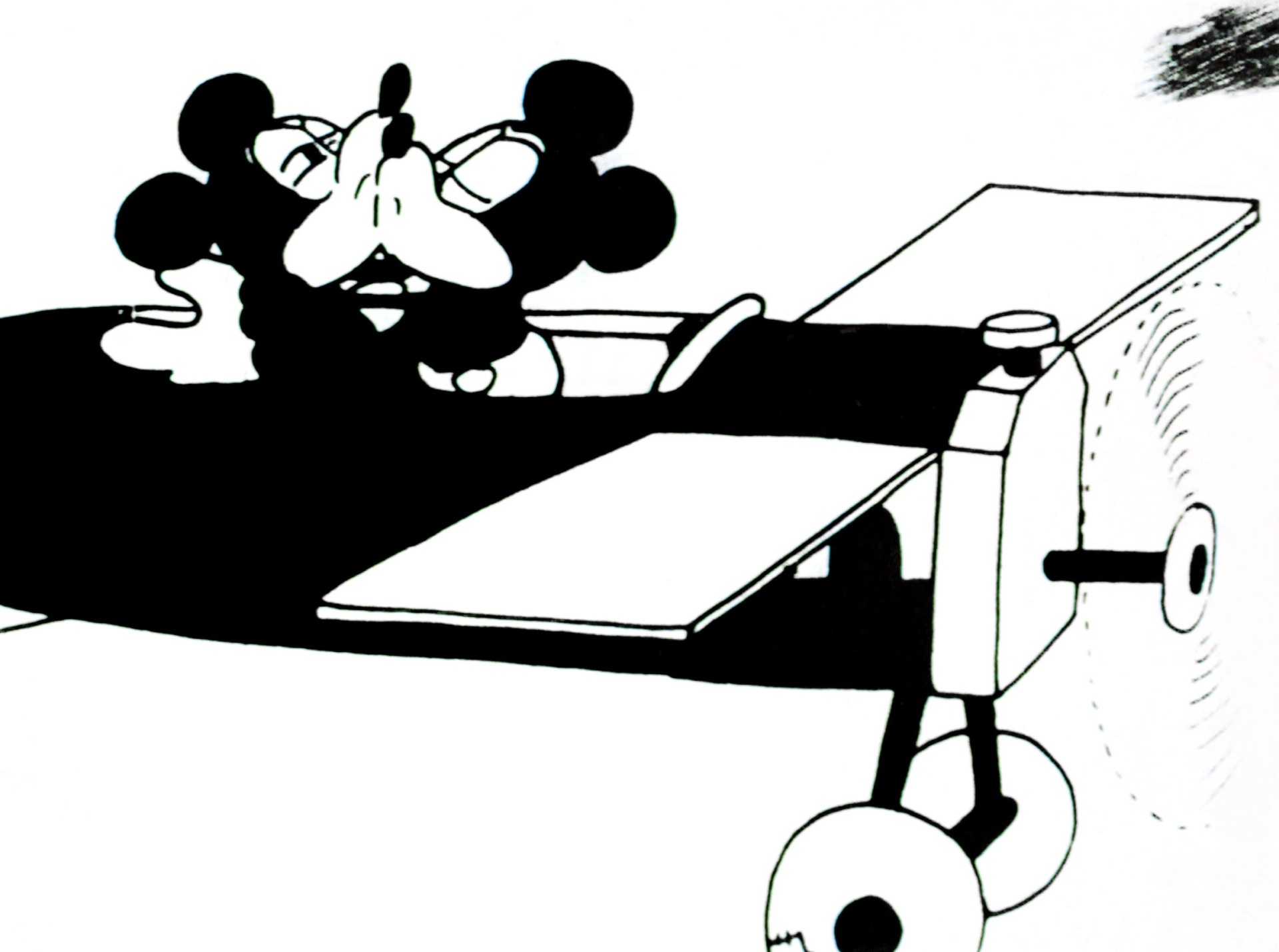
Mickey Mouse kissing Minnie Mouse in “Plane Crazy,” 1928. (LMPC via Getty Images)
Perhaps not surprisingly, Plane Crazy failed to win over distributors when it was screened. A big problem was that it was a silent film, and the business was already enthralled by synchronized sound films following the release of The Jazz Singer. Later that year, Disney released Steamboat Willie with synchronized sound. That became the first widely distributed Mickey Mouse film and is often mistakenly cited as Mickey’s debut. Based on the success of the steamboat film, Plane Crazy was released with sound the following year.
If there’s a broader lesson in all this, it’s probably that you should never give a silent mouse control of an airplane.