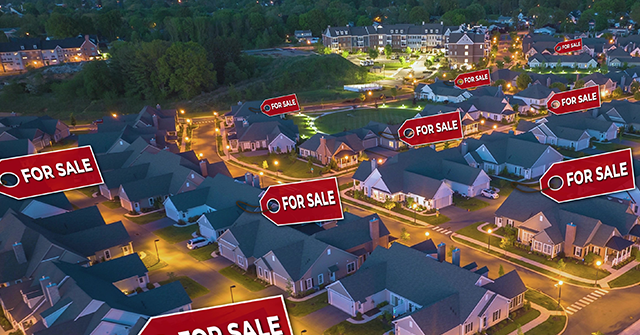
The Myth of the Housing Shortage
There are few ideas in American economic policy that enjoy more universal acceptance than the notion that the United States is suffering from a severe housing shortage. From the Brookings Institution to the Urban Institute, from Freddie Mac to Harvard’s Joint Center for Housing Studies, the experts are practically unanimous: America has failed to build enough homes.
The estimates vary, but the conclusion rarely does. Freddie Mac says we’re short 3.7 million homes. Brookings puts the deficit at 4.9 million. The National Association of Realtors has estimated a shortfall of 5.5 million.
The evidence can seem so straightforward as to be almost undeniable. We’ve seen soaring home prices and ever-escalating rents. Homebuilding has lagged behind historical averages and has been dropping recently. Politicians get elected promising to freeze rents or expand the housing supply. It’s one of the top complaints of many younger American workers: they cannot afford a home.
Many economists and politicians blame increasingly restrictive zoning laws that prevent developers from responding to higher prices by building more houses. They are actively scheming to cajole or bribe towns and cities all over America to upend zoning restrictions, especially restrictions on density.
This strength of this expert-class consensus and the plan to overturn existing local laws should raise red flags for any conservative. And, as it turns out, the housing shortage thesis is extremely myopic. The advocates of using government to increase the housing supply are generals fighting the last war.
The Coming Collapse in Housing Demand
The conventional housing-shortage narrative rests heavily on the experience of the past two decades. Yet the demographic outlook for the next two decades looks radically different.
The Census Bureau’s baseline projection anticipates that America’s population will peak at around 370 million in 2080 before gradually declining. But that projection assumes immigration will continue at relatively high levels.
Under the Census Bureau’s low-immigration scenario, the population peaks much sooner—at approximately 346 million in 2043 — and begins declining thereafter, falling to 319 million by 2100.
That scenario looks increasingly plausible given the popularity of immigration restrictions.
Indeed, the Congressional Budget Office’s latest demographic forecast, incorporating lower immigration and fertility assumptions, projects that population growth will reach zero by 2056, with annual deaths exceeding births beginning in 2030. That’s just thirty years from now.
More importantly, household formation—the actual source of demand for housing—is headed for a historic slowdown.
Harvard’s Joint Center for Housing Studies projects that America will add 8.6 million households between 2025 and 2035, followed by just 5.1 million between 2035 and 2045. That would be the slowest decade of household growth in at least a century.
But those are the baseline projections. Under Harvard’s low-immigration scenario, the country adds just 6.9 million households over the coming decade and only 3.2 million during the following decade.
That’s a mere 320,000 additional households annually by 2035–2045.
Meanwhile, the aging baby-boom generation will increasingly release existing homes onto the market as older Americans die or consolidate households. Harvard consequently projects that underlying demand for new housing construction will fall to approximately 1.1 million units annually over the next decade and just 800,000 during 2035–2045.
Under the low-immigration scenario, that falls to just 610,000 units annually.
Now consider the supposedly anemic pace of American homebuilding.
According to the Census Bureau, housing completions were running at a seasonally adjusted annual rate of 1.192 million in September.
In other words, construction is already running above Harvard’s baseline projection of underlying demand for the coming decade—and nearly twice its low-immigration projection for the following decade. If construction continued at today’s pace, the cumulative excess over projected underlying demand could theoretically eliminate Freddie Mac’s entire estimated shortage within a decade.
The War on Zoning
Yet housing advocates want sweeping changes to America’s communities, particularly the elimination of zoning restrictions that limit residential density. Their argument is that density restrictions artificially constrain supply, driving up prices.
But this overlooks why those restrictions exist. Americans pay substantial premiums to live in low-density neighborhoods with large lots, quiet streets, privacy, and predictable surroundings. Zoning helps preserve these valuable amenities.
Indeed, economic research finds that households have measurable preferences for lower residential density. Zoning also provides something particularly important when purchasing an expensive, long-lived asset: protection against uncertainty.
A family purchasing a home in a neighborhood with density restrictions pays for the reasonable expectation that the character of that neighborhood will remain relatively stable. Those protections are capitalized into property values. Eliminating them can destroy something homeowners have already paid for.
Housing economists often treat the premium associated with restrictive zoning as evidence of an economic distortion. But part of that premium represents genuine value that buyers willingly purchase.
In many ways, zoning restrictions are a rare example of localism and populism triumphing over special interests. The real estate agents, the home builders, and the mortgage lenders would love to see housing supply freed from restrictive zoning. The folks who don’t want it are the people who buy and own homes.
There is something deeply short-sighted about proposing potentially irreversible changes to established communities in response to a housing shortage that demographic trends suggest may already be fading.
Before we tear up zoning laws to accommodate millions of supposedly missing homes, perhaps we should ask whether those homes will actually be needed.
The greatest housing mistake of the next generation may turn out to be building too much, not too little.