
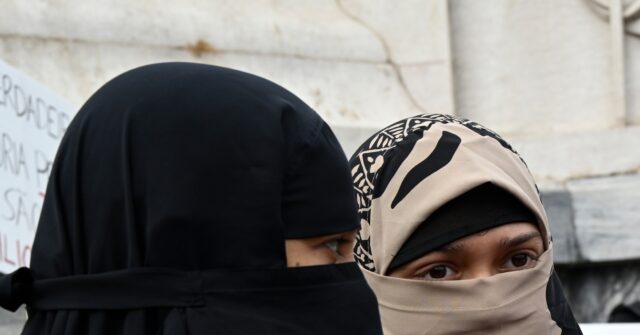
The centre-right government of Portugal has enacted legislation put forward by the populist Chega party to ban full-face covering veils in public in a bid to ensure that all women are afforded the rights of a modern Western society.
Portuguese President António José Seguro, a member of the Socialist Party (PS), gave the final sign-off on the “burqa law” to ban full-face coverings in public this week, despite his and all other leftist parties voting against the legislation.
The legislation was put forward by the Chega of André Ventura, who previously described the proliferation of hardline Islamic garb in Europe as a “cultural invasion that transforms women into objects, completely covered up, without any rights, as if they weren’t people.”
The anti-mass migration leader also stressed that it was not a matter of religious freedom, arguing that if it were the case, it would “open the door for the greatest atrocities against men, women, and children to be committed in the name of religion.”
The new law comes with a fine of 150 to 750 euros for negligently breaking the ban and 400 to 3,000 euros for those who intentionally violate the rule, Sic Noticias reported.
Following the bill’s passage into law, Ventura said it was a “big victory” for Chega, adding, “Those who choose Portugal to live in must respect our rules, our culture, and our values.”
The legislation drew support from centre and right-wing parties, including the populist Chgea party, Iniciativa Liberal, the conservative People’s Party, and the government-leading centre-right Social Democratic Party. All left-wing parties voted against the measure last month.
However, leftist President Seguro, who serves as the largely ceremonial head of state in Lisbon, decided to put his stamp of approval on the law, proclaiming that the face is “considered central to human identity and communication, as a minimum element of mutual recognition between fellow citizens.”
“And to admit that women, and only women, have to hide their entire faces implies an asymmetry incompatible with the values of parity and equal dignity between men and women, values that shape European democracies,” he said.
Seguro also argued that the uncovered face was an essential building block of social trust in Portuguese society, saying that “daily coexistence is based on mutual recognition and the possibility of establishing a direct relationship between people.”
“This common rule is indispensable to life in a democratic, free and plural society. It is a rule of coexistence between human beings with equal dignity.”
France was the first European nation to ban full-face veils in public in 2011, and others, including Austria, Belgium, Denmark, and the Netherlands, have since followed suit.
Legislation to ban the burqa was also put forward by Italian Prime Minister Giorgia Meloni’s Brothers of Italy party last year and is currently being considered by the parliament in Rome. In addition to banning full face coverings, Meloni’s bill to confront “Islamic separatism” would also enact restrictions on arranged marriages, child marriages, virginity tests, foreign funding of mosques, and Islamist hate preaching.