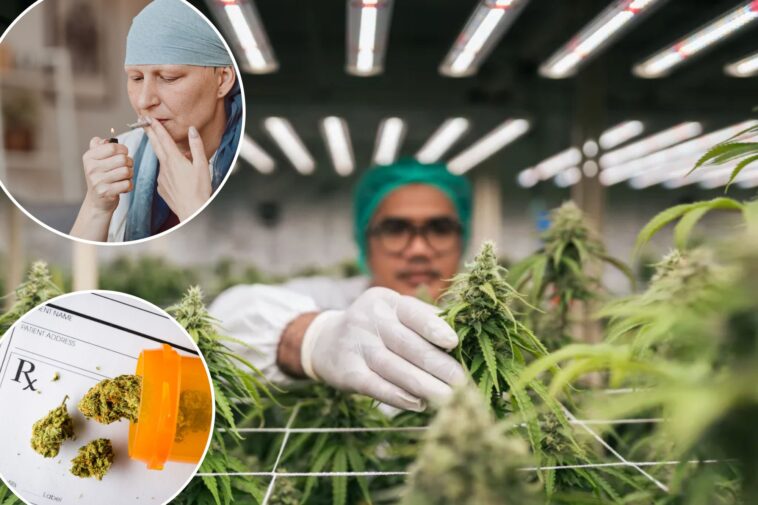
What a long, strange trip it’s been.
Thirty years ago, California made history as the first state to legalize medical marijuana, blazing a trail that now stretches across almost the entire country.
But today’s cannabis isn’t your grandfather’s grass. Step into a dispensary, and you’ll find products vastly different from those available in the ’60s, the ’70s — even three decades ago.
“There’s a lot more nuance because of the emergence of a legal retail market,” Dr. Ryan Vandrey, a professor at Johns Hopkins University’s Behavioral Pharmacology Research Unit, who helps run the school’s Cannabis Science Lab, told The Post.
“In 1996, the only industry around cannabis was: You take this to get high.”

Since then, 41 states and D.C. have legalized medical marijuana, and 24 states have allowed recreational sales to adults 21 and older — even as it remains illegal under federal law.
That’s meant the past three decades have brought a dramatic transformation in the cannabis marketplace — one that experts say has opened up new possibilities for patients while also making the search for relief more complicated.
The race to get higher
Perhaps nowhere is the evolution more apparent than in the potency of today’s products.
“The cannabis that’s available now is much stronger than has ever been available before,” said Dr. Ziva Cooper, director of the UCLA Center for Cannabis and Cannabinoids. “What you hear a lot from people is that cannabis is almost too strong.”
“[It’s] the equivalent of walking into a liquor store and 90% of everything on every shelf is Everclear.”
Dr. Dustin Sulak
Experts call it “THC inflation”: a race to produce cannabis with ever-higher concentrations of the plant’s main intoxicating compound.
“Stores sell more when there’s a higher THC percent on the label, so growers and breeders are driven to create products that have higher numbers,” said Dr. Dustin Sulak, an osteopathic physician who has treated patients with medical cannabis in Maine since 2009.
The result, Sulak said, is a market increasingly dominated by products designed to pack the biggest punch.

“This has created the equivalent of walking into a liquor store and 90% of everything on every shelf is Everclear of different flavors and in the corner you have a little section of beer and wine,” he explained. “A lot of the diversity in the marketplace is literally gone — it’s been bred away.”
But stronger weed doesn’t necessarily mean better medicine. Higher-potency products can increase the risk of adverse effects, without necessarily delivering greater therapeutic benefits.
There’s more than just THC to consider
Beyond THC, many of today’s products also have chemical profiles that differ dramatically from those available in 1996.
Producers have since found new ways to fine-tune the chemical makeup of their products, aiming to produce different user experiences.
“You have edibles now that are not just whole-plant extracts, but rather, they’ve been sophisticatedly manufactured to have precise amounts of different chemical components,” Vandrey said.
“You see products that are geared toward everything from wellness and recovery to athletic performance.”
These chemicals include cannabinoids like cannabidiol (CBD), cannabigerol (CBG) and cannabinol (CBN), the latter two of which researchers are now investigating for potential therapeutic benefits.
One goal is to find ways to relieve symptoms without leaving patients too impaired to get through the day.

“When you think about medicinal use of anything, you want it to be beneficial. If you have something that’s going to reduce pain, you still want to be able to go to work, pick up the kids from school, have social engagements,” Cooper said.
“At certain doses, all of those could be issues with THC, so these other components of the cannabis plant might be helpful.”
A better understanding of how these compounds work could also help doctors tailor treatment to individual patients — but the push toward more potent products could work against that more personalized approach.
“As the THC percentage goes up, your exposure to these other therapeutic compounds goes down,” Sulak said.
A wider range of ways to consume
The products themselves aren’t the only thing that’s changed. Patients today have far more ways to consume the wacky tobaccy than they did in 1996.
“Thirty years ago, it was really just dried flower for the most part,” Vandrey said. “Occasionally, people would take that and bake their own brownies at home — but gummies, THC-infused beverages, capsules and all of that stuff didn’t exist.”
The method of consumption matters because it affects how quickly cannabinoids take effect and how long their effects last.

“For some people, smoking or vaping can provide instant relief for worsening breakthrough pain,” said Dr. Megan Horsham, a physician who certifies patients for medical marijuana through The Sanctuary Wellness Institute.
“Oral and [under-the-tongue] options take longer to take effect, but last much longer and are therefore better for controlling pain for a longer period of time.”
Each method has potential drawbacks. Inhalation raises concerns about lung health, while edibles can take so long to kick in that users may consume more before feeling the effects of the first dose.
Then there are products like wax and shatter, which pack high concentrations of THC into small amounts and have been linked to a greater risk of cannabis-related problems.
More choices, more questions
Together, experts say, these changes have opened up new possibilities for medical marijuana patients — but also made it harder to find the right treatment without guidance.
“I think it’s fair to say that choosing a medical cannabis product has become more complicated, even as our scientific understanding has improved,” said Dr. Nicke Worth, a physician who certifies patients for medical cannabis through NuggMD.

Understanding a product’s ingredients, potency and effects is essential to using it safely, Cooper said — yet public education has lagged behind the industry’s growth.
“People know that if they’re going to have a glass of wine, it’s equivalent to however many beers or shots of spirits. People know, tequila makes me feel this way, red wine makes me feel this way,” Cooper said.
“That’s not the case with cannabis — and also the products are so widely different that there isn’t this historical knowledge that each person has about themselves.”
Clinicians now have more tools to guide patients than they did thirty years ago, when patients were often left to experiment on their own and sometimes used products far stronger than they needed.
“Today we have real clinical frameworks,” Sulak said. “A clinician can tell a patient to start with 1 mg of THC, or with a specific type of product, and explain exactly how to titrate up slowly until they find the lowest effective dose.”
Some states have also introduced testing requirements for contaminants such as pesticides and mold, as well as for potency accuracy, looking to address some safety concerns in a market without uniform federal oversight.
And some clinicians say they’d be open to more support. While professional guidance exists, including recommendations from the Society of Cannabis Clinicians, Worth said the field still lacks a well-validated framework for matching specific conditions to products and doses.
“Universal recommendations are difficult because products vary, individual responses differ, and the products studied in clinical trials may not resemble what patients can actually buy,” she said.
“[But] I would welcome clearer guidance on who might benefit, who faces greater risks, different medication interactions, how cautiously to begin and when to change course or stop.”