
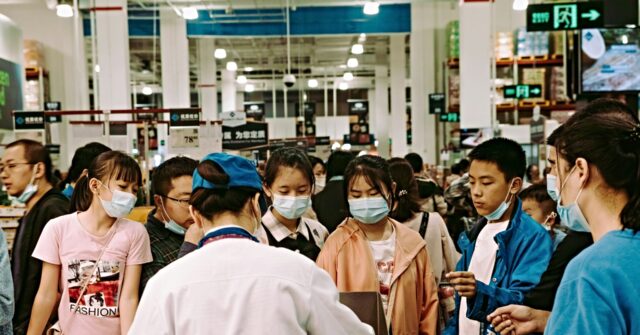
The Chinese Center for Disease Control and Prevention (CDC) began encouraging vulnerable residents – such as the elderly, pregnant women, and those with chronic diseases – to seek out Wuhan coronavirus vaccine products and use sanitary masks as the rate of coronavirus infections skyrocketed in July.
The Chinese state newspaper Global Times first announced in English the CDC warning of a spike in Wuhan coronavirus cases on July 26, insisting that the virus appears to be spreading much faster in southern China than in the north and that it does not appear to be causing severe infections in most people. Experts suggested that hot temperatures driving people indoors to air conditioning has created similar conditions to winter, when many do not go outside because of the cold and the limited air circulation facilitates infections.
Hong Kong’s South China Morning Post identified the culprit of the latest outbreak as the “Omicron NB.1.8.1 variant,” which is reportedly spreading at a “moderate” level but mostly a threat to the elderly or those with other health complications.
The Chinese CDC warned last week that it was documenting more cases of coronavirus than influenza this month, suggesting accelerating rates of infection. The vast majority of those diagnosed with the disease were reportedly between the ages of 15 to 59, suggesting that children and the elderly did not represent the majority of cases.
“The [Wuhan coronavirus] test positivity rate stood at 16.3 percent, up 4.3 percentage points from the previous week, while the influenza positivity rate was 12.6 percent, down 0.9 percentage points week on week,” the Global Times detailed.
The Global Times added that the Chinese government was now encouraging the elderly and those with health complications to “preventive measures, such as wearing masks in crowded places or on public transportation.” All were encouraged to update their vaccine product dosages, particularly pregnant women.
The state outlet China Daily reported an update on Wednesday from Beijing’s CDC discouraging residents from concern, stating that the rate of transmission in the capital city was “within normal cyclical fluctuations” and not straining medical facilities. Overcrowding in Chinese hospitals is a recurring problem during waves of respiratory infections, particularly those targeting children, as many parents choose to take their children to be hospitalized for intravenous treatment rather than attempting to treat respiratory symptoms at home. During past waves of respiratory infections citizens have documented chaotic scenes in city hospitals as emergency rooms failed to offer proper services to the large crowds of people flooding their waiting rooms and ran out of seats of IV fluid treatment.
“The [Beijing health] center said visits to fever clinics remain low across the city, hospitals have sufficient medicine supplies, and the latest increase in cases has not placed noticeable pressure on the healthcare system,” according to China Daily.
The current transmission data available from China indicates that the situation in southern China is more precarious. The U.S.-based Epoch Times, which conducted much of the early reporting exposing the calamity in Wuhan, China, as the coronavirus first began spreading in 2020, noted in its reporting on Wednesday that the gap between cases in the north and south had “widened significantly” and that one potentially complicating factor could be widespread floods in the region that have killed and displaced large numbers of people. The newspaper, citing biomedical science professor Xiaoxu Sean Lin, cited that flooding could potentially cause situations such as “population displacement, centralized sheltering, poor ventilation, overcrowded medical facilities, and compromised nutrition and rest,” all of which help spread respiratory illness.
Lin described the current reports out of the Chinese communist regime as “only the tip of the iceberg,” as many Chinese do not report symptoms consistent with a coronavirus infection, particularly when caused by a variant that only prompts mild symptoms to occur. The outbreak causing a rise in cases has been identified as “Omicron NB.1.8.1.” The South China Morning Post listed common symptoms as “fever and a sore throat.”
Citing Peng Jie, deputy director of the infectious diseases department at Southern Medical University’s Nanfang Hospital, the Morning Post noted that some experts are concerned about an “increasingly unpredictable” trend of coronavirus infections in the summer. While the Chinese CDC typically documents an increase in cases of all major respiratory diseases in the winter, state reports have explicitly noted that they have not documented a similar increase this summer of cases of influenza or respiratory syncytial virus (RSV), which also tend to spread more severely among children and the elderly.
Speaking to the Epoch Times, Taiwanese infectious disease specialist Cheng Yuan-yu posited the air conditioner theory for why coronavirus appears to be spreading at a faster rate.
“High outdoor temperatures drive people flocking to air-conditioned environments, which leads to spending extended periods in enclosed indoor spaces and has increased risk of indoor airborne transmission,” Cheng reportedly said. If this factor is driving infections, Cheng continued, that would mean situations such as “people going to work while sick, the confined environments of commuting, waning immunity, biases in testing and health care-seeking behavior” would result in more cases of people aged 15 to 59 being diagnosed with coronavirus, rather than children or the elderly.
The Wuhan coronavirus was originally identified in the eponymous central Chinese city of Wuhan as a novel pathogen in early 2020, though reports indicated that the first diagnosed case could have surfaced as early as November 2019. As a result of the Chinese Communist Party violently silencing those identifying a new virus, allowing “super-spreader” events to take place to obscure the spread of the disease, then engaging in human rights atrocities to imprison people in the city, the virus went on to infect millions of people around the world, killing over 7 million people.