
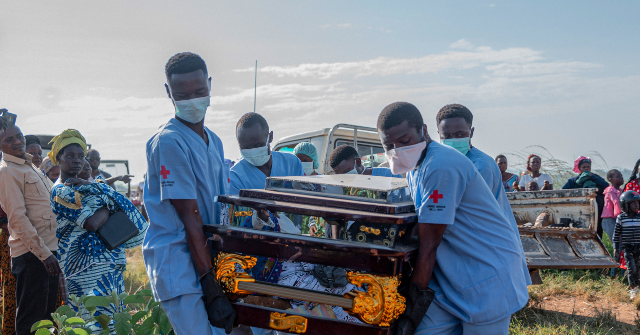
The health ministry of the Democratic Republic of the Congo (DRC) said on Tuesday that total confirmed cases in the Ebola Bundibugyo outbreak have reached 9,066, with 4,381 fatalities.
The outbreak has spread to more health zones across the DRC, and health officials fear the number of unreported cases could be double or triple the soaring number of confirmed infections.
The current outbreak has officially become the worst in the DRC’s history when measured by number of cases, and threatens to eclipse the horrific 2014-2016 West African regional epidemic, which claimed over 11,000 lives.
Ebola has been largely confined to the DRC so far, with only a handful of cases reported in neighboring countries, and most of those were people who evidently became infected while traveling through the DRC.
Kenya reported an Ebola infection on October 5 and a second case on Wednesday. The first patient was reportedly living in the Congo when he contracted the disease, then traveled to Uganda before flying to Nairobi and checking into a hospital, while the second patient was a member of his family. The original patient died in the hospital.
“Both cases are linked, and there is no evidence of spread in the wider community,” the Kenyan health ministry said. The ministry added that 113 out of 128 known contacts of the primary Ebola patient have been tracked down, and 108 of them have entered quarantine.
Local and international health officials cited political unrest in the Congo, shortages of doctors and supplies, and resistance to treatment by Congolese civilians as factors in the ongoing spread of Ebola.
On Wednesday, Reuters cited health officials who said women and children are avoiding health care entirely in the eastern Congo, fearing they will contract Ebola — or that doctors will deliberately infect them — if they enter a clinic or hospital. This has led to soaring maternal death rates in the DRC, especially in the Ebola outbreak province of Ituri, where deaths during childbirth rose by 70 percent from May to July.
“They think the medicines we give them contain the Ebola virus,” a nurse in the city of Butembo told Reuters.
“We should be concerned not only about the direct impact of Ebola, but also its indirect effects on health, nutrition, child protection, and insecurity. The longer an epidemic persists, the greater the risks,” warned United Nations Children’s Fund (UNICEF) public health emergency expert Raoul Kamadjeu.
Kamadjeu said UNICEF is growing concerned about the spread of other diseases, such as measles, because vaccination rates have plummeted during the Ebola emergency. Some local parents confirmed to Reuters they were foregoing vaccinations and medical treatment for their children because they were afraid of being referred to an Ebola treatment center.
A Butembo pediatrician told Reuters that one local mother burst into tears when told her son needed an X-ray because she thought the hospital staff might deliberately infect him with Ebola. Many such frightened parents are turning to ineffective “traditional medicine” to avoid hospitals.
Another problem mentioned by health workers in the DRC is that locals are self-medicating with over-the-counter fever treatments like acetaminophen, which can conceal Ebola infections from routine body-temperature screenings.
Africa Centers for Disease Control and Prevention (Africa CDC) noted that the Kenyan Ebola patient who died on October 5 traveled from the DRC, through Uganda, and back to Kenya over the course of nearly a month, passing through airport checkpoints and making several visits to clinics in the Congo without his infection being detected.
The World Health Organization (W.H.O.) warned on Wednesday that a cholera epidemic is also spreading through the DRC, with 125,000 cases and 3,644 suspected fatalities so far this year.