
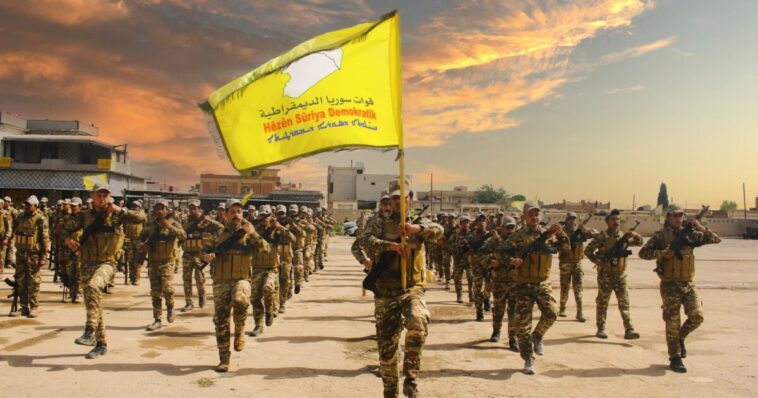

Syrian government forces and the Kurdish-led Syrian Democratic Forces agreed to de-escalate fighting in Aleppo after clashes on Monday, December 22, 2025.
The Syrian Health Ministry reported two civilians killed and several wounded, including two children and two civil defense workers. SDF sources reported one woman killed and 17 civilians wounded. Two Internal Security Forces members and two Syrian Civil Defence rescuers were injured. The violence prompted the temporary closure of schools, universities, and government offices in the city.
The clashes occurred near the Sheihan and Lairmoun roundabouts in the Sheikh Maqsoud and Ashrafiyeh neighborhoods. These are Kurdish enclaves in northern Aleppo that have remained under SDF/YPG control since 2012, even after the Syrian government recaptured most of Aleppo city in 2016.
Both sides denied responsibility and accused each other of initiating the attacks. Damascus claimed the SDF shelled residential areas after withdrawing from joint checkpoints in a surprise attack on Internal Security Forces. The SDF rejected the accusation, stating it had already handed over its positions to the Asayish under an April 1 agreement.
The Asayish is the internal security and police force of the Democratic Autonomous Administration of North and East Syria, formed early in the Syrian Civil War to police areas under Kurdish control. The SDF instead blamed fragmented factions affiliated with the Damascus government, accusing them of imposing a four-month siege on the neighborhoods and using tanks and artillery against residential areas.
The violence erupted amid rising tension over the stalled integration of the SDF into Syria’s national armed forces. Turkey views the U.S.-backed SDF as a terrorist organization and considers the YPG, the main component of the SDF, to be the Syrian branch of the Kurdistan Workers Party (PKK), which both Turkey and the United States designate as a terrorist organization.
Turkish Foreign Minister Hakan Fidan visited Damascus hours before the clashes, stating the SDF appeared unwilling to honor the integration agreement and accusing the group of coordinating with Israel. Fidan stated that Turkey’s patience is running out and that the SDF has no intention of honoring the year-end agreement to integrate into Syrian state armed forces.
Syrian officials echoed Turkey’s concerns, saying they see little effort by the SDF to implement the deal, though Damascus has proposed reorganizing the group’s 50,000 fighters into Syrian army divisions with reduced autonomy.
Turkey’s core security concern is preventing an autonomous Kurdish entity along its southern border. Ankara fears this could fuel Kurdish nationalism in Turkish Kurdistan and provide a safe haven for PKK operations. Turkey has conducted multiple cross-border military operations against the SDF since 2016.
Turkey insists that any integration must involve disbanding the SDF, with fighters joining the Syrian army as individuals rather than as intact units with their own chain of command. Turkish officials have stated they cannot accept YPG commanders being appointed as Syrian army officers. Turkey also insists the process must align with a broader disarmament process linked to the PKK.
Turkish Defense Minister Yasar Guler stated that integration is inevitable and warned that Turkey will take action without consulting anyone if the SDF does not comply. Turkey has warned it may take military action if the group fails to meet a year-end deadline to integrate. Turkey has already deployed large armored convoys and hundreds of troops into northern Syria from areas it controls.
Turkey has expressed conditional support for the March 10 agreement between Damascus and the SDF, but only if it results in complete dismantling of PKK-affiliated structures rather than rebranding them under Syrian government authority. Turkish officials argue that an intact SDF poses risks to Iraq, Turkey, and the Syrian state itself.
There are several reasons, however, why the Syrian Democratic Forces remain hesitant or unwilling to fully integrate into the new Syrian military structure. The most immediate concern is self-preservation. Turkey has made clear that it is demanding complete disbandment, not genuine integration. If the SDF dissolves its command structure and its fighters are absorbed individually into the Syrian army, the group loses all leverage and protection.
Once dispersed, SDF personnel would be vulnerable to Turkish military operations, which have included repeated cross-border attacks since 2016, as well as potential purges or persecution by a Turkish-influenced Syrian government. Full integration would also mean the loss of any remaining Kurdish autonomy or self-governance.
Trust in the new government is another major obstacle. The SDF fought alongside the United States against ISIS, while the current Syrian leadership emerged from Hayat Tahrir al-Sham, a group with jihadist origins and al-Qaeda ties.
Former jihadist factions dominate the post-Assad government, operate under significant Turkish influence, and are led by figures unlikely to protect Kurdish interests or minority rights. From the SDF’s perspective, there is no credible guarantee that their forces, communities, or leadership would be protected after integration.
Territorial control is also at stake. Integration would require surrendering control over oil fields in northeastern Syria, border crossings that generate revenue, and de facto autonomy in Kurdish-majority areas. More critically, it would eliminate the SDF’s ability to protect the civilian population under its control.
Turkey’s insistence that integration include severing all alleged PKK ties further compounds the risk. This would likely involve removing experienced commanders, extraditing individuals Ankara labels as PKK-linked, and dismantling the organizational structure that allowed the SDF to survive the war against ISIS.
The timing further weakens the SDF’s position. Turkey continues to mass forces along the border and openly threatens military action, while U.S. backing remains uncertain under shifting administrations. In this context, the SDF is being asked to disarm and disband voluntarily, without binding security guarantees. From their perspective, integration under Turkish terms amounts to strategic suicide.
Protection of women and religious minorities is another central reason for resistance. The Kurdish-led administration in northeastern Syria has established a governance model that protects Christians, Yazidis, and other minorities through multi-ethnic councils, community policing structures such as the Sutoro, and active protection of churches and religious sites.
It has also created an unprecedented framework for women’s participation, including women serving in security forces, the existence of the Women’s Protection Units, leadership roles across civil administration, and legal protections against forced marriage and honor killings. The co-leadership model, with male and female co-chairs, is foundational to this system.
Disbanding the SDF and integrating into a Syrian military dominated by former jihadists under Turkish influence would almost certainly dismantle these protections. Women would likely be forced out of security and leadership roles, legal safeguards could be rolled back, and minority communities would lose their primary shield against sectarian violence.
Recent events have reinforced these fears. Massacres of Alawites that killed at least 1,000 people, attacks on Druze communities, and the bombing of a church have served as a warning of what happens when armed protection disappears. For the SDF, these attacks are not abstract risks but cautionary examples.
The bottom line is that the SDF does not view integration as a political compromise but as an existential threat. Disbandment would leave Kurdish communities, Christians, Yazidis, women, and other vulnerable populations exposed to a government and regional power structure that has already demonstrated hostility toward them. Stalling and maintaining arms is not defiance for its own sake but a calculation rooted in survival and the protection of those living under SDF control.
Analysts warn that failure to resolve the SDF integration issue risks renewed armed conflict that could draw in Turkey and further destabilize Syria after 14 years of war.