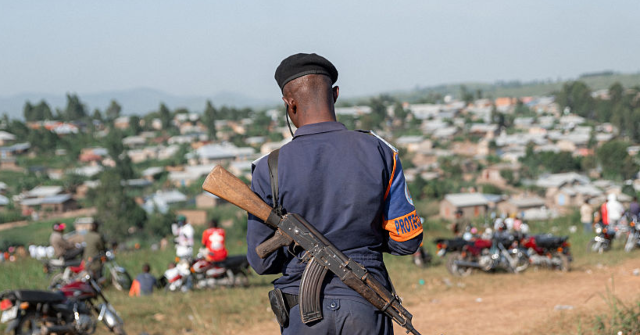
Officials in the Democratic Republic of the Congo (DRC) confirmed on Tuesday that unknown knife-wielding attackers abducted two people, a woman and her six-year-old child, from an Ebola treatment center. Both victims are believed to have tested positive for the disease.
The incident occurred in North Kivu, eastern DRC, one of three provinces experiencing the highest number of Ebola cases during the current outbreak. Neighboring Ituri province is believed to have been the origin of the first case of Ebola since the outbreak began this year. Authorities are unsure when the outbreak began; the World Health Organization (W.H.O.) declared a public health emergency on May 17, but W.H.O. Director-General Tedros Adhanom Ghebreysus told reporters this month that the outbreak could have begun as early as in January.
The chaotic gang violence consuming eastern DRC is a major factor in the delay in public health experts and humanitarian aid workers identifying the outbreak of the disease, as well as a lack of funding, community hostility towards humanitarian aid workers, and the strain of Ebola involved in the situation. Experts ultimately identified the pathogen causing the outbreak as Ebola Bundibugyo, a less common strain of the virus which the tests for other strains, such as the more common Zaire strain, were reportedly not able to identify.
As of Wednesday, the W.H.O. and affected governments have confirmed 856 cases of Ebola Bundibugyo associated with the current outbreak and 198 confirmed deaths within those. Most of these were identified in DRC, with the exception of 19 confirmed cases in Uganda. Authorities have identified another 235 suspected cases of Ebola in DRC but have not confirmed if these individuals are suffering from Ebola or another disease.
Reuters confirmed the story of the missing six-year-old Ebola patient on Tuesday. The girl and her mother were reportedly abducted at gunpoint from the Wanamahika Hospital in Butembo. There were no other reported victims and the attackers apparently did not injure or target anyone else, suggesting that they intended to abduct the two specific people they took rather than generally spread terror or engage in a mass abduction for ransom, as with similar cases elsewhere in Africa.
“The attackers, armed with bladed weapons, stormed a clinic near Butembo, North Kivu province, late on Monday and took the pair away, according to a provincial notice seen by Reuters.,” Reuters reported. “The notice did not identify the assailants or give their motives.”
Local official Dr. Lubambo Maboko Gaston told Reuters that authorities are concerned for the fate of the two victims and about the possibility that extracting Ebola patients from isolation would result in further spread of the disease.
“We are making a solemn appeal for them to go as soon as possible to an Ebola treatment centre, as their return to the community risks worsening their health and, above all, infecting their relatives,” he was quoted as saying.
Eastern DRC is home to a large number armed paramilitaries who often fight for control of mineral-rich territory and force local children to mine for hazardous but lucrative substances under dangerous conditions. Among the most dangerous is the Allied Democratic Forces (ADF), a radical Islamist terrorist paramilitary linked to the Islamic State. The ADF’s attacks have continued unabated throughout the Ebola outbreak, disrupting humanitarian efforts. In early June, for example, an attack attributed to ADF terrorists targeted North Kivu, killing 16 people and displacing entire communities as the terrorists burned down homes in three villages near the city of Beni.
The Congolese outlet Radio Okapi reported on Monday that ADF attacks have escalated since March in Ituri province. The outlet found, citing locals in the communities, that over 20 villages in Ituri had been targeted in ADF attacks in the past three months. These attacks resulted in “loss of human life, massive displacement of populations, and the paralysis of socio-economic activities in this area.”
Ebola patients and health workers in DRC must also contend with the widespread belief in the region that Ebola is not real, but rather an excuse for international organizations to kill large numbers of Africans. This belief that the disease is a “population control” measure fuels attacks on isolation wards, including by relatives of Ebola patients seeking to help their loved ones “escape” a death they believe will come at the hands of healthcare workers.
“Some people say Ebola is a story invented by doctors,” Jean Assumani, a worker in Ituri, DRC, told UNICEF. “Others claim that humanitarians created this disease to make money. But those who have seen people die of Ebola completely change their minds and start protecting themselves. They then understand that this disease is real.”
In May, Ituri and North Kivu experienced a wave of mob attacks in which locals attempted to set isolation centers on fire, steal the bodies of Ebola victims, and help living patients flee.
Ebola spreads through contact with the bodily fluids of those already infected, particularly their blood. Traditional burial rituals in much of Africa require close contact with the dead, facilitating the spread of the disease. Mob attacks to seize control of the bodies of Ebola victims thus greatly jeopardize the health of those participating in them.