
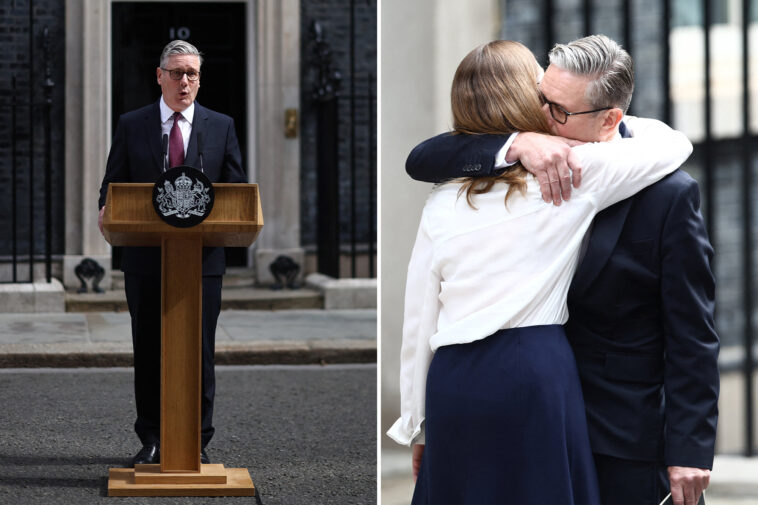

Sir Keir Starmer choked up as he announced his resignation as UK Prime Minister Monday – less than 2 years after the Labour Party stormed to a landslide general election win.
Starmer, 63, set out a timetable to stand down after coming under mounting pressure following last month’s local elections, where the governing Labour Party lost over 1,000 seats.
The Prime Minister announced his intention to step down after admitting the Labour Party was questioning whether he could lead it into the next general election, which must be held before July 2029, just 23 months after leading his party to a landslide win.
“I have heard the answer of my parliamentary party to that question, and I accept that answer with good grace,” Starmer said outside 10 Downing Street in London.
Every decision I’ve taken has been about putting the country I love first. That is why I will resign as leader of the Labour Party. I have spoken to His Majesty the King this morning to inform him of my decision.”
Starmer’s voice cracked with emotion as he concluded his speech — thanking his wife, Victoria, for being a “rock … in good times and bad.”
“When I leave the biggest job in the country, I shall spend more time on the most important job, being the best husband I can to my fantastic wife Vic,” he said. “And being the best dad I can to my beautiful children who are my pride and joy.”

Starmer and Victoria embraced outside No.10 after his emotional address, and the couple held hands as they made their way back indoors.
Starmer confirmed nominations to elect a new leader will open on July 9 and the process will be completed by the summer recess.
This now paves the way for either a coronation or a contest where Labour members will decide who is the party’s next leader, and the UK’s next Prime Minister.
Andy Burnham – the former Greater Manchester mayor – is the overwhelming favorite to succeed Starmer.
He defeated Reform UK by almost 20 percentage points in last week’s by-election in the pro-Brexit North West England constituency of Makerfield.
Polling revealed he would have comprehensively defeated Starmer if the Prime Minister decided to contest any leadership election, which he vowed to do so as recently as Friday.

The next Prime Minister will be the 7th to hold the esteemed office in the 10 years that followed the Brexit referendum – but calls for an early general election are already ramping up.
The next general election must be held no later than 2029 – but prime ministers who enter Downing Street mid term do not necessarily have to call a poll straightaway. Critics claim the next Prime Minister lacks a mandate to carry out a radically different program from the one Labour put forward ahead of the 2024 vote.
Calls for Starmer’s resignation intensified over the past month after Labour was routed by Nigel Farage’s Reform UK party across post-industrial England.

“Starmer isn’t the first Prime Minister I’ve deposed, and he won’t be the last. David Cameron. Theresa May. Rishi Sunak. And next up – Andy Burnham. The reason each leader has failed is the same,” Farage wrote in a Substack post Monday.
“What the political class fails to understand is that the electorate won’t accept being taken for fools. They cannot continue to take the votes of the people who supported them for granted, only to betray them upon having gained power. Politics is about trust.
“That is why I am calling for a general election at the soonest possible date. You know as well as I do that the country cannot afford to waste another week drifting from crisis to crisis.
“That’s why millions of you turned out in the local elections to vote for Reform councillors, and it’s why we have led in more than 300 opinion polls for well over a year.”

Labour was also swamped in Scotland and Wales, losing control of the latter’s devolved parliament — the Senedd — for the first time since its creation in 1999.
Starmer suffered a wave of resignations in the wake of the local elections drubbing.
Health Secretary Wes Streeting resigned after admitting he had lost confidence in Starmer’s leadership — and blasted the Prime Minister for a lack of vision.
“But where we need vision, we have a vacuum. Where we need direction, we have drift,” he wrote in his resignation letter.

Just last week, Starmer lost his Defense Secretary John Healey over the government’s defense investment plan.
“You have been unable, and the Treasury has been unwilling, to commit the resources that the nation needs to defend the country at this time of rising threats,” Healey told Starmer in his resignation letter.
Starmer’s popularity has plunged after repeated missteps and U-turns on policies such as welfare reform, as well as his disastrous decision to appoint Peter Mandelson, a scandal-tarnished friend of Jeffrey Epstein, as Britain’s ambassador to Washington.
The Labour government has also failed to deliver promised economic growth and ease a longstanding cost-of-living crisis.
With Post wires