
A powerful earthquake has devastated parts of Venezuela, reducing buildings to rubble, knocking out communications, and leaving families desperately searching for missing loved ones.
In the days following the disaster, I contacted numerous Venezuelans through missing-person posts and databases created to help families locate relatives. Several of those individuals responded, sharing firsthand accounts of their experiences during and after the disaster.
Their eyewitness testimonies, originally sent to me in Spanish and translated into English via Google Translate, paint a picture not only of a devastating natural disaster but of a country whose emergency response systems had already been hollowed out long before the ground began to shake.
Among those I spoke with was Jorge Perdomo, who spent two days trying to locate his best friend, Edison Jesús Morales, after all communication with him suddenly stopped.
Jorge told me Edison had lived through “the most terrifying moment of his life,” describing his survival as “a miracle from God.”
Two days later, Edison finally managed to make contact.
“Brother, don’t worry. I’m okay,” he told Jorge. “I went through hell.”
Edison described being inside a three-story home when the earthquake struck.
“The apartment was shaking like when you shake a matchbox,” he recalled. “That’s exactly what it was like.”
Water tanks and heavy barrels were thrown around as the building violently shook before he and those inside were finally able to escape.
“Nothing happened to us, thank God,” he said. “But it’s really bad.”
Buildings were destroyed throughout La Guaira, one of the areas hardest hit by the earthquake.
While Edison survived, Jorge said what happened after the earthquake revealed an even bigger problem. When I asked whether the government’s response had made a difference, Jorge answered without hesitation.
“Unfortunately, it would have been the same.”
“In the end, we see the reality of what happened.”
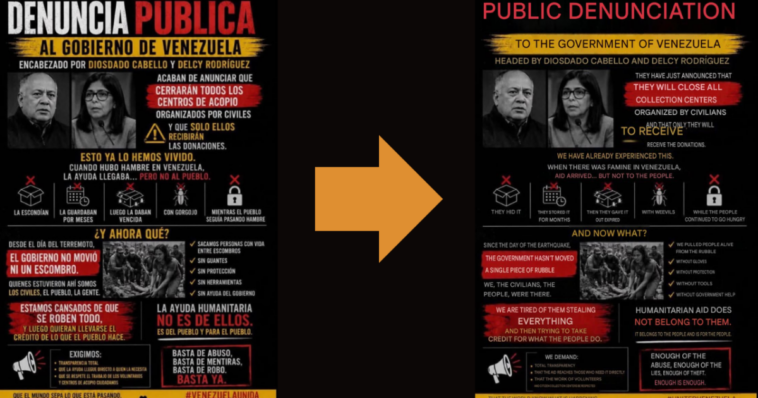
According to Jorge, rescue operations were crippled because communities simply lacked the equipment needed to save lives.
“There is no machinery and no light to support people at night or during the day,” he said.
Instead, he explained, ordinary Venezuelans became the rescue crews.
“We Venezuelans were the ones who solved it.”
He said neighbors dug through collapsed buildings themselves.
“People pulled others out with their hands because they did not have tools.”
Hospitals, he said, faced similar problems.
“There was no medicine or supplies,” Jorge explained.
Instead, ordinary Venezuelans themselves “managed to fill the hospitals with medicine,” despite those being resources “the government itself should provide.”
His account reflects what many survivors near the epicenter described.
International coverage has largely focused on Caracas, but the capital sits roughly 100 miles from the earthquake’s epicenter. Communities much closer to the disaster have suffered extensive damage, while widespread power outages and communications failures have made it nearly impossible for many families to contact loved ones or share images of what has happened. Online reports from residents in the affected areas closely mirror the accounts shared with me.
One resident wrote that an apartment building had completely collapsed.
“All the floors collapsed,” the person said. “We don’t know if there are people trapped in the rubble. We’re taking refuge in the school.”
Another resident described severe structural damage inside a home.
“The whole room is cracked, as is a column in another room, but the most affected one even has a cracked ceiling.”
Another report simply read:
“Building collapse.”
For Jorge, however, the greatest tragedy was not simply the earthquake itself. It was what decades of corruption had left behind.
“The government obviously has us in a bad state, whether Maduro is there or not,” he said.
Later, he added:
“There are no changes. Everything remains the same, and sometimes even worse.”
“As long as those who were with Maduro remain in command, this country will continue going to ruin.”
Those comments reflect a broader frustration shared by many Venezuelans. Despite possessing some of the world’s largest proven oil reserves, survivors described communities without heavy rescue equipment, emergency lighting, adequate medical supplies, or even basic tools needed to pull people from collapsed buildings.
Money and humanitarian aid can arrive after a disaster. But when roads, infrastructure, communications systems, emergency equipment, and government institutions have deteriorated over many years, survivors told me those resources often cannot reach the people who need them most.
The Trump administration has already committed assistance to the Venezuelan people. But there is only so much foreign aid can accomplish when the institutions responsible for responding to disasters have been weakened for years.
The message I have heard repeatedly from the Venezuelans who contacted me is that this tragedy reflects something much larger than a natural disaster. The earthquake exposed the consequences of years of corruption, mismanagement, and institutional decay.
If anything good can come from a tragedy in which thousands are feared dead, tens of thousands remain missing, and countless families still cannot reach loved ones, survivors hope it is that the world recognizes how severely years of government corruption weakened Venezuela before disaster struck.
When governments become systems of entrenched authoritarian corruption, public institutions often deteriorate while those in power preserve themselves. For years, Venezuelans have warned about that reality.
When the earthquake struck, many told me they felt the consequences immediately—not because the earth shook, but because when it did, there was almost nothing left to help them.
Ad block users: Some site features may not work correctly while an ad blocker is enabled, because they break scripts and content this website depends on. If you can’t see comments below, for example, please disable your ad blocker.