
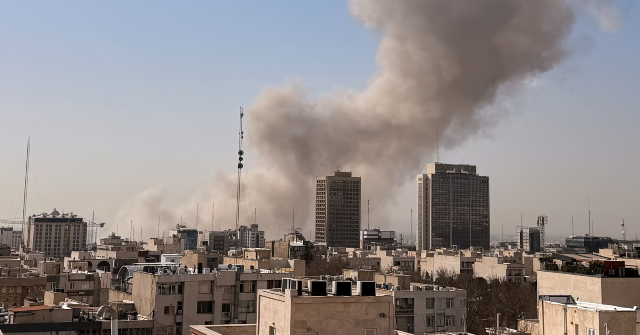
A series of mysterious explosions were heard across Iran on Thursday, even though the U.S. said no strikes were launched after two nights of heavy bombing on Tuesday and Wednesday.
There has been speculation that one or more of the neighboring countries that have been wantonly attacked by Iran might finally be responding, or that an insurgent movement is making a move.
According to Iranian state media, explosions were heard in several cities in southern Iran, including Choghadak, Konarak, and Bushehr, which is the site of a nuclear power plant.
Some of these explosions were reportedly heard after U.S. Central Command (CENTCOM) announced the last of 90 strikes across southern Iran on Thursday, intended to “further degrade Iran’s ability to attack commercial shipping and innocent civilian mariners in the Strait of Hormuz.”
CENTCOM said these attacks targeted “air defense systems, coastal surveillance assets, missile and drone storage sites, naval capabilities, and military logistics infrastructure along Iran’s coastline.”
The CENTCOM statement was issued at roughly 6:30 a.m. local time, shortly before the first of the unexplained blasts were heard.
U.S. officials told several media outlets, including the Jerusalem Post, that American strikes were not responsible for the explosions heard in Bushehr and the other cities on Thursday afternoon.
The governor of Konarak county told Iranian state media that two of the mysterious explosions were heard at a local naval base. An official in Bushehr said the blasts were caused by an “air defense response,” and state media later claimed that a “military base on the outskirts of Bushehr” was “attacked and hit by an American-Israeli enemy projectile.”
Although one Iranian news agency, Mehr, reported explosions in the port city of Bandar Abbas, another Iranian outlet called IRNA denied that report.
The Associated Press (AP) noted that CENTCOM did not respond to questions about the explosions and neither did the Gulf Arab states that Iran has been attacking sporadically for months. Iran’s most recent terror attacks targeted Bahrain, Kuwait, Jordan, and Qatar this week.
The Gulf states invariably denounce these Iranian attacks and promise to stand up for each others’ “sovereignty,” but until now they have never fought back, contenting themselves with intercepting as many Iranian drones and missiles as possible.
The Gulf states have also suffered considerable losses from Iran shutting down the Strait of Hormuz, through which much of the Persian Gulf’s oil and liquefied natural gas (LNG) normally flows. Iran’s Arab neighbors have lost an estimated $2 billion per day in oil exports from the Strait of Hormuz crisis.
The response to the latest provocation from Tehran was a bit more energetic than on previous occasions. The United Arab Emirates (UAE) denounced the Iranian bombardment, even though it was not itself attacked, and its leader Sheikh Mohammed bin Zayed al-Nayhan traveled to Kuwait for meetings with its leaders after Kuwait was hit.
The foreign minister of Qatar — which was attacked by Iran even though it has been attempting to mediate talks between Tehran and Washington — also contacted his counterparts in Saudi Arabia and the UAE after the attacks. The Saudi and Emirati foreign ministers, in turn, met with their counterpart in Oman, which lies across the Strait of Hormuz from Iran.