
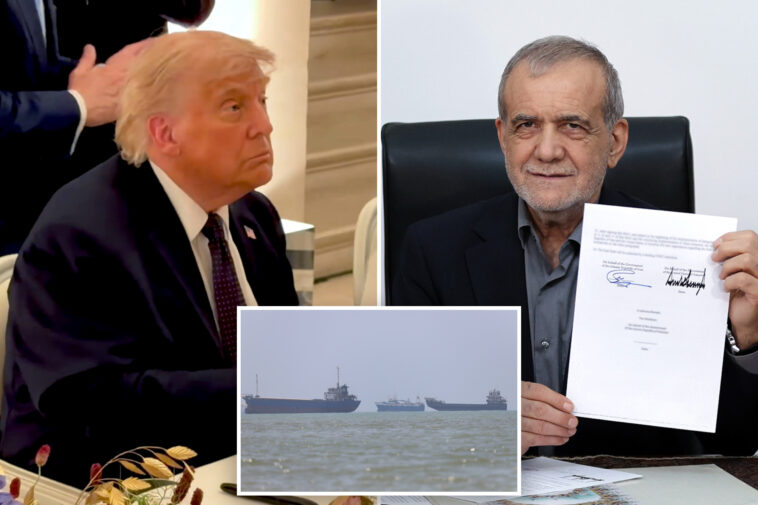

ZURICH — Vice President JD Vance cast doubt on the first round of nuclear talks with Iran going ahead as planned Friday, saying he wasn’t sure exactly when he was going to Switzerland and indicating the US had not confirmed when or if the Tehran delegation would show up.
“Our plan is to go to Switzerland. I don’t know exactly when,” he told reporters at the White House.
Many of the major players in the talks are balking at attending after President Trump formally signed a Memorandum of Understanding with Iran at the Palace of Versailles outside Paris Wednesday evening.

Of the mediating nations, Pakistan is sending a low-level minister and Qatar may only take part in the talks by phone — a poor showing that would result in embarrassment for the White House and leave Vance hanging in Central Europe.
When asked if they were attending talks this weekend, one Middle East diplomat involved in the deal-making told The Post: “Why? Trump already signed it,” referring to the MOU.
No formal agenda or schedule has been announced yet for this weekend’s meeting, with the VP saying: “It will be determined in the coming hours whether the Iranian delegation will be present in Geneva tomorrow or not. And if the answer is yes, the details will be announced.”
A source familiar with the Iranian delegation’s plans backed up Vance’s statement.
The vice president said the issue stemmed from the difficulty of securing travel out of Iran.
“We think these technical negotiations are going to start sometime this weekend, that’s still the plan, but that could change because it’s not an easy country, Iran, to get out of, and so we’re trying to figure out exactly when that’s going to happen,” he said.
“I suspect this weekend, but I’m not sure.”
Start your day with all you need to know
Morning Report delivers the latest news, videos, photos and more.
Thanks for signing up!
Pakistani Prime Minister Shehbaz Sharif — whose nation has led mediations between Washington and Tehran — on Thursday canceled his trip to Switzerland, with Deputy Foreign Minister Mohammad Ishaq Dar set to represent Islamabad at the negotiations, local media reported.
Friday was originally planned as a formal signing ceremony with all the attendant pomp and ceremony.
Now it’s a starting point for phase two of the negotiations, with the future of Iran’s nuclear program at the top of the agenda.
It’s unclear what the attendees would discuss should Iran not field a delegation.
Vance argued Thursday Iran’s nuclear program had been “destroyed” by the US and Israel during Operation Epic Fury and can’t be rebuilt, claiming America has already won the war on that point.
“The nuclear weapons program is destroyed. It is gone. If the Iranians decided tomorrow to build a nuclear weapon, they simply don’t have the capacity in order to do that,” he said.
“They would have to get a lot of money in order to rebuild their nuclear program. You’re talking about billions and billions of nuclear infrastructure that the United States destroyed.”