
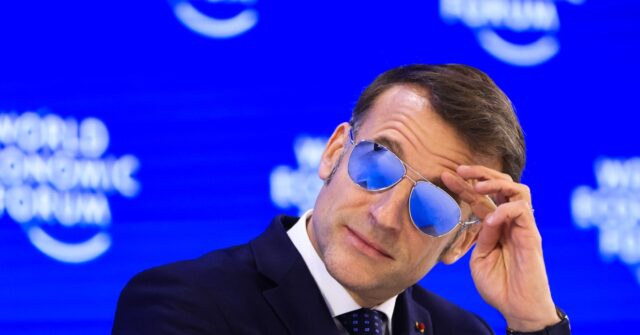
In a stunning indictment of globalist governance, France has seen its GDP per capita decline to the point that it is now in the bottom half of European Union nations.
While France has long stood as one of the wealthiest countries in Europe, ‘La Grande Nation’ has apparently fallen on hard times, with its economic decline precipitating over the past decade under the governance of Socialist François Hollande and globalist Emmanuel Macron.
According to an analysis of 2024 Eurostat figures by the Parisian daily Le Figaro, France’s gross domestic product (GDP) per capita was a full two per cent lower than the bloc’s 27 member states’ average.
This means that the average French citizen was poorer than those in Luxembourg, Ireland, the Netherlands, Denmark, Austria, Belgium, Germany, Sweden, Malta, Finland, Italy, and Cyprus.
While the French were on par with their German counterparts 50 years ago, there has been a steady and then steep decline since, resulting in an 18 point spread on the GDP per capita index, by a margin of 98 to 116.
Although Danish citizens already outpaced the French by 13 points on the index in 1975, they now hold a nearly 30-point lead as of 2024.
According to the deputy director at the French Economic Observatory (OFCE), Mathieu Plane, there were “two major waves of decline” in the French economy, with the first being seen under the socialist government of François Hollande between 2013 to 2017 when France declined from having a nine point advantage over the EU average GDP per capita to just a three point advantage.
Plane noted, however, that the decline accelerated under Macron, with the GDP per capita index falling to 104 in 2020, 101 in 2021, and 97 in 2022.
Significant capital flight occurred under Hollande’s socialist government, which imposed a millionaire “super tax” on earnings above €1m per year. This saw major figures, such as actor Gérard Depardieu, flee abroad to avoid the punitive tax hike.
The tax was struck down in 2012 by the French Constitutional Council as “confiscatory,” but was later replaced with a 50 per cent levy on companies, which had to pay the government for the privilege of employing high earners.
The tax was shifted from individual earners to companies, requiring firms to pay a 50% levy on high salaries, which was described by former Rothschild investment banker-turned-Hollande economic minister Emmanuel Macron as like “Cuba without the sun”.
While Macron swept to power in 2017 on the back of promises to return the foreign-born population of France hit a fresh record in 2024 of 7.7 million out of a total 68 million, meaning that over one in ten people in the country were born elsewhere. to a growth mindset with pro-business reforms, such as cutting corporate tax rates and reducing government spending.
However, as he approaches the end of his second and final term in office, Macron’s government was forced to rely on the same Socialist Party to pass a contested budget without a vote in the National Assembly, thereby increasing public spending and hiking taxes yet again.
This came after multiple governments collapsed, attempting to pay down the enormous debt accumulated during the draconian coronavirus lockdowns imposed by the Macron government between 2020 and 2022.
Director of Investments at Natixis Wealth Management, Benoît Peloille, argued that France’s stagnating productivity is, in part, attributable to Macron’s handling of the economy during the pandemic.
“By encouraging companies not to lay off staff during the Covid shock, we were unable to benefit from the labour market readjustment that took place in neighbouring countries,” he said.
While much of the current economic climate can be laid at the government’s feet, others have noted that the country faces structural issues, notably its ageing population. According to Le Figaro, France has the lowest proportion of workers aged 20 to 64 in the European Union. Nevertheless, the country also struggles to employ its workers, boasting the lowest employment rates for both young and old workers throughout the bloc.
This comes despite successive governments in Paris seeking to boost economic growth by importing millions of foreign labourers, with the foreign-born population reaching an all-time high of 7.7 million in 2024, or around one in ten people living in the country. Economic stagnation, in conjunction with mass migration, has also been observed in fellow European nations such as the United Kingdom, undermining the promises of an economic panacea from open-borders advocates
Follow Kurt Zindulka on X: Follow @KurtZindulka or e-mail to: kzindulka@breitbart.com
.