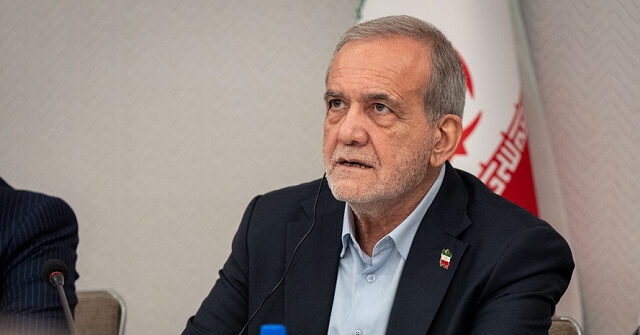
Iranian President Masoud Pezeshkian acknowledged Friday that the U.S. blockade has slashed Iran’s trade and left critical imports — including gasoline — unable to enter the country, as the Trump administration intensifies an economic offensive aimed at isolating a regime already confronting mounting hardship and the threat of renewed unrest.
Pezeshkian said Iranian imports and exports have fallen between 25 and 35 percent under U.S. sanctions and the blockade, with his government now considering doubling the price of gasoline purchased beyond subsidized quotas as supplies tighten.
“The route is now blocked, and goods are not coming in,” he conceded during a televised interview Friday night. “One of those goods is gasoline.”
The admissions came as Washington began putting teeth behind Operation Economic Outcast, the sweeping pressure campaign Treasury Secretary Scott Bessent launched Monday with a pledge to economically “asphyxiate” Tehran and “sever every economic lifeline” sustaining the regime.
On Friday, Treasury took its first major step against a foreign financial institution, proposing to cut Banque Misr UAE off from correspondent access to U.S. banks after identifying its Emirati operations as a “critical node” keeping Iranian networks connected to U.S. dollars.
Over the previous two and a half years, the bank processed roughly $1.8 billion for 103 companies potentially tied to Iranian shadow-banking networks, including apparent fronts linked to the Islamic Revolutionary Guard Corps (IRGC) and Iran’s defense establishment, according to Treasury.
Bessent had put foreign banks on notice Monday that they could no longer help finance Tehran while retaining access to the dollar-based financial system. By Friday, he had his first example.
“Banque Misr UAE decided to find out the hard way,” Bessent said, calling the move “the first step in holding it accountable for its continued, egregious support of the Iranian regime.”
Treasury simultaneously targeted the manager of Iran’s Bank Melli branch in Dubai and a Hong Kong facilitator, while the State Department vowed that Economic Outcast would continue “in full force.”
The financial offensive builds on a blockade that has already deprived Tehran of oil revenue while allowing growing volumes of its neighbors’ energy exports to move through the Strait of Hormuz.
Iran had used the strait as one of its strongest sources of leverage since the conflict began, mining shipping lanes and threatening Gulf energy traffic. On Thursday, CENTCOM commander Adm. Brad Cooper announced that U.S. forces had cleared Iranian mines from the internationally recognized lanes and restored growing commercial traffic through them.
Nearly 1,500 vessels carrying roughly 750 million barrels of oil have moved through the strait even as Iran has exported nothing from its own shores since the U.S. blockade resumed in mid-July, according to CENTCOM. Ships entering or leaving Iranian ports remain subject to U.S. enforcement, apart from permitted humanitarian traffic.
Trump summed up the administration’s assessment of the operation in a phone interview published Friday.
“That sucker is open,” the president said of the strait.
Iran’s response, Trump added, has been “very mild” because “they don’t want us to go back at them.”
“That’s the whole ball game. The rest doesn’t matter.”
Inside Iran, economic indicators have continued to deteriorate as signs of public hardship become increasingly visible.
Inflation has reached 84 percent, while the rial has fallen to roughly two million to the dollar. Fuel queues and panic buying have emerged amid concerns over gasoline supplies, as oil workers, pensioners, teachers and other workers have begun staging smaller demonstrations over wages and deteriorating living conditions.
For some Iranian families, the financial strain is reaching even assets they had intended to leave for the dead.
Iran International reported Friday that Iranians have begun listing burial plots reserved for themselves or relatives for sale to cover living expenses. One woman was trying to sell a tier of her father’s grave that her family had reserved for her still-living mother.
“Thank God our mother is alive, and right now we need this money more,” she explained.
Others described the strain in more immediate terms.
“People are hungry, confused and unable to find a way out,” a 37-year-old Tehran resident told the New York Times Friday, warning that another economic uprising could prove impossible to contain.
Senior Iranian officials had already publicly warned that deteriorating economic conditions could threaten the regime’s ability to endure.
“No matter how much military power we have, if people are hungry and we do not have financial circulation and economic growth, we will not endure,” Parliament Speaker Mohammad Bagher Ghalibaf said this month.
Bessent highlighted Ghalibaf’s admission Tuesday as evidence that the administration’s pressure campaign was taking hold.
“Iran’s leadership is admitting what the world can now see: the pressure is working,” he wrote.
Iran’s security establishment had begun preparing for the possibility of renewed unrest before Economic Outcast was formally launched.
Earlier this month, Iran’s unseen Supreme Leader Mojtaba Khamenei placed veteran intelligence hardliner Hossein Taeb at the head of the Basij, the sprawling IRGC-linked militia that has repeatedly been used to crush anti-regime demonstrations.
Khamenei ordered Taeb to strengthen the Basij’s grassroots intelligence network, expand its reach through neighborhoods and mosques and deploy new technologies against emerging threats, as Iranian security officials increasingly warned that economic grievances could be exploited to reignite unrest.
On Friday, Taeb described the U.S. campaign as an effort to cripple Iran’s economy from within, accusing Washington of seeking to “shut down the cycle of production, trade and consumption.”
Where Washington had previously pursued its objectives with “missiles and bombs,” Taeb charged, “today they are pursuing it with security and economic tools.”
His remarks came on the six-month anniversary of the February 28 opening strikes of Operation Epic Fury, which killed Supreme Leader Ali Khamenei, decimated Iran’s senior military leadership and reportedly left his son and eventual successor, Mojtaba, severely wounded.
Mojtaba Khamenei has remained entirely out of public view since taking power, with no photograph, video, or audio recording released of him. Iranian officials insist the supreme leader continues to make major decisions from behind the scenes, while Trump said Wednesday that he believes Khamenei is alive but “very seriously wounded.”
On Friday, Khamenei marked Government Week with another written message — this one focused heavily on the economic and social pressures confronting the regime.
He directed officials to tackle inflation, unemployment and rising prices, strengthen domestic production and gradually reduce Iran’s dependence on the dollar. Even while portraying the government as resilient, Khamenei acknowledged that the enemy’s actions during and after the conflict were “not without effect.”
Khamenei also warned against rhetoric and political divisions that could weaken public confidence and social cohesion, including disputes over negotiations, compromise and the continuation of the conflict.
He then issued an explicit directive.
“I firmly declare that committing any act that harms social cohesion is prohibited,” Khamenei said.
Iran’s most senior political and security officials immediately embraced the order.
Ghalibaf called Khamenei’s message “the apple of our eye” and declared actions damaging social cohesion a “national and religious prohibition.” Pezeshkian pledged “complete unity and cohesion,” while Mohsen Rezaei — recently elevated to lead the powerful Supreme National Security Council — called Khamenei’s instruction a “clear and unambiguous strategy for all.”
Tehran is also seeking to limit foreign participation in Economic Outcast as Washington targets the remaining financial channels connecting Iran to the international banking system.
Iran’s Foreign Ministry on Friday branded the campaign “economic terrorism” and called on governments around the world to refuse to enforce U.S. sanctions, accusing Washington of using access to the dollar to pressure countries into cutting financial ties with Iran.
The appeal followed more explicit threats earlier in the week. Rezaei warned neighboring countries that cooperation with Washington would make them “enemies,” while Tehran separately warned that participation in the U.S. economic campaign would be treated as an “act of war.”
Iranian officials are also continuing to dispute U.S. assertions that Washington now controls the flow of traffic through Hormuz.
The IRGC Navy insisted Friday that its control of the strategic waterway remains “completely decisive” and called U.S. assertions that the strait is open “an obvious lie.”
Pezeshkian, however, acknowledged hours later that the blockade is preventing goods, including gasoline, from entering Iran. CENTCOM, meanwhile, says nearly 1,500 vessels carrying roughly 750 million barrels have moved through U.S.-cleared lanes while Iran has exported no oil from its shores since mid-July.
Pezeshkian also called Friday for Washington to return to the June memorandum of understanding that had provided a framework for reopening Hormuz before the agreement collapsed.
The Iranian president said that during its implementation, Iran exported nearly 90 million barrels of oil, banking and petrochemical restrictions began easing, negotiations advanced over frozen Iranian assets and officials prepared plans for as much as $300 billion in foreign investment. Tehran now says it will reopen the strait under a revised framework only if Washington restores sanctions relief and fulfills the other commitments Iran says were contained in the agreement.
The Trump administration has rejected a return to the previous arrangement, which U.S. officials say Tehran failed to honor, and is seeking new terms covering Iran’s nuclear program and Hormuz.
“I don’t want to meet; they do,” Trump said Thursday. “In fact, they are begging to make a deal.”
Mediators from Qatar, Oman and Pakistan remain active between the sides, but the White House reiterated Friday that no direct U.S.-Iran negotiations are underway.
The economic offensive comes six months after Operation Epic Fury opened with a massive U.S.-Israeli air campaign that destroyed much of Iran’s military infrastructure and leadership, followed by a U.S. campaign that cleared Iranian mines from key Hormuz shipping lanes while imposing a blockade on Iranian exports.
The administration is now targeting the financial networks sustaining the regime, with Bessent describing the blockade and Economic Outcast as a “one-two punch” and declaring earlier this month: “We are going to collapse this regime.”
Trump has kept the threat of renewed military action behind that campaign.
“It doesn’t mean we’re finished with the military,” he said Thursday.
Joshua Klein is a reporter for Breitbart News. Email him at jklein@breitbart.com. Follow him on Twitter @JoshuaKlein.