
Conservatives pride themselves on conserving things. It’s right there in the name. Among other things, we believe in conserving our literary heritage — the works themselves, and the authorial intent of the writers who left them to us. We believe this, knowing full well that the very concept of authorial intent is now regarded as quaint in the age of postmodernity, where all manner of writers are “deconstructed” and foundational documents like the Bible and the Constitution are interpreted at will. Nevertheless, we conservatives persist in conserving.
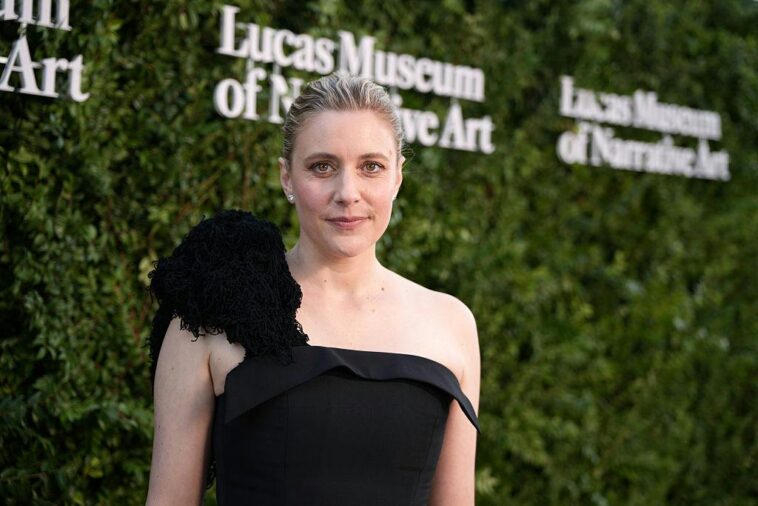
This makes it baffling and not a little insulting for Tim Rice to ridicule conservatives for their dismay over Greta Gerwig’s forthcoming elaborate reimagination of Aslan in “The Magician’s Nephew.” Or, in her Meryl Streep-voiced rendering, we might say “Translan.” And not only transgender but, by the look of the teaser image, transspecies. Fur, feathers, and even scales are all commingled in a glammy mashup which, Gerwig tells us, takes inspiration from David Bowie. I do happen to like David Bowie, card-carrying conservative though I am. I simply fail to see what he has to do with Aslan, or Narnia, or C. S. Lewis.
Rice patronizingly emphasizes and reemphasizes that Narnia is not the Bible, that Aslan is not literally Jesus, and that we do not worship Aslan on Sunday morning. I can reassure Rice that Narnia lovers past and present have never been confused on these points. As the character of Mr. Beaver explains quite clearly in “The Lion, the Witch and the Wardrobe,” Aslan is not a man. But he is a lion who quite intentionally evokes a man: a masculine figure embodying perfect wisdom and goodness, who sacrificially redeems the world he created with his shed blood, rises again to defeat death, and judges all souls at the world’s end. A figure at once infinitely gentle and terrifying, who is not and never will be “tame.” In short, Jesus.
For Gerwig to invert this design is, granted, a drearily predictable move in a postmodern artistic milieu that includes all-female Shakespeare casts and a “Jesus Christ Superstar” starring Cynthia Erivo. It is also a predictable outworking of Gerwig’s Unitarian Universalist theology. She is on the record saying that she always found “Jesus Christ is my Lord and Savior stuff” to be “creepy” and the idea of God the Father “alienating,” but she was intrigued that Catholics “worship the Virgin Mary.” It’s unsurprising that her personal vision of the divine is feminine. What Narnia lovers rightly take offense at is her imposition of that vision onto C. S. Lewis’s vision, as though Aslan were a divine Rorschach blot. God’s masculinity may be immaterial to Gerwig, but to Lewis, who wrote that we are all, “corporately and individually, feminine to Him,” it was in the warp and woof of his art.
Ziggy Aslan’s transspecies quality is likewise anathema to Lewis’s vision. In the final Narnia chronicle, “The Last Battle,” an ape evoking the Anti-Christ sets out to convince hapless Narnians that Aslan is interchangeable with the pagan bird-god Tash. A simple donkey is conscripted to wear a leonine skinsuit while the ape ventriloquizes through him. We are meant to be thoroughly creeped out by the uncanny valley effect of this devilish ruse: Aslan, gloriously and particularly incarnate as one creature, has been repackaged and sold as every-creature.
This isn’t the first time Gerwig has distorted a beloved children’s author’s artistic vision. Her “Little Women” switches Jo March’s trajectory from “Girl gets boy” to “Girl gets book,” with the meta-twist that “Little Women” is Jo’s masterwork. Gerwig claimed to be realizing and honoring Louisa May Alcott’s proto-feminism thereby, but Alcott, despite her proto-feminism, still wrote her heroine into a happy marriage. Gerwig’s chronic compulsion to center the feminine at the expense of the masculine — which we also see in “Barbie”’s focus on the title heroine’s journey to “real girlhood” while poor Ken’s dreams languish unfulfilled — overrode Alcott’s authorial intent.
We are a culture more starved than ever for icons of noble, strong yet nurturing masculinity. It’s why we still look back on the heroic men of September 11 with awe. It’s why a lifeguard’s daring rescue goes viral on social media. It’s why Jordan Peterson could become a cultural phenomenon, or Rob Kenney’s “Dad, how do I?” YouTube channel could earn millions of subscribers. In approaching the Narnia chronicles, Gerwig had a golden opportunity to bring the most memorable icon of all children’s literature to fresh life. For such a talented filmmaker to have squandered it on the altar of her idiosyncratic feminist hangups is a tragedy, not to mention a commercially bizarre decision to alienate the demographic most eager to embrace a big-budget Narnia movie. One wonders exactly who Netflix imagines will be packing out the theaters. Gay Anglicans? Episcopalian pastrixes? Exvangelical millennials with daddy issues who think Lewis was secretly “queer-coded”?
One little boy’s mother once wrote to ask Lewis on his behalf if he should be worried that he loved Aslan more than Jesus. Lewis replied that this wasn’t actually possible, because “the things he loves Aslan for doing or saying are simply the things Jesus really did and said.” Meanwhile, God created little boys’ imaginations and will understand how they work.
However Tim Rice may huff and puff to the contrary, sowing children’s imaginations with confusion about the nature of masculinity, femininity, and reality is not a trivial matter. Conservatives reserve the right to be righteously indignant about it, especially when it’s done in C. S. Lewis’s name.
***
Bethel McGrew is a freelance writer based in Michigan. Her work has appeared in First Things, the Wall Street Journal, the Lamp, and more. Follow her on Substack at Further Up.