
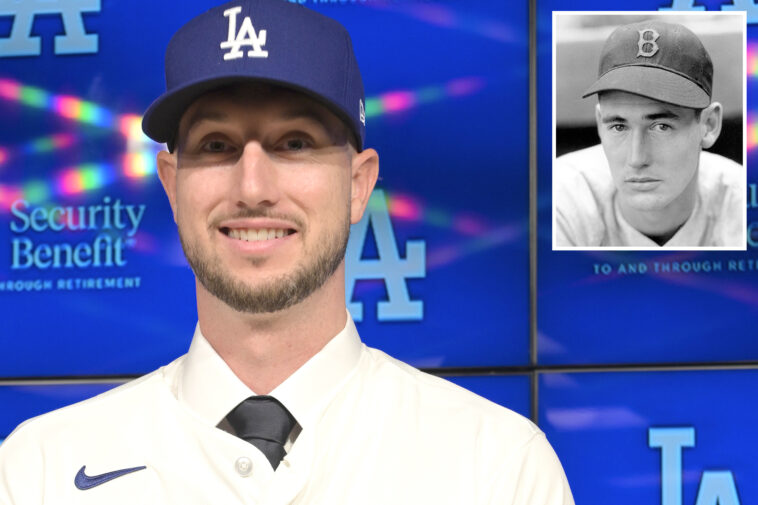
After signing with the Astros ahead of the 2019 season, it didn’t take long for former All-Star outfielder Michael Brantley to hear about his new organization’s top prospect.
“They were comparing this kid to Ted Williams,” Brantley recalled. “And I was like, ‘Well, that’s kind of special.’ I want to see this.”
The kid, Brantley would soon learn, was named Kyle Tucker.


And the comparison, he still marvels at now, was shockingly apt.
“It made me laugh at first, because he does a lot of things that are unorthodox,” Brantley said. “But when you actually break down his swing, he gets into such great positions.”
Download The California Post App, follow us on social, and subscribe to our newsletters
California Post News: Facebook, Instagram, TikTok, X, YouTube, WhatsApp, LinkedIn
California Post Sports Facebook, Instagram, TikTok, YouTube, X
California Post Opinion
California Post Newsletters: Sign up here!
California Post App: Download here!
Home delivery: Sign up here!
Page Six Hollywood: Sign up here!
Long before he became a touted young talent, then a four-time All-Star slugger, then a blockbuster $240 million signing with the Dodgers this offseason, Tucker’s baseball career began in the backyard of his Tampa-area home — where childhood games of stick and Wiffle ball with his older brother, Preston, first helped mold one of the most complete hitters in Major League Baseball today.
The origin story is simple. Growing up, Tucker would emulate Preston (who was six years his elder, and destined for his own MLB career) in their backyard games. Because Preston hit right-handed, Tucker would mirror him from the left side of the plate. And because Preston had a similarly unusual swing, Tucker’s mechanics naturally followed suit.
Some days, the boys would pitch a small ball of cork to each other, letting natural instinct take over as they whacked at it with the handle of a broomstick. Other times, they used a standard-issue Wiffle ball set, learning how to adjust to the serpentine movement of the perforated plastic sphere.
“All they had time to do was just use their hands,” said Dennis Braun, Tucker’s high school coach at Plant High in Tampa. “That’s how they learned how to hit.”

For Tucker, the result was a swing with seemingly flawed fundamentals.
He’d step up to the plate with the wrong foot. His hands would drop low as he started to attack the ball. His bat path had an atypically sweepy motion. He would drop his back knee and almost scissor his legs as he made contact and completed his follow-through.
Years of practice, however, had taught him how to sync it all together; giving him the ability to hit for power, adjust to breaking pitches and most importantly keep his hands inside the ball consistently on every pitch.
“You can’t teach somebody to do it,” Braun said. “But I told him, ‘Don’t let anybody tell you you can’t hit that way, because I think it’s a thing.’ ”
All along, the comparisons to Williams — who earned the moniker of “the greatest hitter who ever lived” with an eerily similar swing — steadily grew.

When Tucker was a high school freshman, one of Braun’s assistant coaches, former Yankees catcher John Ramos, first bestowed him with the “Ted Williams” nickname.
“I said, ‘Wait a minute,’ ” Braun recalled with a laugh, “the kid’s got nowhere to go but down.’ ”
As Tucker became a top draft prospect in the 2015 class, eventually going fifth overall to the Astros (who also had Preston in their organization), scouts began drawing parallels in their reports, too.
The California Post is here. Sign up for Morning Report.
Get the perfect blend of news, sports and entertainment delivered to your inbox every day.
Thanks for signing up!
“I’m not one of those guys who thinks anybody’s gonna be a first-rounder when they show up as a freshman,” Braun said. “But as we went along each year, he got bigger and bigger. By the time he got to his senior year, the amount of people that were out here watching BP was in the hundreds.”
In 2018, a few months before making his highly anticipated MLB debut as a 21-year-old, Tucker was even enlisted to impersonate Williams in a PBS documentary about the late Hall of Famer, donning a 1950s-era uniform as filmmakers captured slow-motion shots of his swing.
“He’s tweaked it a little bit over the years,” Tucker’s mom, Lisa, said. “But if it’s gotten you to where you’re at, it’s like, ‘Why change?’ ”
That was also Brantley’s initial impression after meeting Tucker for the first time and watching him swing up close.

“It doesn’t always look as pretty as a normal swing would,” Brantley said. “But if you really break down the science of the swing, and see where his hands get to, his foot is at the time of contact, and the position at contact, it is very special.”
And over the last five years, Tucker has used the swing to make his own name in the majors.
In 2020, he cemented himself as an everyday player for a contending Astros team, flashing plus outfield defense and an ability to steal bases to go along with offensive production. In 2021, he received MVP votes after batting a career-best .294 with 30 home runs. In 2022, he earned what would become the first of four consecutive All-Star selections. And now, he has established himself as one of the most consistent players in the sport, one of only four big-leaguers to post at least 4.5 wins above replacement every year since 2021, per Baseball Reference.
For that, Tucker has given much credit to Brantley.
When the veteran first arrived in Houston, he made a point of taking Tucker under his wing, becoming his catch partner, his hitting cage confidant, and his locker-mate in the clubhouse.
During spring training, he’d challenge Tucker to beat him to the facility in the mornings. “I’d usually get to the field around 7 a.m.” Brantley joked. “And Tuck’s not a morning guy.” Yet, Tucker would be there, ready to warm-up in the gym and get to work early on the field.
Brantley retired from the majors at the end of the 2023 season. Tucker left Houston a year later, getting traded to the Cubs in his final season before free agency. But the two remain close. So much so, Tucker said he will wear Brantley’s old jersey number, 23, with the Dodgers as a nod to his former teammate.
To Brantley, that was a “very special” gesture. However, he emphasized that Tucker’s success has been all his own doing — going back to the superstar’s five-tool skillset, a deep “passion” for the game that goes overlooked by his outwardly quiet demeanor, and of course the Ted Williams-esque swing that remains universally admired and largely unchanged.
“He just settled into his own, and took the world by storm,” Brantley said. “As he should have, because he was such a big prospect. But he panned out because of the hard work he put in.”