The art was fake, but the sentencing will be very real for a father-daughter art scam team from Poland.
Between 2020 and 2025 Erwin Bankowski and Karolina Bankowska hustled fake works attributed to Andy Warhol, Banksy, Pablo Picasso, Native American Luiseño artist Fritz Scholder, and others across New York.
Collectors fell for their charms and they sold more than 200 artworks in what the US Attorney’s Office has since characterized a “Prolific Counterfeit Art Scheme,” which generated at least $2 million.
Among well-known auction houses that are said to have been targeted: Bonham’s, Phillips and Freeman’s. The biggest earning fake, presented as being a work by Richard Mayhew, sold for $160,000.

But a tip from the FBI led it all to unravel, leaving everyone — especially the duped collectors — in shock.
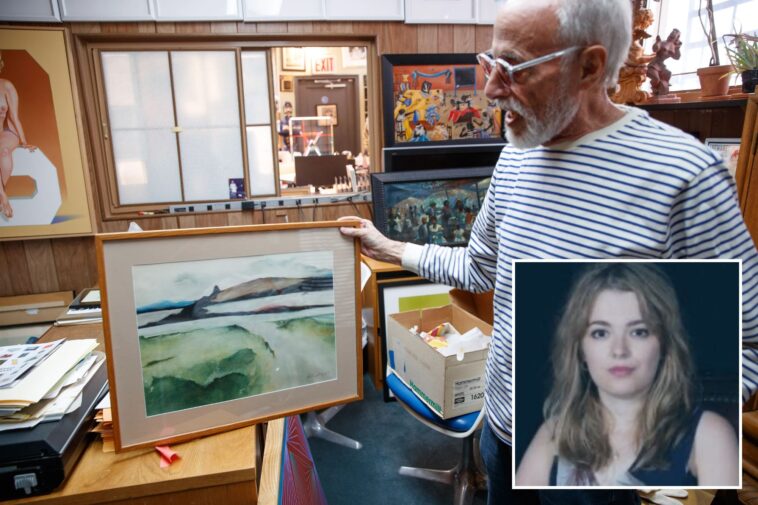
For gallerist Robert Rogal, who owns RoGallery in Long Island City, it all started when a blond-haired 26-year-old walked in with a framed painting she said was by the highly regarded optical artist Richard Anuszkiewicz, which she characterized as a family heirloom.
“I’m a compulsive buyer. I try to buy select art and look to make deals. I ask sellers where they got the art, how they got it, if they have a receipt. I know what to ask,” Rogal told The Post from his art space, where he has some 10,000 works in inventory.

“This woman seemed very credible to me, very straight.”
Rogal has spent 40 years buying and selling art, and his RoGallery is loaded with work by the likes of Warhol, Roy Lichtenstein, Picasso and Salvador Dali, among many others.
The piece Karolina was selling was finely rendered, possessed the kind of painted block-letter signature for which Anuszkiewicz was known and the painting was backed by pegboard, a material the modern artist sometimes used in the 1960s, when this work was purported to be from.


“I asked if she wants to consign it. It’s one price if you sell it outright and another [typically higher] price if you consign it [for auction].
“She said she preferred selling it outright. I gave her a check and she signed a bill-of-sale stating that the art is 100 percent legitimate. I think it was five grand.”
Considering that “she did not have a great provenance … she just said it was from her family,” what convinced Rogal and others to cough up thousands for misrepresented works?


“The art looks that good. There are good forgers. What can I tell you?” he replied. “And it’s hard to go back on these [checking the authenticity]. In the 60s and 70s, this work wasn’t all that expensive.”
As a result, the art was not incredibly well documented by galleries which, in many cases, no longer exist.
The works were produced by a deft artist in Poland commissioned by the father and daughter, it emerged in court.
“It started, I believe, with the relationship with the Polish artist, just selling rinky-dink artwork online,” said one inside source. “Then, when it turned out that the Polish painter was able to replicate works by well-known artists who have their own market, they asked him to replicate original artwork and then sold it.”

Alongside that, the pair used design software to create forged certificates of authenticity which were imprinted onto aged paper and affixed to the counterfeit works, court papers show.
“Today’s printers have become so sophisticated that the reproductions they produce have become almost indistinguishable from Warhol’s originals,” writes art dealer Richard Polsky for My Art Broker. “Mind you, these are not perfect copies, but they are good enough to fool most collectors and many dealers.”
One work presented by the pair as a genuine Warhol featured a nude man and a woman gazing at each other, which sold for $5,500. A counterfeit Banksy printed on carboard, showing a military helicopter with a bow tied to it — work which is hard to authenticate, as the artist uses only stencils — sold for $2,000.

Perhaps emboldened by successfully passing off the phony Anuszkiewicz, Bankowska returned with what she said was a piece by Andrew Wyeth, an artist who specialized in rural images and landscapes.
The response from Rogal this time was tepid. “I had my doubts” he said, noting he was put off by a “stamp of authenticity” that looked too new and came from Knodler gallery. That also raised red flags as the gallery has been at the center of other controversies involving forged art.
Nevertheless, he took it on consignment, pending further investigation.
“I checked it with the Wyeth Foundation and they turned it down [deeming it inauthentic]. So, we never listed it for sale. I called [Bankowska] to come get it back, but she never showed up.”

New Jersey based Bankowska and her father were no novices in the art world. They were, as the source told The Post, “involved in the regular selling of legitimate art.”
As the source put it, they started out selling work by unknown artists which looked pretty, designed to be hung in homes and businesses. It was legit art, but only had value as decorative pieces, rather than being collectible.
There is an LLC called Art Sector registered to Karolina Bankowska located in Mount Laurel, New Jersey. Attempts to reach the company by The Post were unsuccessful.
Tired of making small amounts selling unknown artists’ works, the duo apparently saw “a business opportunity that they took advantage of,” with their Polish artist connection, whose identity has not been revealed.

“They came to realize that this artist was very talented and there was a large market for auction houses and galleries to take on the artwork,” said the source. “Then they created a scheme where they [promoted] the artwork as authentic and original.”
The crime lies not in the creation of the copied work by the artist, but in the passing it off as real — the part Karolina and Erwin carried out.
Rogal is far from the only one who had the wool pulled over his eyes. A buyer whom he describes as “a foundation,” bought the Anuszkiewicz at an online auction for what he remembers as $15,000. Then the FBI phoned.
“They said, ‘You know why we’re calling,’” he said. “I told them I had no idea.”

Representatives for abstract realist Raimonds Staprans suspected a painting of his, “Triple Boats,” which had been put up for auction, was fake.
The auction house was contacted and, according to NPR, the painting sold for $60,000. Afterwards, the FBI got involved and the dominoes began to fall.
The FBI confirmed the Anuszkiewicz which Rogal had just sold was a fake. Honest man that he is, the gallerist did the right thing and reversed the sale.
“Of course I bought it back,” he said, explaining that making good on a sale that goes sideways, through no fault of his own, is the only solution. “I’m a very fortunate guy and that sale is not going to change my life.”
He remains in possession of the two fakes and has no idea what he’ll do with them, but is taking the whole experience in stride.

Karolina and Erwin were arrested and charged with wire fraud conspiracy and misrepresentation of Native American produced goods and products, for works including the Scholder and the Mayhew, both of whom have native American heritage.
The father and daughter pleaded guilty and are facing a maximum of 20 years in prison each, plus restitution of at least $1.9 million. As they pleaded instead of going to trial, they are most likely to serve around three years each. As they are not citizens they will face deportation to Poland afterward.
“For years, these defendants painted themselves as purveyors of fine art while selling lies on canvas to unsuspecting collectors,” United States Attorney Nocella said after receiving their plea.
Karolina’s lawyer, Todd Spodek, specializes in representing people accused of financial scams including alleged inside trader Anthony Viggiano and the infamous Anna Delvey.
He told The Post, “Karolina Bankowska understands that true accountability requires making things right. She is taking full responsibility for her actions, which is why she has already secured over $700,000 toward restitution to help ensure the victims are repaid.”
Asked what Anuszkiewicz, now dead, would make of being knocked off, Rogal replied, “He would probably be flattered. Some [artists] are very resentful and others might take the approach of being flattered that they were that much of an influence that people are copying.”