
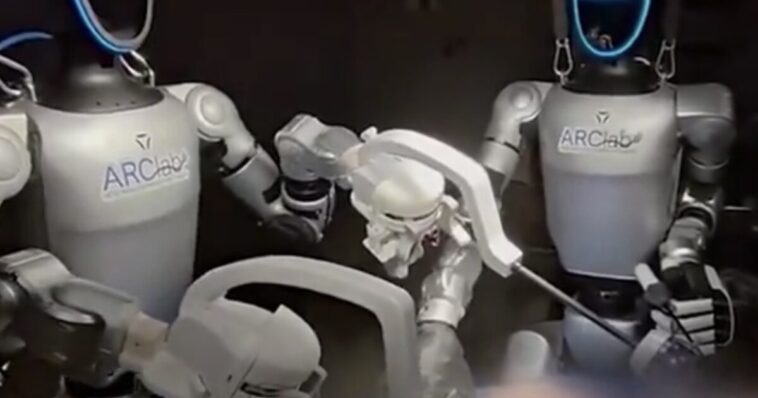
Humanoid robots have successfully performed gallbladder removal surgeries in live pigs for the first time, marking a significant milestone in the development of robotic surgery and paving the way for future human trials.
The procedures were carried out by researchers at the University of California, San Diego, with the findings published Wednesday in the journal Nature.
The first operation involved a humanoid robot working alongside a surgeon. In the second, two humanoid robots completed the procedure together without direct human assistance.
Researchers say the successful surgeries represent an important proof of concept as the technology moves toward clinical testing in humans.
“As a proof of concept, it absolutely worked,” Dr. Ryan Broderick, interim director of the Center for the Future of Surgery at UC San Diego, told ABC News.
The world’s first humanoid surgical robot can now be used in operating rooms, guided by surgeons during real procedures. Surgeons at UC San Diego have used humanoid robots to remove gallbladders and perform two additional procedures on pigs, marking a key step toward future human… pic.twitter.com/uMAWzGg4ec
— ABC News (@ABC) July 11, 2026
Unlike conventional robotic surgical platforms, the humanoid robots feature a head and two arms.
This allows them to work in operating rooms without the bulky equipment typically required for robot-assisted procedures.
“The space constraints didn’t exist like in traditional robotic surgery,” Broderick said.
“It was a human-type bedside assistant, so it just fit into the space that we’re traditionally used to being in for laparoscopic surgery.”
ALERT: Humanoid robots performed the first-ever live surgery on pigs during a preclinical trial at a California university.
Engineers and a team of surgeons at the University of California, San Diego successfully used teleoperated humanoid robots for live surgery.
In one of the… pic.twitter.com/xEKJbQ35og
— E X X ➠A L E R T S (@ExxAlerts) July 10, 2026
Researchers believe the compact design could eventually make advanced surgical care available in remote or resource-limited settings.
“You can imagine this device being deployed on a ship, in a village somewhere, in a smaller operating environment that’s not in major cities,” added Dr. Shanglei Liu, a colorectal surgeon at UC San Diego.
“And it opens up, I think, a lot of doors for access,” he continued.
The team also believes humanoid robots could help address staffing shortages by assisting surgical teams and increasing the number of procedures hospitals can perform.

Ben Kew is a writer and editor. Originally from the UK, he moved to the U.S. to cover Congress for Breitbart News and has since gone on to editorial roles at Human Events, Townhall Media, and Americano Media. He has also written for The Epoch Times, The Western Journal, and The Spectator.
You can email Ben Kew here, and read more of Ben Kew’s articles here.
Ad block users: Some site features may not work correctly while an ad blocker is enabled, because they break scripts and content this website depends on. If you can’t see comments below, for example, please disable your ad blocker.