
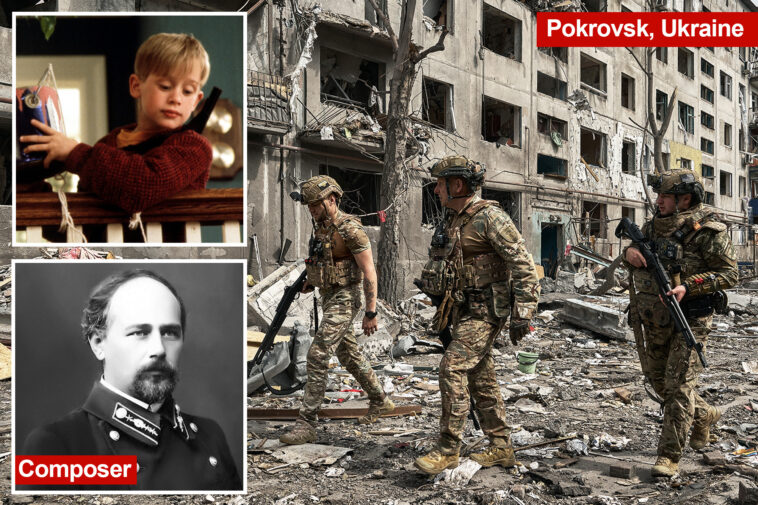
“This is my house, I have to defend it.”
That’s what Kevin McCallister said as he bolted his front door and began fortifying the home against invaders in one of the most iconic scenes from “Home Alone” — a scene where “Carol of the Bells” plays prominently, helping to make the song an American Christmas staple.
The song wasn’t always associated with Christmas, however, but the scene is a remarkably apt parallel to its true origins: an anthem of Ukrainian defiance against Russian invaders.
And it’s especially poignant today, as Ukrainian forces are fighting through the holiday to throw Russian soldiers out of Pokrovsk, the very city where composer Mykola Leontovych lived and was inspired to write the melody.
“It was never just a Christmas song, but a Ukrainian cultural message to the world, a greeting card of the nation’s deep-rooted spirituality and resilience in the face of threat,” Leontovych biographer Larysa Semenko told Politico.
“The same threat our nation is fighting today,”
Leontovych lived in Pokrovsk during the first years of the 20th century, and it was there he began to make a name for himself as a composer while teaching music and running a local choir.
And it was around that time that he repurposed a local folk tune to write Carol of the Bells — then called Shchedryk — and after World War I it became the anthem of Ukrainian nationalists hoping to gain independence from Russia, which had controlled the country’s people for centuries.

A short-lived independent Ukrainian government even sent a choir on a tour of Europe in 1922 to showcase its culture with the song and promote its independence from Russia — and it was a sensation across the world.
“Shchedryk, which was a hit and always played as an encore, enchanted Europe and America, and helped Ukrainians to declare their nation and state to the world,” said author Anatoliy Paladiychuk.
But Leontovych paid dearly for his defiance of the Russian yoke.
After the Bolsheviks retook swaths of Ukraine during the Russian Civil War, he was tracked down by Soviet agents and murdered in a 1921 assassination that was covered up until the 1990s.
“Just like they do in occupied territories of Ukraine now, Russian authorities saw a threat in Ukrainian culture,” Semenko told Politico.

“That was the start of great terror against Ukrainian freedom fighters, politicians, and educators. Leontovych was one of many who were killed.”
Today — 105 years after Leontovych was murdered — his old hometown is battling for its survival after retreating from Russian invaders in November.
Swaths of the historic city are in ruins as the war nears its fourth year, with Russia claiming to currently occupy it.
Ukrainian forces, however, now insist they’ve won it back and that Russian troops have been spreading propaganda by sneaking in and photographing themselves near landmarks.

“Our active operations in the Pokrovsko-Myrnoрrad agglomeration area continue. In Pokrovsk itself, in the past few weeks, we were able to regain control of about 16 square kilometers in the northern part of the city,” Ukrainian Gen. Oleksandr Syrskyi wrote in a Dec. 13 Telegram post, vowing to continue resisting the scores of Russian troops trying to overtake the city.
Pokrovsk is in the thick of the Donbas region, which Putin has vowed to seize in full before he’ll end the war.
Ukrainian President Zelensky has been equally defiant about holding Donbas since the war began, but on Wednesday agreed let about 30% of the territory become a demilitarized zone in return for peace.
Moscow has not yet replied to the offer, but Ukraine says it is prepared to keep up the same fight for independence that inspired Leontovych to write Carol of the Bells — and defend their home with the fervor of Kevin McCallister.
“We continue to destroy the enemy,” Gen. Syrskyi said.