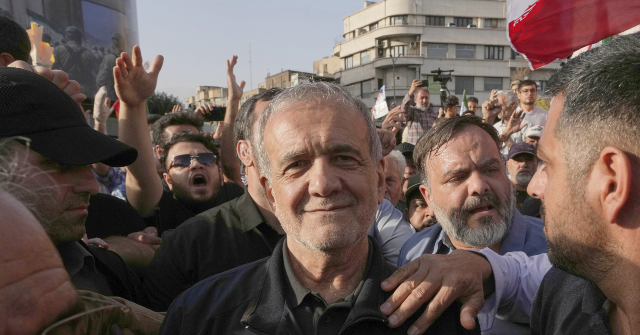
Iranian President Masoud Pezeshkian, who is subordinate by law to the nation’s Islamic “supreme leader,” appeared on the streets of Tehran alongside Foreign Minister Abbas Araghchi on Tuesday night to join celebrations for Islamic Republic Day.
Pezeshkian could be seen walking down the street and greeting a crowd, presumably forced into assembly by the repressive terror state, who showered him with flowers and asked to talk selfies with him. Araghchi appears more discreetly, covering his head with a hoodie and removing it only to speak to friendly media. The foreign minister said that he had decided to join the regime-orchestrated celebration as a morale boost to continue discussions with the United States, which he had just confirmed were occurring in an interview with Al Jazeera on Tuesday.
The public appearance of the two officials is notable given the unclear nature of the leadership of the country after the launch of Operation Epic Fury on February 28. American and Israeli military attacks have eliminated dozens of the most powerful people in the Iranian Islamist regime apparatus, most prominently the “supreme leader” himself, Ali Khamenei. For the first weeks of the war, top Khamenei advisor Ali Larijani was considered the likeliest de facto leader of the regime, but Iranian state media confirmed two weeks ago that he, too, had been eliminated in the conflict.
Iran nominally has a supreme leader — Mojtaba Khamenei, the son of Ali Khamenei who had previously never held public office, nor was he a well-known personality in politics in the country before his appointment. Khamenei has yet to make a public appearance at press time, nor has he broadcast any live video statements, raising questions around the world as to whether he is running the country, or whether he is even alive.
Pezeshkian and Araghchi appeared on camera, alive and healthy, on Iranian and Chinese state media on Tuesday night, celebrating Islamic Republic Day. Pezeshkian appeared surrounded by a small team ensuring some distance from others on the street, while the footage of Araghchi appears to show him without any visible security. The footage was shared both in Iranian media and on the Chinese state network CGTN.
“I came to be among them, to draw energy from the movement on the ground and to enjoy this unity and popular cohesion,” Araghchi said in an on-camera interview. “Seeing these people truly gives tremendous morale to everyone and I am just a small part of these people.”
The appearances follow assurances from President Donald Trump that his administration is in talks with Iran and that Iran’s regime has already changed since the beginning of the conflict, fulfilling a goal of the hostilities.
“The United States of America is in serious discussions with A NEW, AND MORE REASONABLE, REGIME to end our Military Operations in Iran,” Trump wrote in a message on his website, Truth Social, on March 30. On Wednesday, Trump again complimented the country’s alleged “new” leadership as “much less radicalized and far more intelligent.” He claimed that “Iran’s New Regime President… asked the United States of America for a CEASEFIRE.”
Pezeshkian has been the president of Iran before and after the conflict; it is unclear who else Trump would have been referring to. The current president was indeed elected in 2024 as a “moderate” candidate. Iran does not host free and fair elections, however, and Khamenei only allowed hand-picked Islamist radicals on the ballots prior to the vote; Pezeshkian was only “moderate” relative to other alternatives.
Iran has resisted confirming any negotiations with Trump for weeks, though Trump has insisted that talks have been ongoing. Speaking to Al Jazeera on Tuesday, Araghchi confirmed the talks, but eschewed the word “negotiations.”
“I receive messages from [U.S. special envoy Steve] Witkoff directly, as before, and this does not mean that we are in negotiations,” he claimed. “There is no truth to the claim of negotiations with any party in Iran. All messages are conveyed through the Foreign Ministry or received by it, and there are communications between security agencies.”
Pezeshkian, meanwhile, issued statements to the European Council on Monday insisting that Iran has “the necessary will to end this conflict,” but emphasizing that “essential conditions” to Iran must be met before it stops attacking its neighbors, the main response Tehran has made to the American and Israeli operations.
“The solution to normalizing the situation is the cessation of their aggressive attacks,” he claimed.
Mojtaba Khamenei has not made any substantive statements regarding finding a resolution to the conflict. Iranian media claimed shortly after his selection that he had issued a statement, but it was a written statement acknowledging his appointment to “supreme leader” that did not include any proof it came directly from him. More recently, on Tuesday, Iran-friendly media reported that Khamenei allegedly sent a letter to the leader of the Iran-affiliated jihadist terror group Hezbollah, encouraging the terrorists to continue attacking Israel.
“In his message, Sayyed Khamenei pointed out that steadfastness and resilience in the face of the fiercest enemies of the Islamic nation, namely the United States and the Zionist entity, were among the most prominent characteristics of the martyred imam leader,” Hezbollah said in a public release confirming the receipt of the message, but again not offering any proof it came from Khamenei.
In late March, Iranian state media finally released a video of Khamenei, but the video was undated, of poor quality, and did not offer any context relevant to his status today.
As a result of the secrecy surrounding the alleged “supreme leader,” rumors have erupted throughout the internet questioning his health status and competence. Some rumors claim that he was severely injured in the airstrike that killed his father. Others, most confusingly, have accused Khamenei of homosexuality, which would not answer why he has not made any public appearances.
The latest update on Khamenei came from the Russian ambassador to Tehran, Alexey Dedov, who told reporters on Wednesday that the “supreme leader” is “in Iran,” without clarifying whether he is healthy, alive, or gay.