
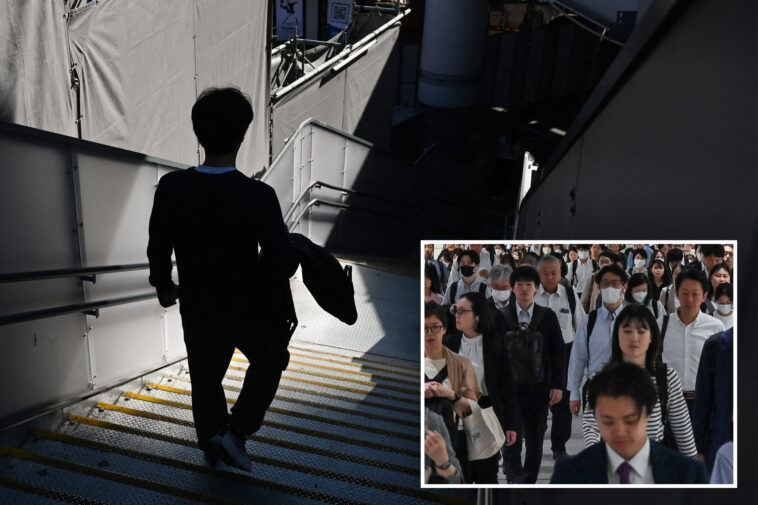
“I’ll abandon work-life balance.”
That was Japan’s new far-right Prime Minister’s victory speech vow.
Sanae Takaichi was talking about how she’d lead her own party. Not reform the nation’s notoriously long work weeks.
But the comments still let loose a pretty big backlash.
Sounds like overkill, right? Well, when you look at what followed in her first few weeks in office, probably not.

Weeks later, Takaichi summoned her team for a meeting. With a casual 3 a.m. calltime. She also urged her labor minister to relax the rules on overtime work.
So this is about more than just talking points. And there’s another reason it’s hitting a nerve.
Behind Japan’s legendary work ethic lurks a dark secret.
For decades, the country has been plagued by people driven to an early death by the stress of their never-ending jobs.

It’s called karoshi. Death by overwork.
That’s right. This social illness is so common, it’s earned its own name.
The issue is even blamed for the country’s critically low birth rate and declining productivity.
Official figures put cases of karoshi between hundreds and thousands per year. But experts say the real number is much higher.
So is Japan’s deadly hustle culture making a comeback?

‘Above the karoshi line’
Weeks after Takaichi’s speech, it was revealed record numbers of victims are seeking compensation for overwork in Japan.
Yohei Suda is part of the National Defence Counsel for Victims of Karoshi, who issued a statement demanding that the PM retract her remarks.
Suda tells news.com.au karoshi is being driven by lingering corporate culture and new laws exposing the issue.

“People are more aware of their rights,” says Suda. “But many are still compelled to work above the so-called the karoshi line.”
Suda says working 80 or more overtime hours per month on an ongoing basis brings a risk of death.
So he can see why the dawn of Yohei’s term has raised eyebrows.
“As the head of government, her words hold symbolic value.”
Corporate loyalty
In Japan, corporate loyalty is a big deal.
Most workers rarely switch companies or careers once they’ve landed a position.
But the real measure of your loyalty is how long your feet spend under your desk.
Japan’s rapidly-ageing population also plays a big part.
In the first half of 2025, the country recorded a record birthrate decline. This comes after nine straight years of falling figures.
This phenomenon has left many employers grappling with severe labour shortages.
This means more responsibilities are falling on fewer employees.
Yohei says one of his most tragic cases was representing the mother of a young doctor who was taken from life far too soon.
“He was very capable, so the employer made him work very hard,” says Suda.
“He was forced to work very long hours in a crowded space.”
The doctor fell into depression and addiction to cope. Finally, he overdosed on medication.
He was 27.
But when the doctor’s mother applied for compensation from the government, the claim was denied.
Start your day with all you need to know
Morning Report delivers the latest news, videos, photos and more.
Thanks for signing up!
“It should have been recognised as death from overwork,” says Suda.
Suda successfully defended the mother at the Tokyo District Court. Thanks to him, she was compensated for the senseless loss of her son.
“That case was memorable because many of his colleagues testified or provided statements, which is rare.”
That his colleagues were willing to speak out against their employer is a testament to the extent of the problem.
But how could they deny the problem in the first place?
‘We can’t prove work kills you’
Dr. Sugumar Mariappanadar, Fellow of Organisational Psychology and expert in sustainable HR at ACU, is Australia’s top overwork expert.
“We can’t prove work kills you,” he tells news.com.au.
“We all know it anecdotally. But there’s no evidence to prove it.”
“If I smoke, you can measure how many packets a day and analyse that. But there’s no equivalent metric for work,” he says.
“That’s the reason why businesses claim it’s just a public health issue, Right? That’s why we pay tax.”

“They’re saying, that’s not our problem. How do you prove we caused it?”
“It might be a family issue, their DNA. That’s what we’re seeing.”
In Japan, many workers clock up 80-hour weeks, year-round. These hours may run overnight or on weekends, with no overtime pay.
To put it in perspective, in Australia full-time employees only work an average of 38 hours.
But if you think karoshi is a uniquely Japanese issue, think again.
World Health Organisation data shows countries around the world are recording surging rates of overwork. And there are more and more cases of karoshi globally.
So Japan should serve as a cautionary tale.
‘Burnout cycle’
A burnout cycle wears the body down.
Over sustained periods, overwork can cause high blood pressure, high cholesterol, and other conditions contributing to chronic disease.
Not to mention poor mental health and exhaustion.
That’s why it’s so common to see salarymen – a term for Japanese businessmen devoted to their jobs – dozing on Tokyo’s train system. But behind closed doors, the reality is even darker.
Grinding themselves into the ground, Japan’s workers are suffering stress-induced heart attacks, strokes or starvation. Some literally drop dead at their desk.
“Karoshi is killing people because it doesn’t allow our energy to sustainably recover enough to keep working,” Mariappanadar says.
“You can only push yourself so far. The body only has a limit.”
Mariappanadar says overwork kills more people than road accidents in the developed world.
And he believes we’ll look back on this time and view overwork like we did for smoking or asbestos in the past: as this era’s major public health crisis.
For years, the Japanese government has been grappling to bring the crisis under control.
Recorded cases of karoshi have declined over the last decade. They’ve even set a Net Zero target.
More and more young people are also unsubscribing to hustle culture.
“They’re putting higher priority on work-life balance,” says Suda.
Everything seemed to be heading in the right direction. That was, until Takaichi’s recent moves.
When those tasked with ending karoshi boast they’ll be ending “worklife balance,” you can see why it doesn’t inspires confidence about the rest of the country’s workload.
“Japanese work culture is about being selfless,” says Mariappanadar.
“When you’re selfless, you work for the good of the organisation.”
“In the West, you work for a sense of identity.”
Perhaps Takaichi, a heavy metal drummer as a student, just wants to start with a hard-hitting agenda.
Time will tell what beat Japan’s workers must march to into the future.