
Iranian weapon debris, blown to pieces or mechanically crippled, keeps dropping from the Middle East sky.
For that, we can thank heat-seeking satellites, military-grade malware and radar-jamming software, all made in America.
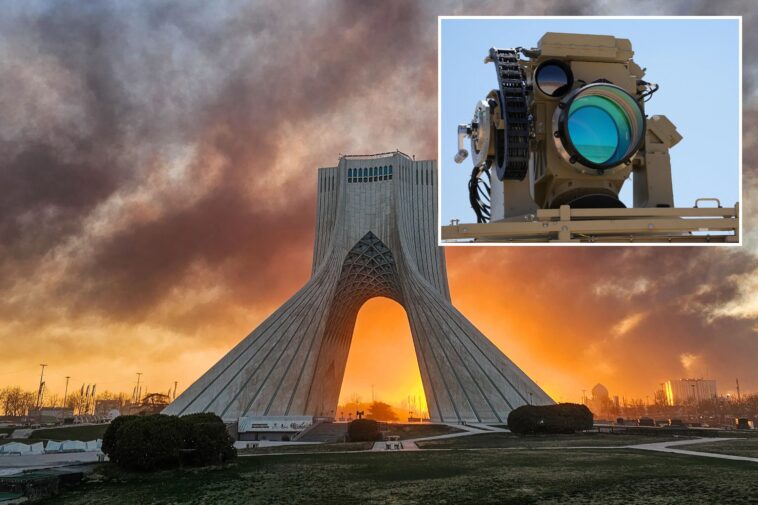
New technology laser weaponry has also been deployed against Iran as part of Operation Epic Fury, The Post has learned.

A US Navy destroyer vessel off the coast of the Middle East nation is fitted with the new weapon, which appears to be the High-Energy Laser with Integrated Optical Dazzler and Surveillance (HELIOS) system, videos released by US Central Command show.
The laser is a state-of-the-art device with a steerable head, able to concentrate a “intense, tightly focused beam” of energy and take out drones, according to keen-eyed military watchers.
Similarly, videos of the skies over the Israel-Lebanon border showed rockets being launched, only to explode seconds later. That has been widely, but unofficially, credited to the Israeli military’s new Iron Beam weapon, an advanced laser able to disable rockets and defend territory.
Neither the US Navy nor the Israeli military has confirmed or denied the use of lasers in Epic Fury, which began Feb. 28. However, the Navy said at the beginning of February it had taken out four drones in a test of HELIOS.

During the first 72 hours of battle, 1,700 targets were struck by US forces. Over 200 of Iran’s ballistic missile launchers have been destroyed, about half of those the nation possessed. Additionally, dozens more of the launchers have been made inoperable. Hundreds of missiles have been destroyed, foiling them from doing their damage.
The US’s precision strikes against missile silos, nuclear facilities and leaders have been hailed a huge success, with minimal losses on US and Israeli sides.
Those strikes have been made possible by devices operated higher off the ground than previously — from space.


The US Space Force, established in 2019, is critical for air and sea forces to know where and when to attack, when to take cover, and the locations of enemy missiles.
They do it “with satellites that have infrared sensors for finding where rockets are being fired,” Brent David Ziarnick, former professor in the Space Force program at Johns Hopkins University and retired officer in the US Air Force, told The Post.
“They can spot the missiles and pinpoint where the launchers are. The missiles can be intercepted and destroyed [often with Patriot Missiles]. Field forces get notified that an attack is coming, so they can go to shelters or bunkers.”
Space Force’s infrared beams track the missiles the second they launch, via the heat they create. According to ABC News, hundreds of Iranian missiles have been destroyed with this technology.
Incredibly, despite the fighting taking place in the Middle East, most of Space Force’s work is centered in the US.
Crews work inside radar domes, called Radomes. Resembling giant golf balls, they receive information in the sky in real time, calculate the trajectory of missiles and, therefore, likely destination and act accordingly.


“[The] system is built to ensure, if a missile is ever launched, the United States will be the first to know about it,” said Sam Eckhome, host of “Access Granted,” said on his YouTube show.
“Together, the three layers form one of the most advanced early warning networks in the world,” he added, referring to satellites, radar and Radomes.
The fact the US has been able to keep boots off the ground, and only suffered six casualties in four days of fighting is a testament to the advanced tech being deployed, according to an ex-Space Force colonel.
“The fact that this isn’t a mass formation of troops with rifles on the ground speaks to the fact that this force is built with extreme technology and the brain power to operate it,” Bree Fram, formerly in Space Force and now running for Congress in Virginia, told The Post.
“Those combine to make us the most capable force on Earth and keep Americans safe from harm as they do the most difficult, inherently risky things that we ask them to do.”

Working alongside Space Force but carrying out operations on the street level are US Cyber Command.
“Space Force figures out where the radar is, then work with Cyber Command to jam it,” said Ziarnick, describing how missile launching systems are crippled.
“Cyber Command will try to make [Iran’s] radar not work. It will involve infiltrating the system and shutting it down … or taking it over. The software goes and the computer turns into a brick.”
Joint Chiefs of Staff Chairman Gen. Dan Caine confirmed after the start of operation Epic Fury that before any shots were fired, cyber command hit “communications and sensor networks” across Iran to “disrupt, disorient and confuse the enemy,” he said at a press conference Monday.

Israeli cyber spies claimed Tuesday how they spent years hacking nearly every traffic camera in Tehran so they could monitor Iranian Supreme Leader Ayatollah Ali Khamenei ahead of the mission to take him out.
Intelligence agency Mossad’s operatives were able to determine who Khamenei’s security guards were, where they parked their cars, their addresses and who they protected via the cameras, according to the Financial Times.
One aspect of the Iran operation has been the opposite of how it would run in most cases. As happened during uprisings against the government by Iranian civilians in January, the regime cut off all internet access across the nation as soon as the US attack started, presumably to stop people from different regions communicating and organizing.
However, it’s likely the Iranian leaders will still have a closed-circuit network which they are communicating through — which is highly likely to be one of Cyber Command’s current targets, if they haven’t already gained access.
“They can reach out and touch people,” warned Ziarnick, speaking of Cyber Command, “It’s now a force to be reckoned with.”